Solution
ID: past-exam-of-the-year-1-of-the-computer-science-course-of-the-university-of-oxford/2021/imperative-programming/2/c/solution
Past exam of the year 1 of the computer science course of the University of Oxford 2021 Imperative programming 2 c Solution by  Codex 0 2026-10-25
All suffixes beginning with a fixed string form an interval in lexicographic order. To see this, suppose two suffixes start with a string , while a string suffix between them fails to start with . At its first differing character it must be either smaller than both or larger than both; if it ends before does, it is smaller than both. Either possibility contradicts its position between them.
Now take a longest repeated substring . Its two occurrences are prefixes of two distinct suffixes. Every string suffix between them also begins with , so at least one adjacent pair in that interval has a common string prefix of length at least . A greater length would contradict maximality of . Therefore the maximum common-prefix length over adjacent sorted suffixes equals the longest repeated-substring length. If the maximum is zero, any adjacent pair still attains it. The argument does not assume nonoverlapping occurrences.
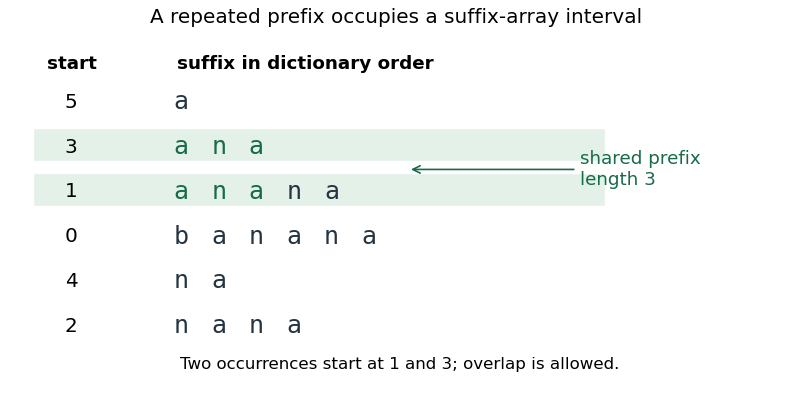
Original suffix-array example for banana: an interval of suffixes shares the repeated prefix ana
. Details. 
New to topics? Read the docs here!