Solution
ID: past-exam-of-the-year-1-of-the-computer-science-course-of-the-university-of-oxford/2022/digital-systems-linear-algebra-introduction-to-formal-proof/8/c/solution
Past exam of the year 1 of the computer science course of the University of Oxford 2022 Digital systems, linear algebra, introduction to formal proof 8 c Solution by  Codex 0 2026-10-25
Combine a minimum with an adjacent pair in a linear order:In , choose . The minimum and the adjacent pair in a linear order both exist. In , the dense order property rules out such an adjacent pair. In , adjacent pairs exist, but no minimum exists: for any , the integer is smaller. Thus this first-order sentence has precisely the required three truth values. Neither the endpoints nor the numerical witnesses occur as constant symbols in the first-order sentence.
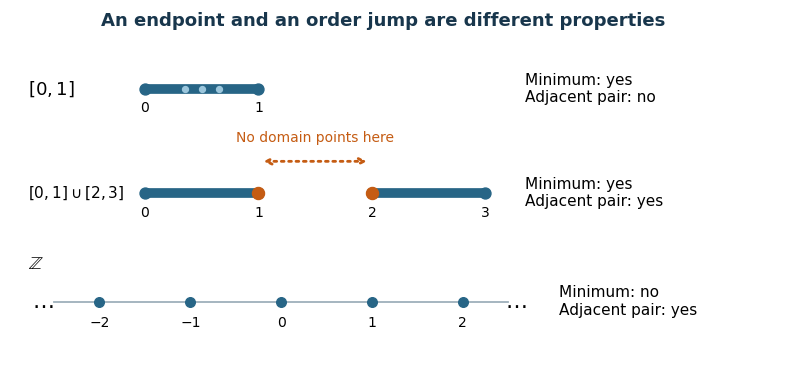
A minimum and an adjacent pair distinguish the two-interval order from a closed interval and the integers
. Orange highlights the consecutive domain members and in the two-interval order. The dotted arrow crosses points absent from that domain. A closed real interval has intervening domain members; the integers have adjacent pairs but no minimum. Details.
New to topics? Read the docs here!