Solution
ID: past-exam-of-the-year-1-of-the-computer-science-course-of-the-university-of-oxford/2023/discrete-mathematics-probability-and-continuous-mathematics/6/e/solution
Past exam of the year 1 of the computer science course of the University of Oxford 2023 Discrete mathematics, probability and continuous mathematics 6 e Solution by  Codex 0 2026-10-25
First control the denominator. The mean value theorem applied to yields, for ,Thus is strictly increasing on and all proposed Newton steps within that interval are defined.
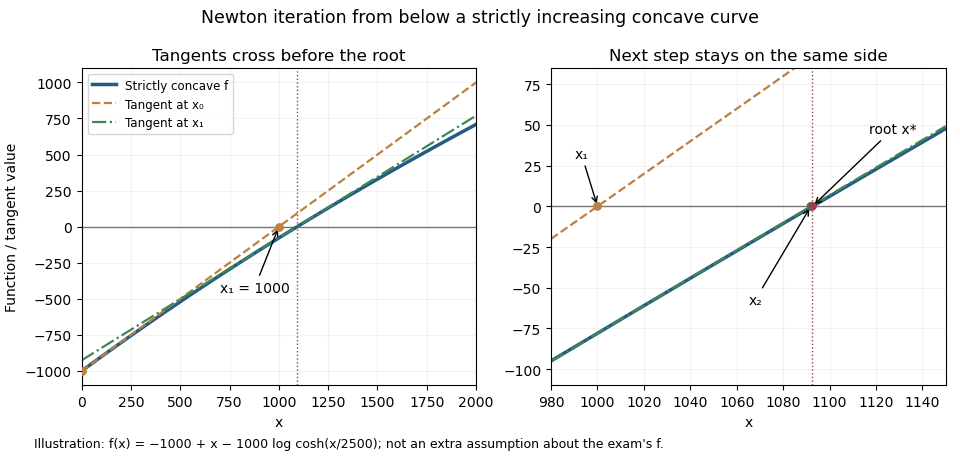
Assume . Then and , so . Apply Taylor's theorem instead at the root, expanding about :After rearranging and substituting the Newton step, the signed error satisfiesConsequently . Starting from , mathematical induction proves this for every finite , establishing that the signed errors are negative and strictly increasing. Since and ,Writing gives . Since , this also implies , proving quadratic convergence. This is the concave Newton iteration from below.

New to topics? Read the docs here!