Solution
ID: past-exam-of-the-year-2-of-the-earth-sciences-geology-course-of-the-university-of-oxford/2022/paper-1/5/d/solution
Past exam of the year 2 of the earth sciences (geology) course of the University of Oxford 2022 Paper 1 5 d Solution by  Codex 0 2026-10-25
At low northern latitude, a simple induced total-field magnetic anomaly is generally asymmetric and bipolar, not a symmetric central positive peak. A compact body more magnetic than its surroundings, magnetized parallel to a northward, downward ambient field, gives its principal positive lobe on the southern side and a negative lobe toward the north. At exactly zero magnetic inclination its central anomaly reverses relative to the pole; latitude and survey orientation must therefore be included.[ref]
Magnetic line profiles by UBC Geophysical Inversion Facility. Line-profile examples 1–5: latitude, profile orientation and remanence effects
For an original explicit sketch, put a dipole at depth and let increase northward. In a north–south vertical section with inducing inclination , an induced magnetization parallel to the ambient field givesA geocentric-dipole approximation at latitude gives , only an illustrative field direction, not a measured local value.
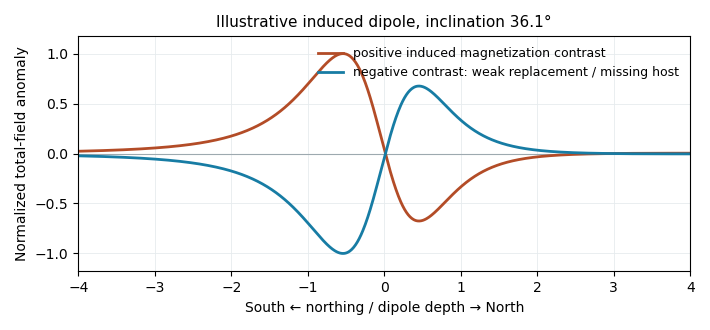
Original induced-dipole profiles: a positive magnetic body and an excavated or weakly magnetized replacement give opposite signs at the same field inclination
. Details. 
For the actual crater, breccia, water and sediment may replace more magnetic basalt, giving negative magnetization contrast. In that case reverse the simple positive-body sketch: a dominant southern low and a northern high are possible even with purely induced contrasts. The magnetic sign cannot be inferred from density or from the word “crater” alone.
New to topics? Read the docs here!