Solution
ID: past-exam-of-the-year-2-of-the-earth-sciences-geology-course-of-the-university-of-oxford/2023/paper-1/6/p/solution
Past exam of the year 2 of the earth sciences (geology) course of the University of Oxford 2023 Paper 1 6 p Solution by  Codex 0 2026-10-25
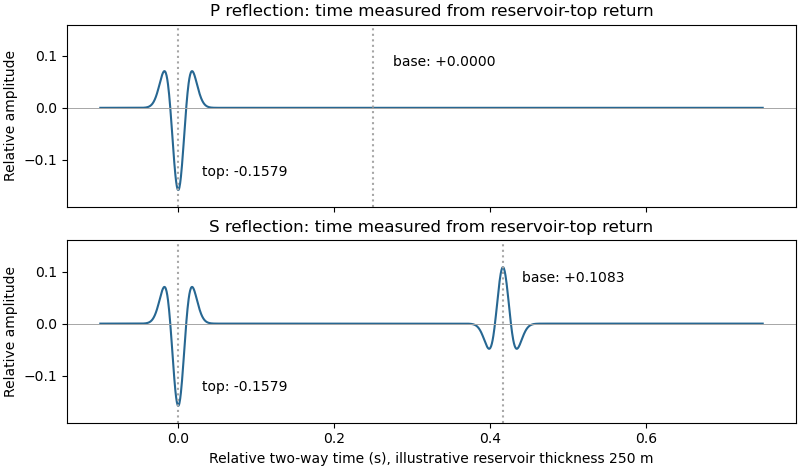
Let a positive incident stress wavelet be and measure return times relative to a receiver just above the reservoir. The top interface gives a negative P return of amplitude and no basal P return. For a separately generated and measured S wave, the top return is also negative, , while the basal return is positive, at the lower interface.
If is reservoir thickness, the basal return arrives or after the top return; no numerical is supplied. Including downward and upward transmission through the top boundary, but ignoring seismic attenuation, spreading and seismic multiples, its observed S-wave amplitude isThus the synthetic S trace has an earlier negative wavelet and a later, smaller positive wavelet; the synthetic P trace has only the earlier negative wavelet. The figure chooses solely to separate the pulses visually. Receiver electronics or a displacement convention can reverse the displayed trace polarity, so the convention must accompany the sketch.
A marine hydrophone streamer with a purely normal-incidence P source does not directly record the hypothetical S trace. A seabed multicomponent receiver and suitable S excitation or oblique-incidence seismic mode conversion are required. This distinguishes the calculated solid-layer response from what a particular acquisition system can measure.

New to topics? Read the docs here!