Polar form of a complex number
ID: polar-form-of-a-complex-number

A nonzero complex number has polar formwhere is its modulus and is an argument. The equality uses Euler's formula; sine and cosine recover the imaginary part and real part from polar coordinates. For , take and radians, so and .
If , thenThus multiplication multiplies moduli and adds arguments modulo ; division divides moduli and subtracts arguments modulo . Since , multiplying by gives , of modulus and argument radians. One formula simultaneously describes its new size and direction.
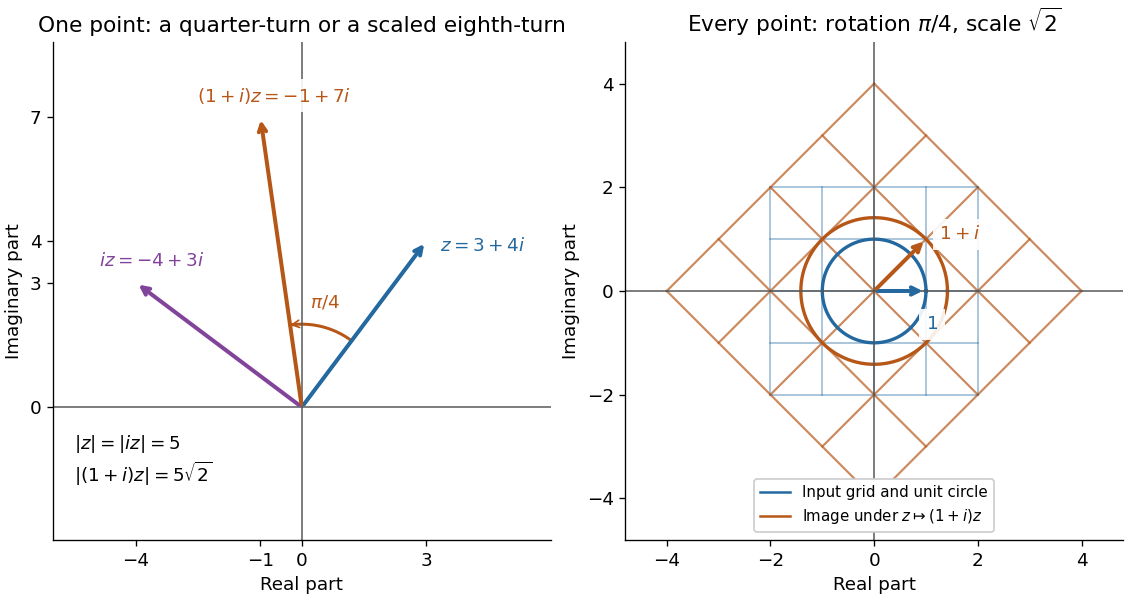
Complex multiplication rotates every direction and scales every length equally
. Details. 
Repeated multiplication now becomes especially simple: for a positive integer . This explains the evenly spaced arguments of the roots of a complex number. For example, has modulus and principal argument radians. The Cartesian calculation and the polar form provide independent checks on both its location and its size. Choose polar form when the task concerns multiplication, division, or repeated turns; use real parts and imaginary parts for addition.
New to topics? Read the docs here!