Quadratic reciprocity
ID: quadratic-reciprocity

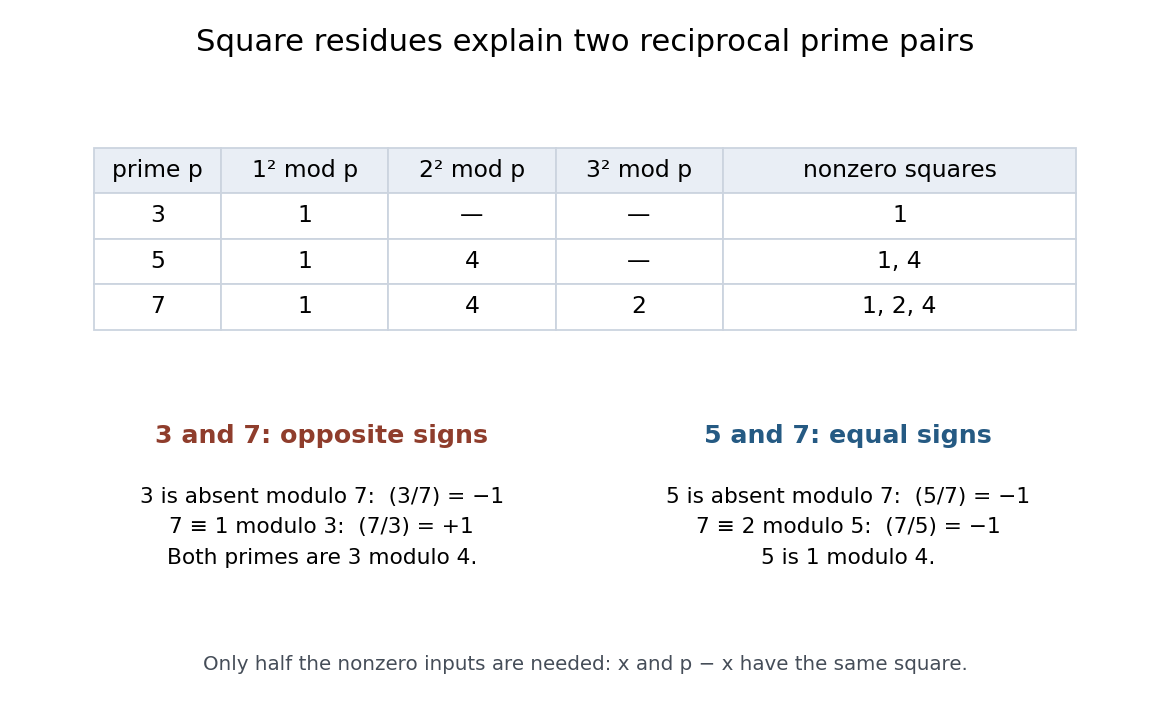
Quadratic reciprocity compares two questions: is the prime number a quadratic residue modulo , and is a quadratic residue modulo ? Let be distinct odd primes. In terms of the Legendre symbol,The two Legendre symbols have opposite signs exactly when both primes are modulo ; otherwise they are equal. Their values are nonzero because the primes are distinct. Equal signs can mean two quadratic residues or two quadratic nonresidues: reciprocity compares the answers rather than declaring either answer positive.[ref]
NIST Digital Library of Mathematical Functions. T. M. Apostol, Chapter 27, §27.9, equation 27.9.3: distinct odd prime hypotheses and reciprocity law
For a direct computation, the nonzero quadratic residues modulo are respectively , , and . Squaring just suffices because and have the same square modulo an odd prime .The pair has a sign flip, whereas has two negative signs. These small quadratic residue tables make the distinction tangible.
The first supplementary law for quadratic reciprocity handles numerator , and the second supplementary law for quadratic reciprocity handles numerator :For an odd prime , is a quadratic residue exactly when , while is a quadratic residue exactly when . The remaining odd congruence classes modulo , namely , make a quadratic nonresidue. These laws fill the cases excluded from swapping distinct odd primes.[ref]


Quadratic reciprocity is a fundamental theorem in number theory that describes the solvability of quadratic equations modulo prime numbers. It addresses the question of when a quadratic residue exists for two distinct odd prime numbers.
New to topics? Read the docs here!