Regular polygon edge rotation criterion
ID: regular-polygon-edge-rotation-criterion

For cyclically ordered planar vertices, let , with indices modulo . They describe a convex regular polygon exactly when and there is a single choice of sign for which every successive edge vector is obtained by a rotation through in that orientation. Necessity follows from equal sides and equal exterior angles. Conversely, the edge vectors have the form . Their sum is zero because the corresponding geometric series runs through the distinct roots of unity. Summing its partial series shows that the vertices are a translated and scaled copy of those roots, so they form a convex regular polygon. A larger turn such as can instead trace a star, which is why merely checking a constant turning angle is insufficient.
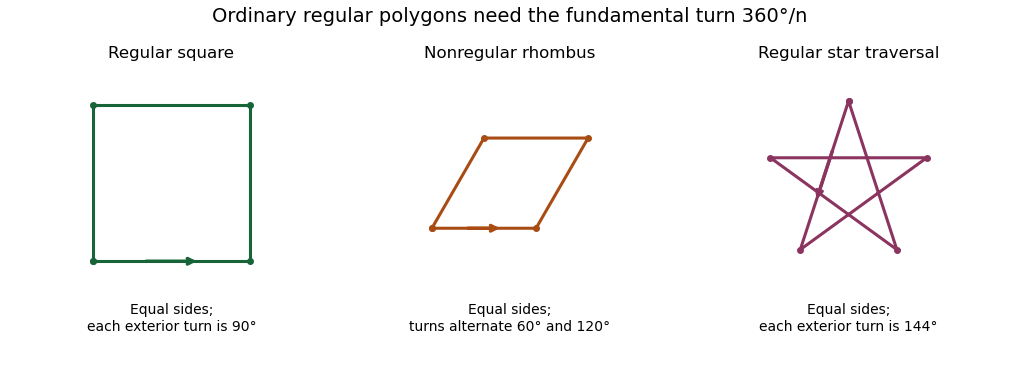
Equal sides, equal turns and the fundamental turn distinguish an ordinary regular polygon
. Original constructions: a square satisfies the edge-rotation criterion; a nonsquare rhombus has unequal turns; a five-point star uses the wrong turn, instead of . Arrows indicate traversal direction. Details.
New to topics? Read the docs here!