
A screw thread is a ridge following a helix around an external or internal surface. Cylindrical threads repeat around a cylinder; tapered forms can instead follow a conical spiral. The thread's shape and dimensions determine how it mates with another threaded component.[ref]
A simple geometric model represents one reference helix on a cylindrical thread bywhere is the chosen radius, is an angle measured in radians, and is the screw lead. Increasing by returns to the same angular position while increasing the axial coordinate by . This curve describes a reference path, rather than the full three-dimensional ridge profile.
A thread start is a distinct continuous helical ridge. With equally spaced starts and thread pitch , the advance of one start per turn is . The same axial spacing can therefore coexist with different advances per turn.[ref]
Selecting the Optimal Screw Technology by Tolomatic. Screw Terminology, printed pp5–6: lead, pitch and single/double-start diagrams
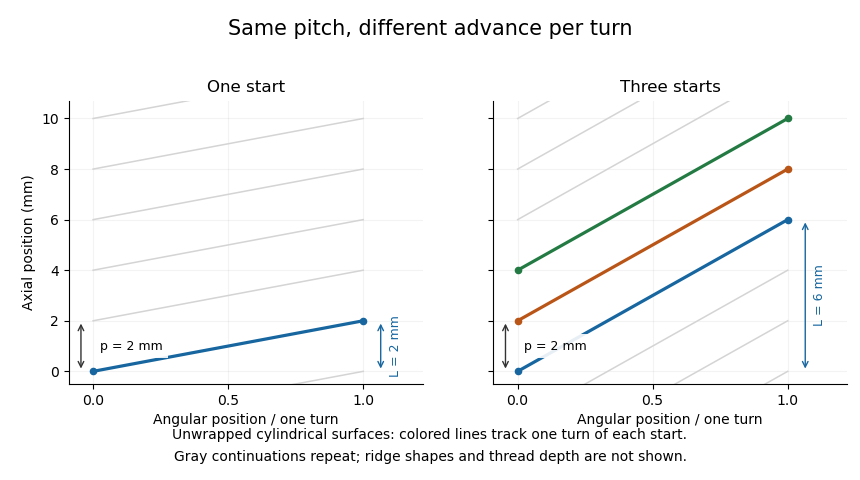

When a matching nut is guided against rotation, relative rotation can produce axial movement in a lead screw. Clearance can produce backlash, while deformation of loaded components contributes mechanical compliance. Thus ideal thread geometry predicts a motion ratio, while the actual load path also depends on contact and deformation.
New to topics? Read the docs here!