
The solution set of a mathematical condition in a specified domain collects every allowed value that satisfies it:It describes the answer without committing to the steps used to find it. For the equation over the real numbers, the solution set is ; restricting to positive real numbers leaves . For , the solution set is over the rational numbers and the empty set over the integers. The domain is part of the question.
An equation can have one solution, several solutions, no solutions, or an entire domain of solutions. Over the real numbers, gives the singleton set , gives the empty set, and the mathematical identity gives the whole real line. Changing that second equation's domain to the complex numbers gives . The elementary definition by values that satisfy an equation and the classification by solution sets appear in College Algebra 2e, §2.2: Solving Linear Equations in One Variable.
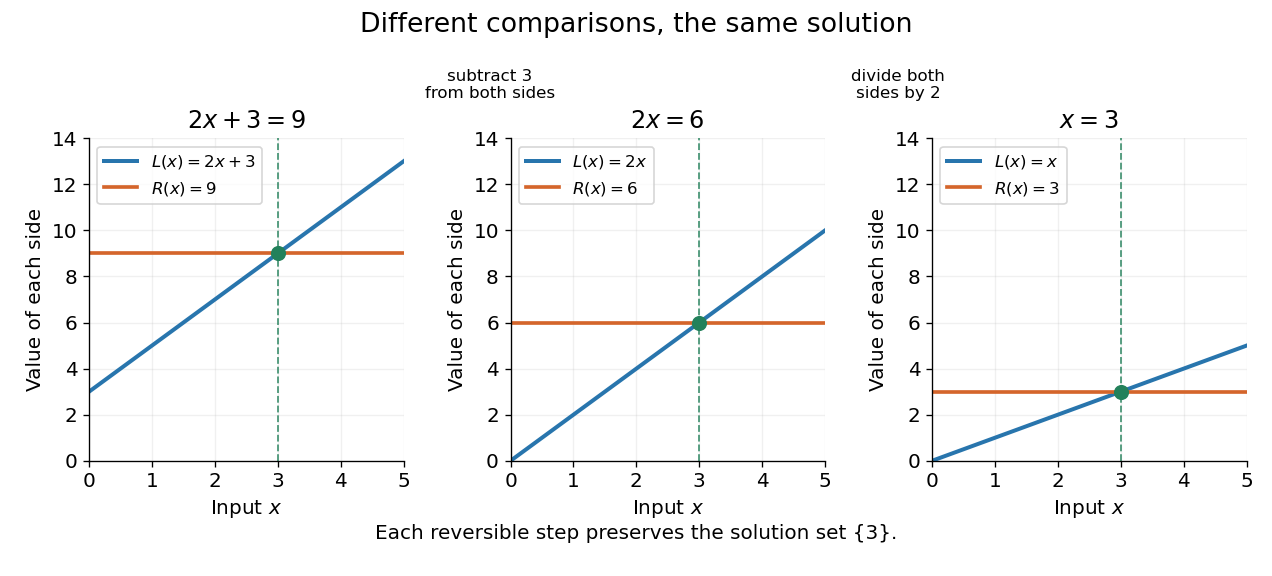
Three equivalent equations have the same singleton set of solutions , even though their displayed function values differ
. Details. 
Requiring several conditions simultaneously takes the intersection of their solution sets. The squared equation has solution set . Adding the restriction giveswhich is also the solution set of . The extraneous solution example explains why the sign restriction is needed. Requiring at least one of several conditions instead takes their union. This turns logical combinations of constraints into reusable operations on sets.
For several variables, a solution is an ordered assignment, usually represented by a tuple. The real equation has solution set , a straight line in the Euclidean plane with coordinates . Adding intersects that straight line with another, leaving the single tuple . A system of linear inequalities has no solution exactly when the intersection of its individual solution sets is the empty set. For optimization constraints, this common solution set is the feasible region.
Because a solution set is a set, the order in which its members are listed is irrelevant. The multiple root of is still the one solution ; its multiplicity of a root is additional polynomial information, rather than a second occurrence inside the solution set. Equivalent equations preserve the solution set on the stated domain, even if their algebraic forms differ.
New to topics? Read the docs here!