Third-order pulse correlation ghost
ID: third-order-pulse-correlation-ghost

A third-order pulse correlation ghost is a correlation lobe generated by a real feature in the nonlinear gate, appearing at a delay where no separate input pulse need exist. It is a property of the measurement's cross-correlation, not automatically an optical prepulse or optical postpulse.
The optical pulse temporal contrast article derives the separated-replica model for , and nonoverlapping identical-shape pulses. In third-order intensity autocorrelation, the main, positive-delay and opposite-delay lobe weights are respectivelyThe physical delayed replica enters linearly when it meets the strong squared gate; its squared contribution to the gate creates the opposite-delay ghost. Lobe separation and negligible pulse overlap are assumptions of this simple decomposition.
For an original , the real postpulse has four percent of the main intensity and equal duration. Normalized to the correlation's main peak, its lobe is , while the ghost is . A feature at negative delay near that latter level does not establish a physical prepulse. The ghost-to-real-lobe ratio is exactly in this model. This ghost-level consistency test for a delayed pulse replica can check an interpretation, although an actual prepulse could also be present.
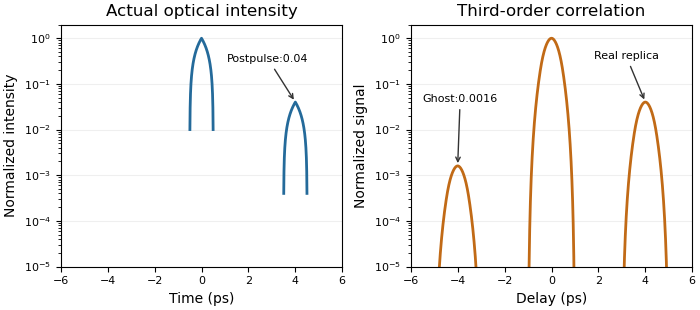
A real optical postpulse creates an opposite-delay ghost in an ideal third-order intensity autocorrelation
. Original compact triangular intensity profiles with a delayed replica at4ps and relative peak0.04. Direct numerical correlation produces the opposite-delay lobe near0.0016; the optical profile has no pulse there. Each panel is normalized to its own maximum. Source. Details.
The historical correlator's inserted-etalon test supplies a controlled physical postpulse for checking the delay orientation.[ref]
A Single Shot 3rd Order Cross-Correlator for Pulse Contrast and Pulse Shape Measurements by J. Collier and others. printedp195, Results and Figure4
Independent changes to the replica strength, or a reference with known temporal structure, test the ghost interpretation. Overlapping pulses, unequal shapes and instrument backgrounds require a richer model. New to topics? Read the docs here!