
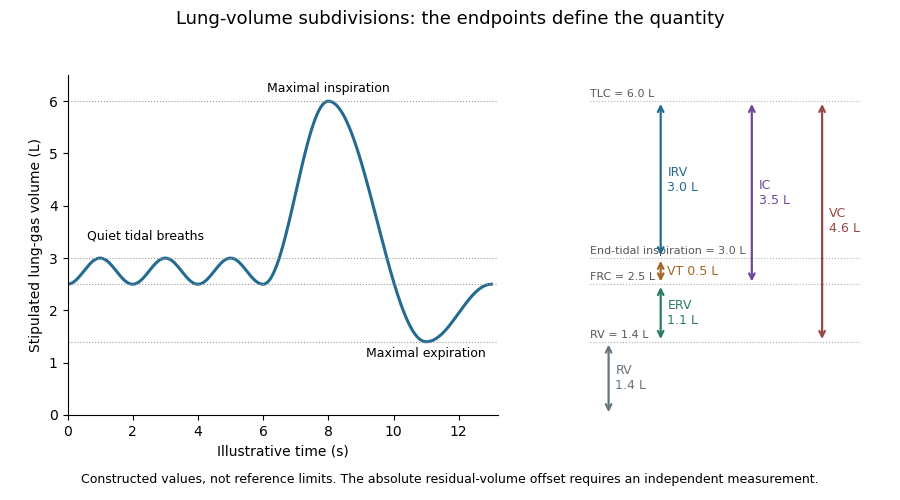
Tidal volume, , is the volume of gas inhaled or exhaled during one respiratory cycle. It is a per-breath increment, distinct from the gas remaining at functional residual capacity or the maximum total lung capacity.[ref]
Standardisation of the measurement of lung volumes, 2023 update by Nirav R. Bhakta and others. Definitions and subdivisions of lung volume; Figure 1
A flow measurement becomes a volume by integration. If is positive during inspiration, thenA stipulated triangular inspiratory flow pulse lasting 1 s with peak 1 L/s has area L. Integrating a signed flow over an entire balanced breath instead gives approximately zero, because expiration cancels inspiration; that signed net transfer is not tidal volume.
Multiplying by respiratory rate gives minute ventilation, . Two constructed patterns, 0.5 L at 12 breaths/min and 0.25 L at 24 breaths/min, both move 6 L/min. They need not deliver the same gas exchange. In an ideal fixed-respiratory dead space model,where is the per-breath volume not participating in the modeled exchange. For stipulated L, the two patterns give alveolar ventilation 4.2 and 2.4 L/min. This comparison assumes each breath exceeds the modeled dead-space volume; it is an accounting example, not an individual breathing prescription.
A spirometry or flow trace therefore needs an identified interval and sign convention before its integral is interpreted. The illustration places a quiet tidal volume within a full lung-volume excursion: it shows increments on a constructed absolute scale rather than claiming that ordinary spirometry directly observes the residual offset.

New to topics? Read the docs here!