Unicode Bidirectional Algorithm
ID: unicode-bidirectional-algorithm

The Unicode Bidirectional Algorithm computes visual text order from logical text order. Unicode bidirectional classes and context determine bidirectional embedding levels: levels with an even integer value run left-to-right, and those with an odd integer value run right-to-left. Stored code points retain their order; text shaping is separate.[ref]
After levels and line boundaries are resolved, level-based reordering of bidirectional text descends from the largest level to the smallest level that is an odd integer. Each pass reverses maximal consecutive runs at or above its level.[ref]
Unicode Bidirectional Algorithm (Revision 51) by the Unicode Consortium. §3.4, rules L1–L3, especially L2
Here is a small example with the resolved levels supplied. The labels each represent a distinct right-to-left text character, while represent left-to-right text characters. All rows below are written in physical left-to-right order. Start withThe level 2 pass changes the middle digits to . The level 1 pass then reverses the whole five-item middle run, producingThe digits have been reversed twice, preserving their original internal order. Reversing the entire stored sequence once would instead exchange and and leave the digits in the wrong order. This example demonstrates the reordering step, not how all Unicode bidirectional classes are resolved.
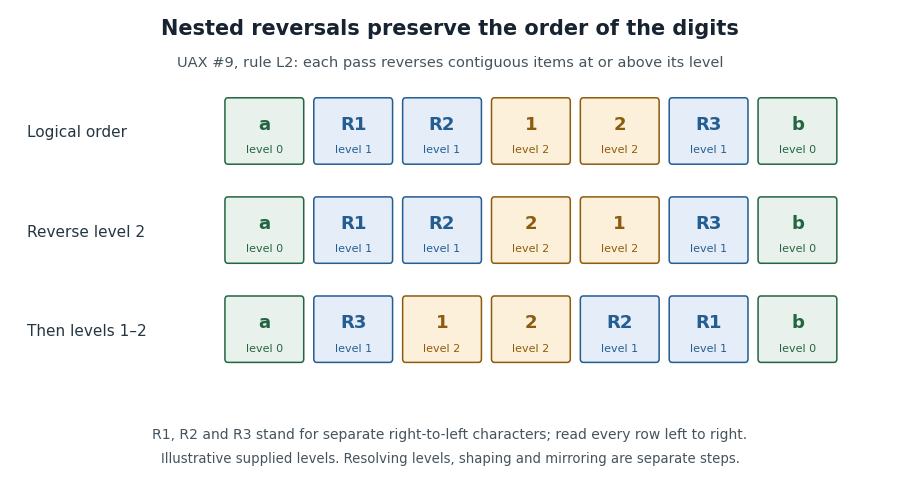
Two level-based reversals preserve the internal order of the digits
. Original illustration with supplied bidirectional embedding levels. The boxes denote individual abstract text characters, not literal multi-character labels. Details.
A bidirectional isolate limits directional interaction between inserted text and its surroundings. Markup can express isolation without storing explicit formatting code points.[ref]
New to topics? Read the docs here!