
For a positive integer modulus , a residue class is a unit when it has a modular multiplicative inverse: some integer satisfies . Modulo twelve, the units are exactlyIn particular, five is its own modular inverse, since . Multiplying all twelve residue classes by five gives a permutation; multiplying the outputs by five recovers the inputs. By contrast, multiplying by six gives only zero and six, with six inputs for each output. It cannot be reversed.
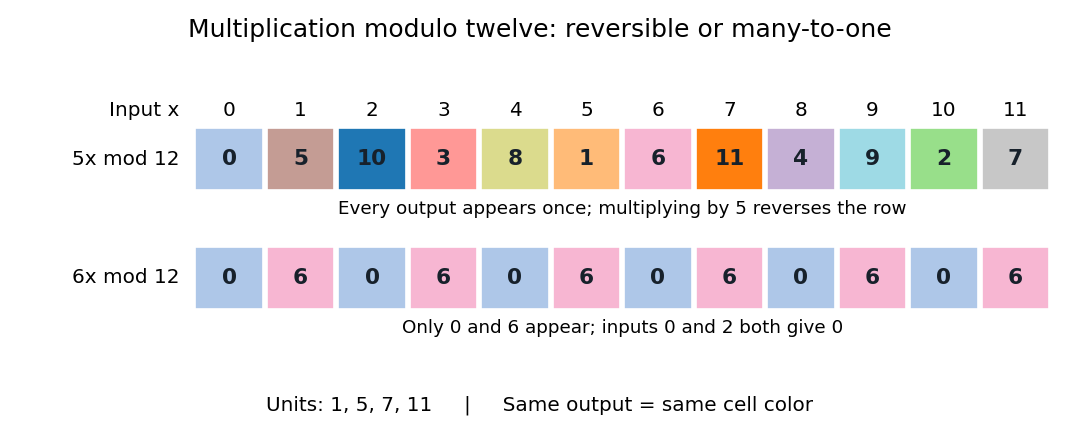
Multiplication by five permutes all twelve residue classes, whereas multiplication by six merges distinct inputs
. Details. 
In general, the exact criterion isFor the forward direction, implies every common divisor of divides one. Conversely, if their greatest common divisor is one, Bézout's identity supplies , so is a modular inverse. The extended Euclidean algorithm computes these coefficients. The units form the unit group under multiplication. [ref]
https://ocw.mit.edu/courses/18-200-principles-of-discrete-applied-mathematics-spring-2024/mit18_200_s24_lec15.pdf. Ankur Moitra, MIT 18.200, Lecture 15 (2024), pp. 3–4: inverses, coprimality and the unit group
Multiplicative cancellation while keeping the same integer modulus is valid for a unit modulo n: from , multiply by a modular inverse of to get . A nonunit cannot be cancelled as a general rule. For example, , yet . Thus division by six cannot undo this multiplication; solving a linear congruence instead keeps track of all possible classes.
This distinction marks the boundary between commutative rings and fields. Modulo a prime number , every nonzero residue class is a unit, so is a finite field. Modulo twelve it is a commutative ring with zero divisors, and is not a field. For , the sole class satisfies and is a unit; this one-element zero ring is not a field. [ref]
https://ocw.mit.edu/courses/18-200-principles-of-discrete-applied-mathematics-spring-2024/mit18_200_s24_lec15.pdf. Moitra, MIT 18.200, Lecture 15, pp. 8–9: the prime-modulus field criterion
New to topics? Read the docs here!