For example, this sentence. And then another one.
For example, this sentence. And then another one.
Proof of the fundamental theorem of calculus is a very important subject about which there is a lot to say.
For example, this sentence. And then another one.
For example, this sentence. And then another one.
Latest discussions
| Score | # id | Title | Author | Comments | Created | Updated |
|---|---|---|---|---|---|---|
| #2 | Add mention of the fundamental theorem of calculus |  Barack Obama 11 Barack Obama 11 | 0 | 2022-11-02 | 2024-08-20 | |
| #1 | There's a typo in this article at "mathmatcs" |  Donald Trump 29 Donald Trump 29 | 3 | 2022-11-02 | 2024-05-21 |
Top discussions
| Score | # id | Title | Author | Comments | Created | Updated |
|---|---|---|---|---|---|---|
| #2 | Add mention of the fundamental theorem of calculus | Barack Obama 11 | 0 | 2022-11-02 | 2024-08-20 | |
| #1 | There's a typo in this article at "mathmatcs" | Donald Trump 29 | 3 | 2022-11-02 | 2024-05-21 |
Articles by others on the same topic

An integral adds up contributions of a function across a domain. For a continuous function on , the Riemann integral is the common limit of its Riemann sums as the largest subinterval width tends to zero:Each product combines a value with the width over which it acts. When is nonnegative, the result is the area beneath its graph; values below the horizontal axis contribute with the opposite sign. The signed area under a graph can therefore vanish even when the graph encloses nonzero geometric area.
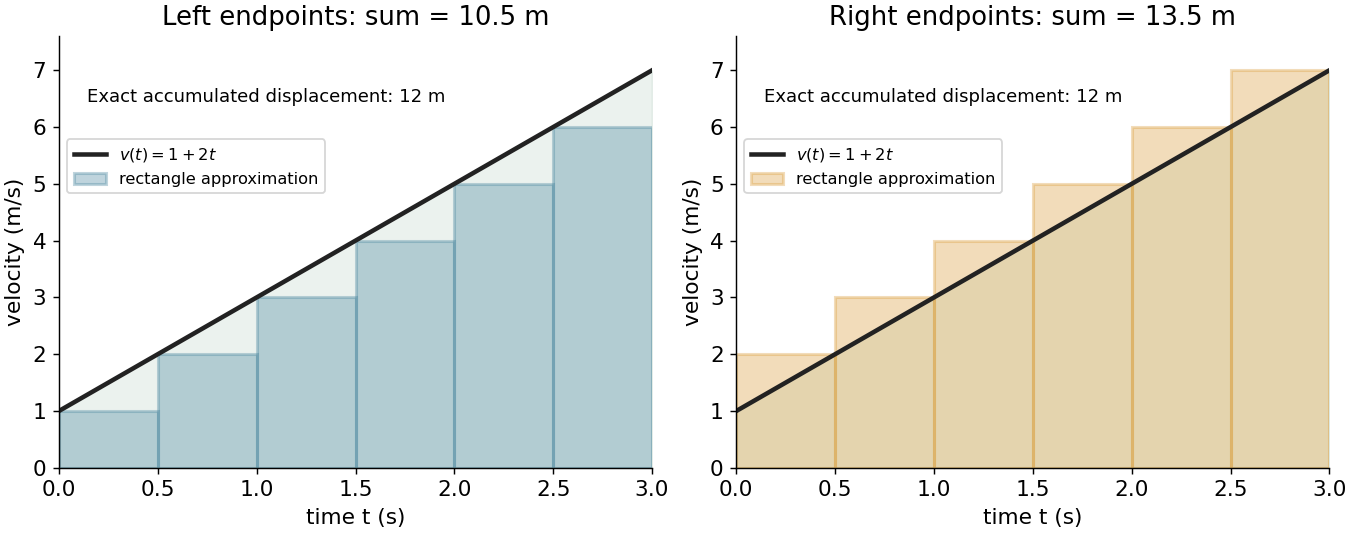
For a velocity on , use equal time steps. The left and right Riemann sums areBecause the function is increasing, they bound the integral. With six steps they give and ; with sixty steps they give and . Both approach the same total, . This is accumulation made exact by refining finite measurements.
An integral retains units: velocity times time gives displacement, and a probability density function integrated over an interval gives a probability. Weighting a density by a function gives its expectation. The same operation serves different subjects because it expresses a common pattern, value multiplied by extent, then accumulated.
The fundamental theorem of calculus often evaluates a definite integral by finding an antiderivative, but a finite sum or a numerical approximation is still useful when no convenient antiderivative is available. An indefinite integral denotes a family of antiderivatives; a definite integral denotes an accumulated value between specified endpoints. More general constructions, including Lebesgue integration, extend the class of functions and domains that can be handled.


