Given a linear operator over a space that has a inner product defined, we define the adjoint operator (the symbol is called "dagger") as the unique operator that satisfies:
Articles by others on the same topic

For a bounded linear operator between real or complex Hilbert spaces, its adjoint is the unique bounded linear operator satisfyingThe inner product here is linear in its first argument. The adjoint operator transfers an output measurement back to the input: measuring against the vector gives exactly the same scalar as measuring against . It depends on both inner products.
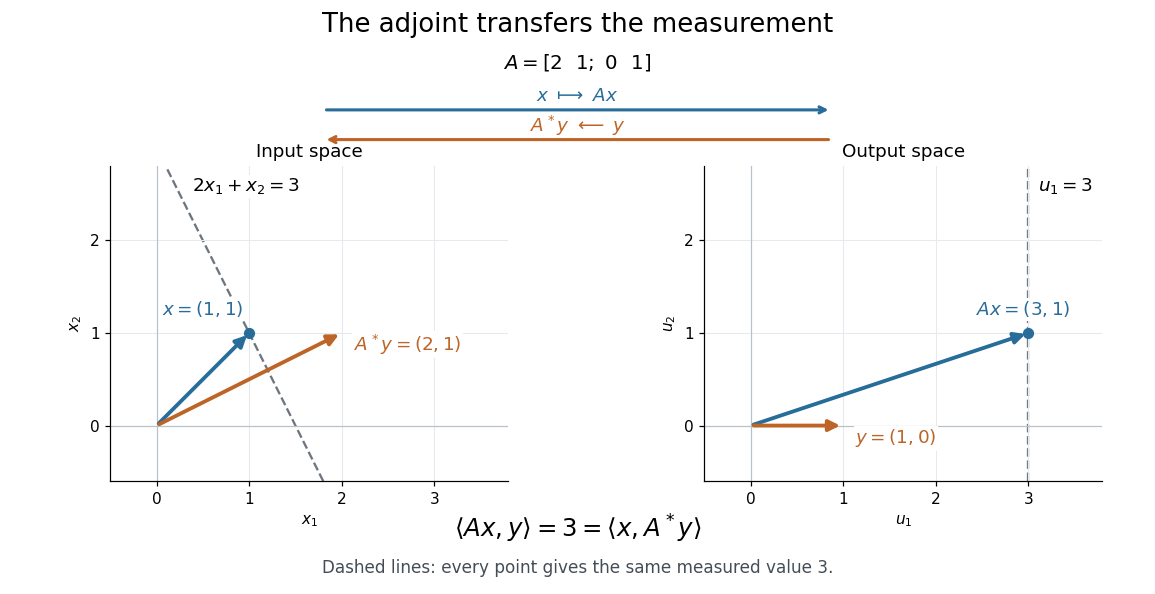

In this real example,Both inner products equal . The dashed lines collect all vectors giving that same measurement: the output line becomes the input line . The adjoint operator therefore moves the direction that describes the measurement. It generally differs from the inverse matrix: here .
For an explicitly complex example, use the standard inner product on . In the standard orthonormal basis, the adjoint operator is represented by the conjugate transpose:For and , direct matrix multiplication givesand henceThe complex conjugate is essential to this agreement.
Existence follows from the Riesz representation theorem: for fixed , the bounded linear functional has a unique representing vector . The resulting adjoint operator has the same operator norm as , andMIT's lecture 18 develops the representation argument and the conjugate transpose example.[ref]
https://ocw.mit.edu/courses/18-102-introduction-to-functional-analysis-spring-2021/7f23bfc43ee2e1efd238a5384e5b9d51_MIT18_102s21_lec18.pdf. Rodriguez, notes by Andrew Lin, MIT 18.102, lecture 18, Theorem 185 and Example 186, 2021
This transfer explains the normal equation for a linear inverse problem: a least-squares solution has residual orthogonal to every attainable direction , so for every , equivalently . An output residual becomes an input condition through the same adjoint operator. All identities in this section concern bounded operators defined on the whole source Hilbert space; for a densely defined operator that is not bounded, use the adjoint of a densely defined operator and check its operator domain.