Key examples:
Some specific examples:
Sometimes, especially in the case of structures with an infinite number of elements, it is often more convenient to talk in terms of some parameter that characterizes the structure, and that parameter is usually called the degree.
The degree of some algebraic structure is some parameter that describes the structure. There is no universal definition valid for all structures, it is a per structure type thing.
This is particularly useful when talking about structures with an infinite number of elements, but it is sometimes also used for finite structures.
Examples:
- the dihedral group of degree n acts on n elements, and has order 2n
- the parameter that characterizes the size of the general linear group is called the degree of that group, i.e. the dimension of the underlying matrices
Examples:
Articles by others on the same topic

An algebraic structure is a set equipped with specified algebraic operations satisfying selected axioms. An operation's domain is part of the structure: a binary operation on takes two elements of and produces another element of . Groups specify one such operation, rings specify addition and multiplication, and vector spaces specify vector addition and scalar multiplication by a separate field.
Different choices of operations can give the same underlying set different structures. The integers form a group under addition, since every integer has an additive inverse. They do not form a group under multiplication: for example, has no multiplicative inverse among the integers. Even the nonzero integers fail that inverse requirement. In contrast, nonzero rational numbers form a group under multiplication.
Finite multiplication tables make such distinctions visible. Arithmetic modulo gives a field; arithmetic modulo gives a commutative ring with zero divisors. In the former, multiplying by any nonzero element permutes all residue classes. In the latter, multiplying by reaches only , and even though both factors are nonzero.
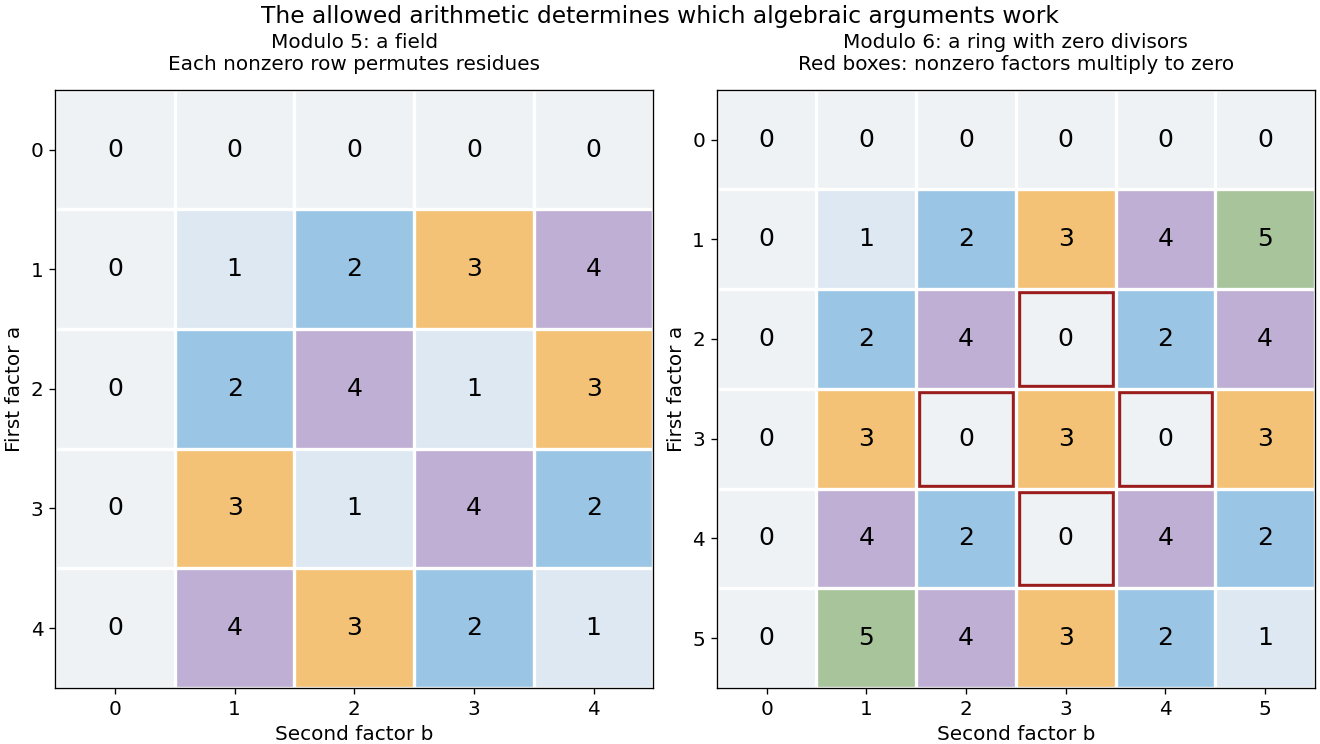
The goal is to extract reusable properties rather than memorize isolated tables. A homomorphism preserves the specified operations, and an isomorphism shows that two structures have identical operation patterns after relabeling.


An algebraic structure is a set paired with one or more operations that satisfy certain axioms or rules. In mathematics, algebraic structures provide a framework for studying various mathematical concepts and properties. Here are some common types of algebraic structures: 1. **Groups**: A set \(G\) with a binary operation \(*\) that satisfies the following properties: - Closure: For all \(a, b \in G\), \(a * b \in G\).