visualizing the Riemann hypothesis and analytic continuation by 3Blue1Brown (2016) is a good quick visual non-mathematical introduction is to it.
The key question is: how can this continuation be unique since we are defining the function outside of its original domain?
The answer is: due to the identity theorem.
Good ultra quick visual non-mathematical introduction to the Riemann hypothesis and analytic continuation.
Essentially, defining an holomorphic function on any open subset, no matter how small, also uniquely defines it everywhere.
This is basically why it makes sense to talk about analytic continuation at all.
One way to think about this is because the Taylor series matches the exact value of an holomorphic function no matter how large the difference from the starting point.
Therefore a holomorphic function basically only contains as much information as a countable sequence of numbers.
visualizing the Riemann hypothesis and analytic continuation by 3Blue1Brown (2016) is a good quick visual non-mathematical introduction is to it.
One of the Millennium Prize Problems and Hilbert's problems.
What is the Riemann hypothesis REALLY about? by HexagonVideos (2022)
Source. Articles by others on the same topic

An analytic continuation extends a holomorphic function beyond its original domain without changing its existing values. Formally, if are domains and is holomorphic on , a holomorphic function on with is an analytic continuation. More locally, holomorphic functions on overlapping open sets continue one another when they agree on the overlap, allowing a chain of patches along a path. The identity theorem for holomorphic functions forces agreement throughout a connected overlap once they agree on a nonempty open set in it. It also makes an extension to a fixed connected domain unique. [ref]
https://ocw.mit.edu/courses/18-04-complex-variables-with-applications-spring-2018/af8c9c78c3915aaf3fd1695f8d32a3b3_MIT18_04S18_topic13.pdf. Orloff, MIT 18.04 Topic 13, section 13.2 and Theorem 13.2
The geometric series illustrates why a formula can reach farther than the power series that first represents it. For , its partial sum isWhen , , so the series converges to . The rational function is holomorphic on and agrees there with the sum on the unit disc. It therefore continues to every point except its simple pole at . In particular,Thus analytic continuation gives a value at without making the original geometric series converge there. Its radius of convergence remains : on the terms do not even tend to zero.
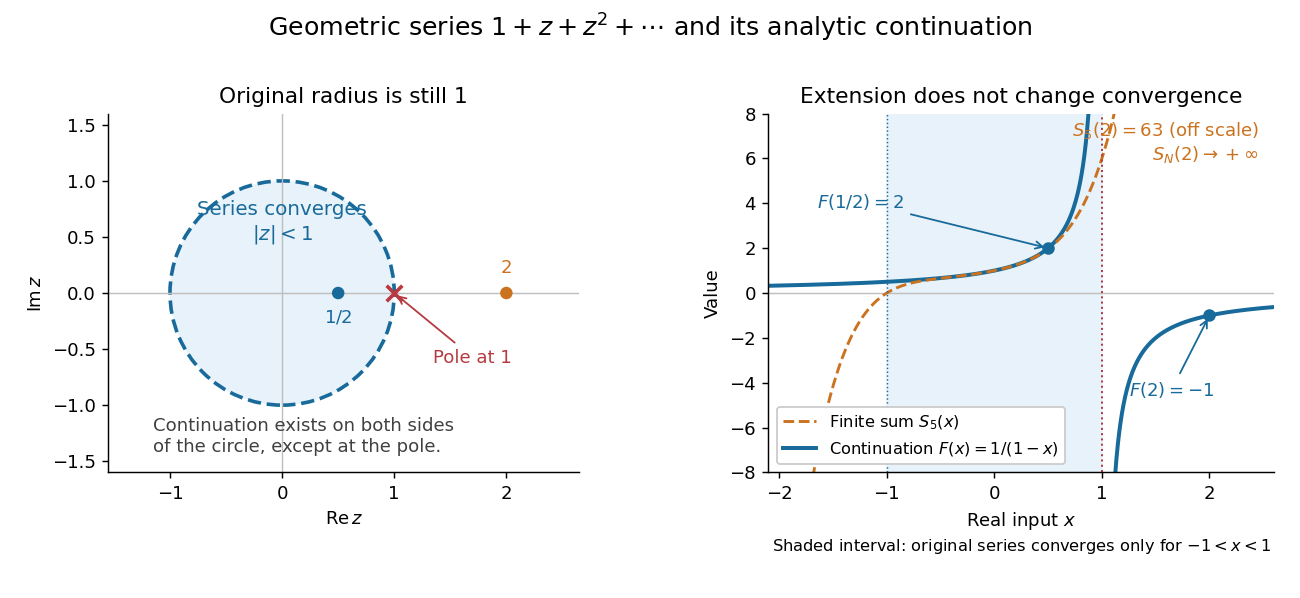
The original geometric series converges only inside the unit circle, while its rational continuation exists everywhere except the pole at 1
. Details. 
The pole at limits the original Taylor series, although most points of its convergence circle are regular for . Recentring at gives another genuinely convergent power series,At this yields , even though the original powers of grow. This is the useful idea: overlapping local descriptions can represent one holomorphic function on a larger region.
Uniqueness on a connected overlap does not imply that every path leads to the same terminal germ of a holomorphic function. Continuing a complex logarithm around changes its value by , giving monodromy; the return patch can carry a different branch of a multivalued function. If two patches have a disconnected overlap, agreement on one component imposes no agreement on the others. [ref]
https://ocw.mit.edu/courses/18-04-complex-variables-with-applications-spring-2018/af8c9c78c3915aaf3fd1695f8d32a3b3_MIT18_04S18_topic13.pdf. Orloff, section 13.2.1, Example 13.4
Continuation using the rational function is single-valued: any path avoiding gives the same terminal germ of a holomorphic function, even if it winds around the pole.