Articles by others on the same topic

Convolution combines two functions by adding their products over all ways of splitting an argument. For Lebesgue integrable functions on the real line, their convolution isThe arguments and always add to . For in the L1 space, the integral exists almost everywhere and defines another element of the L1 space, with by Young's convolution inequality. Particular examples below have a value at every .
To see what the integral counts, take the indicator function . The product equals one exactly when belongs to both intervals and . Its integral is their overlap length, soAt , the overlap is and the output is ; at , the two intervals coincide and the output is one. The result is the shifted triangular function . As changes, is a reflected and translated copy of : the moving overlap makes the entire graph visible without a difficult integration.
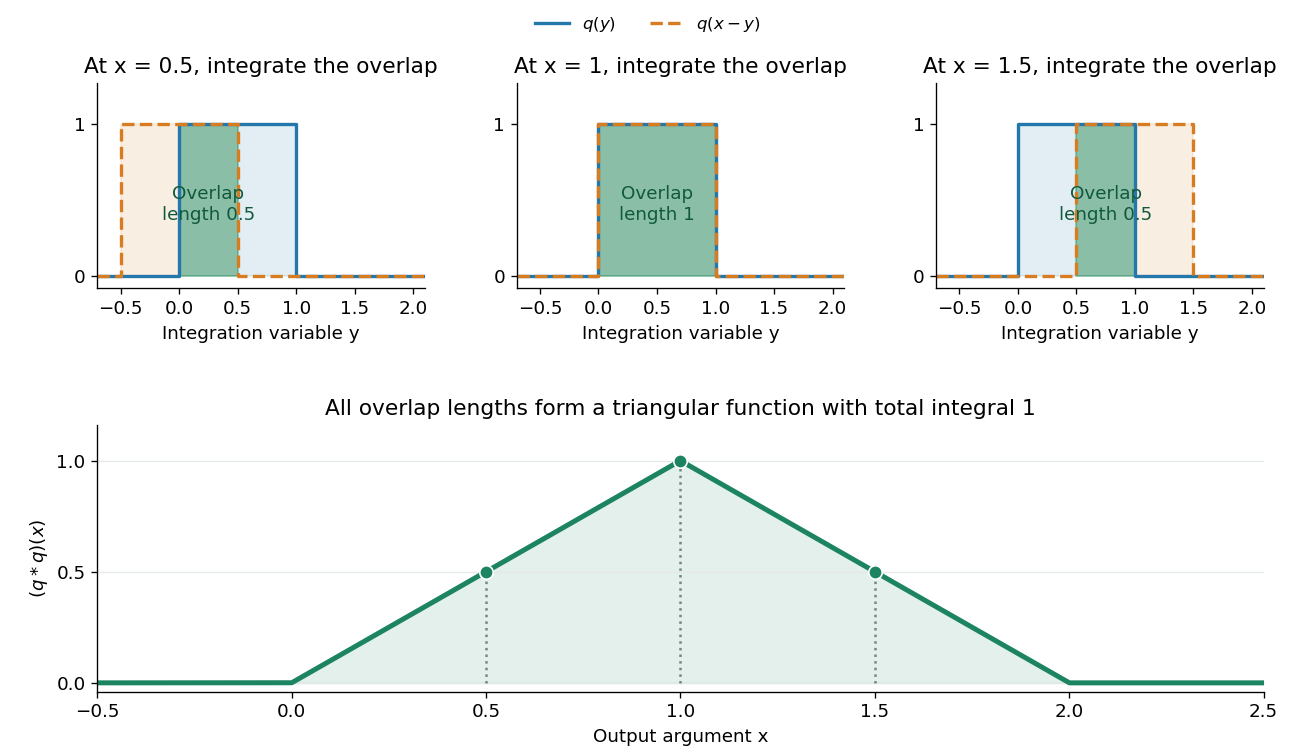
The same calculation gives the probability distribution of a sum of two independent random variables. If are independent random variables with the continuous uniform distribution on , each has probability density function . Their sum has probability density function by convolution of probability densities. The probability density function at one is larger than near zero or two because there are more combinations of the two inputs giving that sum. Its total integral is one; its expected value is one and its variance is . These follow equally from integrating the triangular function or from linearity of expectation and variance additivity for independent random variables.
Convolution also gives a useful averaging operation. For , let . Thenthe mean of in a neighborhood of . A smaller examines a smaller neighborhood. For a continuous function , this mean tends to as , an example of an approximate identity. Integrating a sharp input against a distributed convolution kernel can produce a smoother output; the triangular example turns two discontinuous inputs into a continuous output.
In signal processing, a linear time-invariant system combines shifted copies of its impulse response by the same rule. In discrete time, an input value at index contributes a scaled response at index , and discrete convolution sums these contributions. This is the superposition interpretation developed in Oppenheim, MIT Signals and Systems, Lecture 4, convolution sums and integrals. The convolution theorem then gives another description: transform both inputs with a Fourier transform and multiply their transforms. Combining shifts, combining independent quantities and multiplying frequency descriptions are three faces of the same operation.


Convolution is a mathematical operation that combines two functions to produce a third function, representing the way in which the shape of one function is modified by the other. It is widely used in various fields, including signal processing, image processing, and machine learning.