A way to defined geometry without talking about coordinates, i.e. like Euclid's Elements, notably Euclid's postulates, as opposed to Descartes's Real coordinate space.
There are 5: en.wikipedia.org/w/index.php?title=Euclidean_geometry&oldid=1036511366#Axioms, the parallel postulate being the most controversial/interesting.
Articles by others on the same topic

Euclid was a mathematician associated with Alexandria around 300 BCE. His Euclid's Elements organized geometry and number theory into definitions, assumptions and chains of proofs, drawing together earlier results as well as material attributed to him. Very little reliable biographical information survives, so the familiar portraits are later imagined likenesses.[ref]
https://mathshistory.st-andrews.ac.uk/Biographies/Euclid/. Biography, evidence for dating and composition of the Elements
The lasting attraction of the Euclid's Elements is its deductive structure: a construction or mathematical theorem becomes reusable in subsequent proofs, rather than remaining an isolated calculation. Its Euclidean algorithm and proof that there are infinitely many prime numbers remain basic tools of number theory.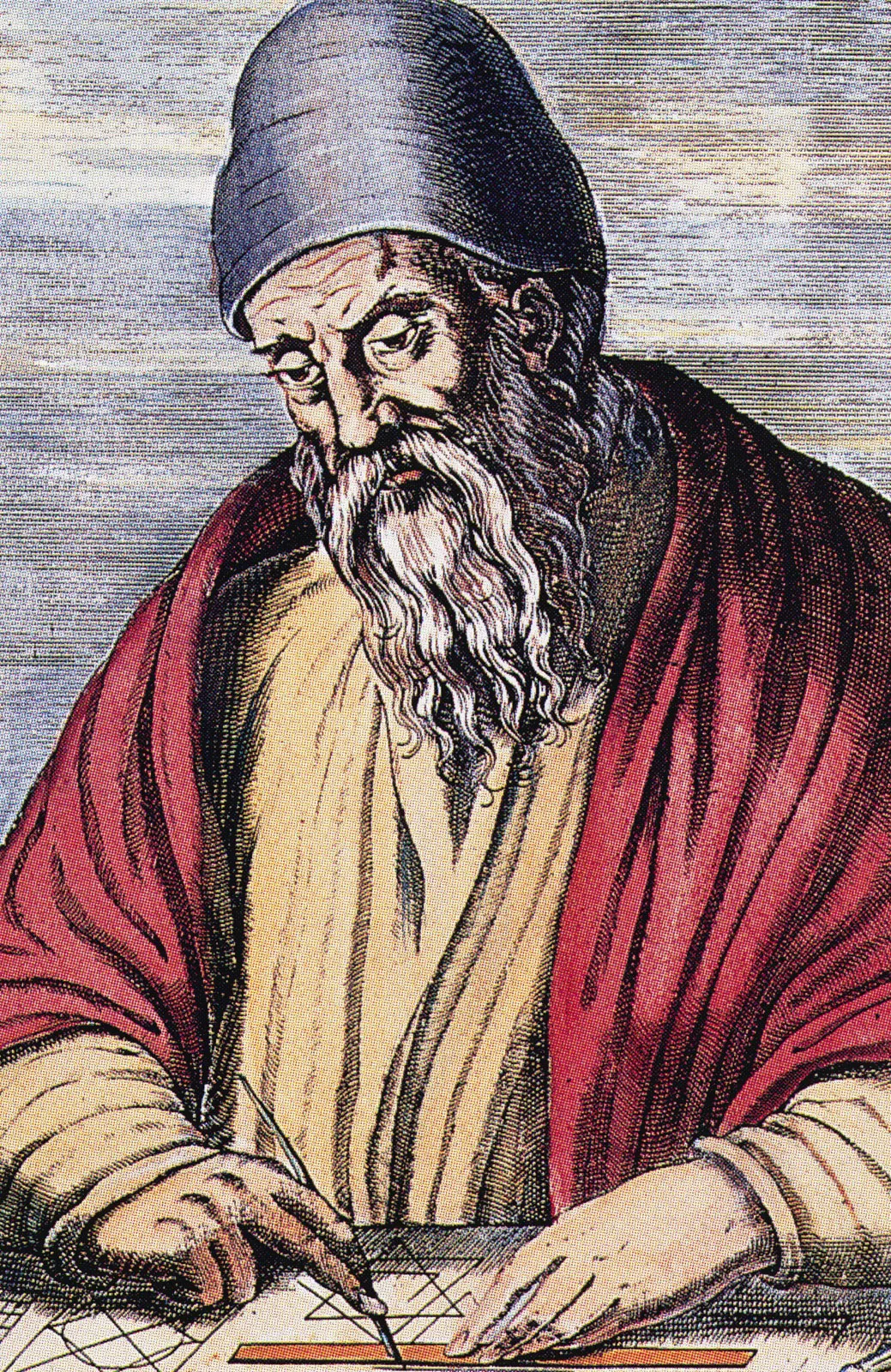
Portrait of Euclid
. Later imagined depiction dated 1584, identified on Wikimedia Commons. This is not an authentic likeness from antiquity; Commons identifies the artwork as public domain. Source.

Euclid can refer to several different concepts, depending on the context: 1. **Mathematician**: Euclid (circa 300 BC) was a Greek mathematician often referred to as the "Father of Geometry." He is best known for his work "The Elements," a comprehensive compilation of the knowledge of geometry of his time, which systematically presented definitions, postulates, propositions (theorems and problems), and proofs.