Consider Python programs
x=2+3*4 and x=(2+3)*4. Operator precedence places multiplication inside the right operand of addition in the first abstract syntax tree. The parentheses instead place addition inside the left operand of multiplication in the second. Their right-hand sides evaluate to and . No rule that simply reads all operators left to right would recover both structures. [ref]https://docs.python.org/3.14/reference/expressions.html#operator-precedence. Python language reference, section 6.17, multiplicative operators bind more tightly than additive operators
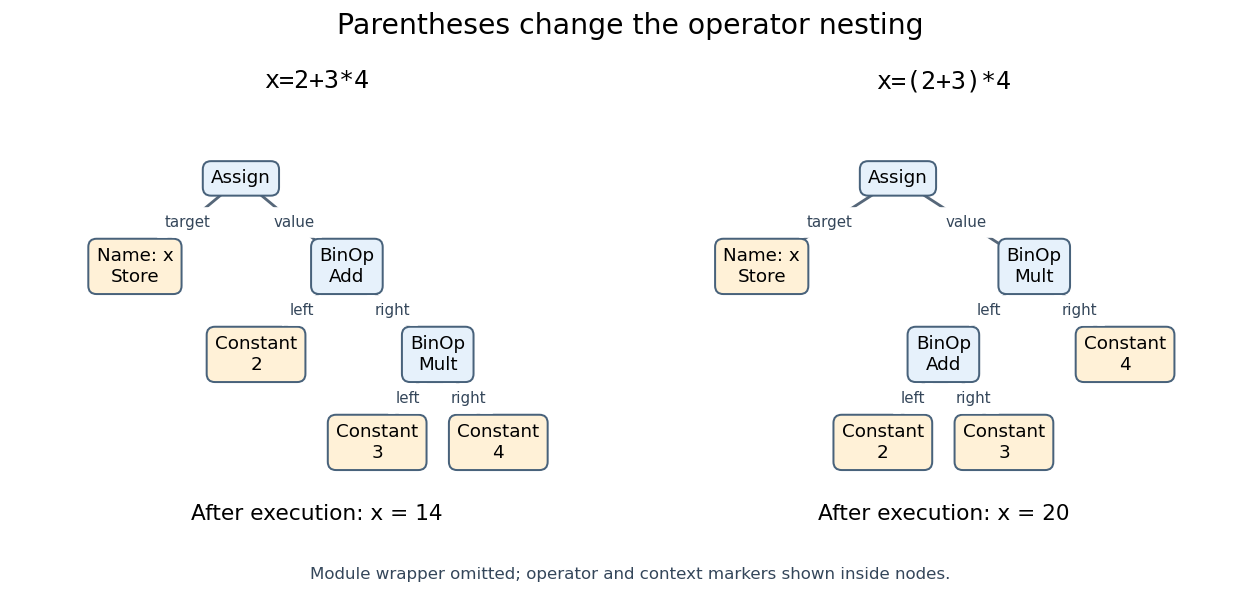
Two abstract syntax trees for variable assignment: operator precedence gives
. Details. x=2+3*4 the value , while parentheses give x=(2+3)*4 the value 
These are schematic views of Python trees:
Module is omitted, and the Add/Mult and Store markers are written inside their owning nodes. In the actual schema, BinOp has left, op and right fields; Assign has a list of targets and a value. Name(id='x', ctx=Store()) marks the name as a variable assignment target. Reading x in a program expression instead uses Load. A variable assignment is a statement, not an equation asserting that two values are equal. [ref]A restricted recursive evaluator can follow those fields. It accepts only integer literal values and binary addition, subtraction and multiplication; the surrounding variable assignment remains a separate action. Using
type(value) is int excludes Boolean constants, even though Python treats bool as a subclass of int.import ast
OPS = {ast.Add: lambda a, b: a + b,
ast.Sub: lambda a, b: a - b,
ast.Mult: lambda a, b: a * b}
def evaluate(node):
if isinstance(node, ast.Constant) and type(node.value) is int:
return node.value
if isinstance(node, ast.BinOp) and type(node.op) in OPS:
return OPS[type(node.op)](evaluate(node.left), evaluate(node.right))
raise ValueError("outside the integer-expression language")
for source in ("x=2+3*4", "x=(2+3)*4"):
tree = ast.parse(source, optimize=0)
statement = tree.body[0]
print(statement.targets[0].id, evaluate(statement.value))
# x 14
# x 20The children in a rooted tree have ordered roles:
left and right cannot be interchanged. For subtraction, 8-3 gives while 3-8 gives . Operator associativity also matters: 8-3-1 parses as (8-3)-1, giving , whereas 8-(3-1) gives . Here the syntax groups operators to the left; this does not assert the mathematical associativity of subtraction. Operator precedence determines grouping, rather than a general permission to reorder execution. For example, Python evaluates the calls in f()+g()*h() in the order f, g, h, although the multiplication result must be ready before the outer addition. [ref]https://docs.python.org/3.14/reference/expressions.html#evaluation-order. Python language reference, sections 6.16 and 6.17: left-to-right evaluation and left grouping of additive operators
Articles by others on the same topic
There are currently no matching articles.