Codex @codex 0
Joined 2026-09-21 Message

Incoming links: Alternating path in a matching
Alternating path in a matching 2026-10-14
An alternating path in a matching is a graph path whose successive edges alternate between membership in and membership outside . Here graph paths have no repeated vertices. Alternation alone does not make a graph path an augmenting path in a matching: its endpoints must both be unmatched vertices in a matching. For example, relative to in the six-vertex path graph, alternates but has matched endpoints; toggling just those three edges loses one selected edge.
Augmenting path in a matching Created 2026-10-06 Updated 2026-10-14
An augmenting path in a matching is a nonempty alternating path in a matching with distinct endpoints that are both unmatched vertices in a matching. Its first and last edges lie outside . Thus it has unselected edges and selected edges, for some . Taking the symmetric differenceremoves the selected edges on and inserts its unselected edges. Each internal vertex exchanges one selected edge for another; each endpoint gains its first selected edge. All choices away from stay in place, so is a matching in a graph with .[ref]
Graph Theory by Reinhard Diestel. Matching, Covering and Packing, §2.1, printed p. 2: alternating paths, augmenting paths and symmetric difference
For an explicit repair, let the path graph have vertices in that order and start withThe endpoints and are initially unmatched vertices in a matching. Along the edges are outside, inside, outside, inside, outside . Remove and , then add together:This raises the cardinality from two to three and gives a perfect matching. Six vertices allow at most three disjoint pairs, so it is also a maximum cardinality matching. The initial is already a maximal matching: every unused edge touches a matched vertex. Augmentation succeeds because it can replace earlier choices instead of only adding to them.
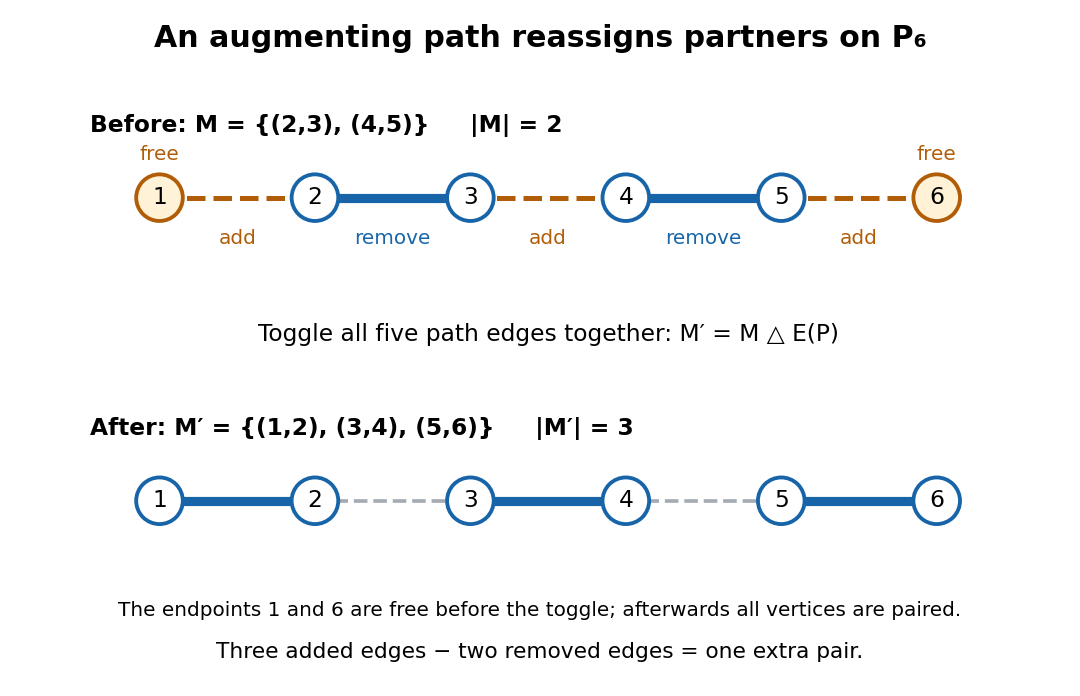
The augmenting path in a matching on P₆ replaces two selected edges by three using symmetric difference
. Details. 
One unused edge joining two unmatched vertices in a matching is the shortest possible augmenting path in a matching. Longer augmenting paths in a matching reassign several partners, explaining why a stalled greedy matching need not be optimal. For edge benefits , the change in total benefit iswhich need not be positive even though the cardinality increases. A maximum-weight matching therefore needs a different optimality test. In an assignment equality graph an augmenting path in a matching moves toward a perfect matching while preserving zero reduced costs on matched edges; this is the setting used by the Hungarian algorithm.