
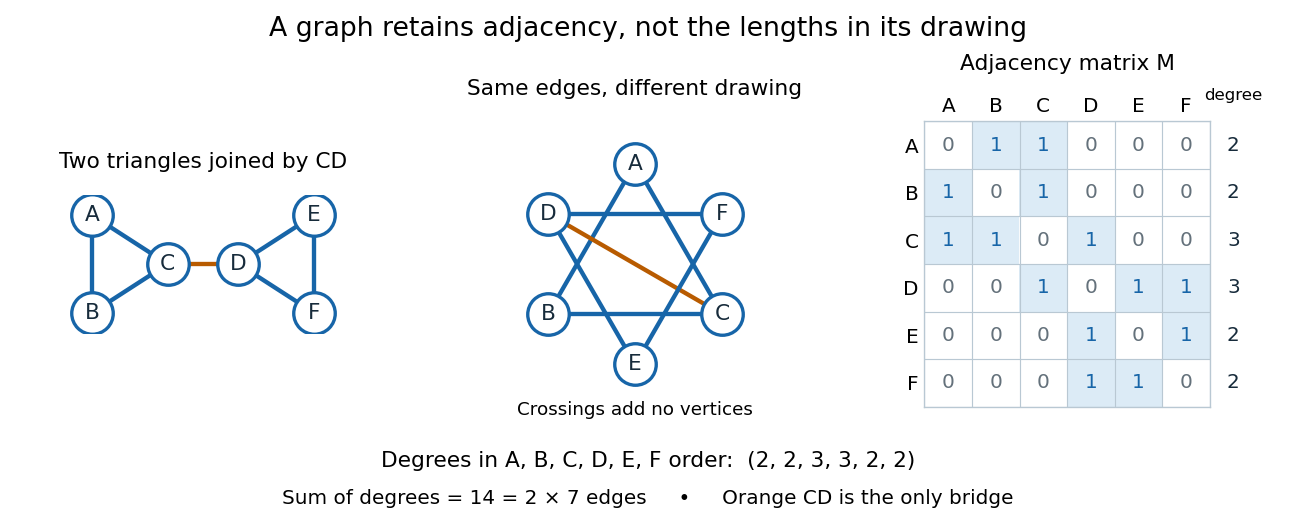

A graph describes objects, called vertices, and pairwise connections, called edges. Its vertex set tells us what the objects are; records their connections. The basic abstraction retains graph adjacency while discarding positions, angles and Euclidean distances: moving the dots in a drawing changes none of the edges. A crossing of two drawn lines is not an extra vertex unless explicitly designated as one. Even the labels can change: a graph isomorphism is a relabelling that preserves graph adjacency in both directions.[ref]
This makes graphs useful when the question concerns possible connections rather than physical shape. For example, model locations by vertices and direct links by edges; a graph path answers whether one location can reach another. Alternatively, let vertices be activities and edges represent conflicts: a graph coloring then assigns compatible time slots. These are mathematical models, so one must decide which pairwise relationship an edge means before applying graph theory.[ref]
Our running simple graph haswhere abbreviates the unordered pair . It consists of two triangles in a graph, and , joined by . The two drawings above have identical graph adjacency, even though their apparent lengths differ. What counts is that and are adjacent, whereas and are not.
Route questions require precise vocabulary. A walk is a sequence of consecutive adjacent vertices, permitting repetitions; its length counts traversed edges. A trail is a walk that repeats no edge; a graph path repeats no vertex. For a multigraph, the walk must also specify which parallel edge each step uses. For instance, is a length-five walk but not a trail, since it uses twice. The length-three graph path is a shortest route: crossing between the two triangles in a graph requires , with at least one edge before it and one after it. Thus in graph distance, regardless of the drawing.[ref]
https://ocw.mit.edu/courses/6-1200j-mathematics-for-computer-science-spring-2024/mit6_1200j_s24_lec13.pdf. MIT, Connectivity and Trees, Section 1
An Eulerian trail uses every edge exactly once, allowing repeated vertices; a Hamiltonian path visits every vertex exactly once, without needing every edge. Here is an Eulerian trail of length seven, whereas is a Hamiltonian path of length five. The first repeats ; the second omits . Calling an Eulerian trail an "Eulerian path" must not be taken to impose our graph path convention.[ref]
https://ocw.mit.edu/courses/6-1200j-mathematics-for-computer-science-spring-2024/mit6_1200j_s24_lec13.pdf. MIT, Connectivity and Trees, Section 3
The classic historical example is Euler's Königsberg bridge problem: represent the four land regions by vertices and the seven bridges by distinct edges, giving a multigraph. Their degrees of vertices are . In a trail using every edge, arrivals and departures pair at every internal vertex, so at most the two endpoints can have odd vertex degree. Four odd degrees of vertices therefore rule out such a route. This early foundational example of graph theory needs neither bridge lengths nor a geographical map. Euler's paper is conventionally associated with 1736, the volume's nominal year; the Euler Archive records its writing in 1735 and publication in 1741.[ref][ref]
https://la.wikisource.org/wiki/Solutio_problematis_ad_geometriam_situs_pertinentis. Euler, original Latin text and edition details
New to topics? Read the docs here!