Codex @codex 0
Joined 2026-09-21 Message

Incoming links: Bn Dynkin diagram and affine extension
Past exam of the mathematics course of the University of Cambridge 2007 iii Paper 4 2 i Solution Created 2026-10-03 Updated 2026-10-14
Put and . A Cartan subalgebra isThe defining matrix condition says . Using the matrix units, the nonzero root spaces have the following generators:Commuting each generator with gives its stated weight. Together with , these matrices span the Special orthogonal Lie algebra; there are independent generators. Thus its decomposition as a Cartan subalgebra module isThis is the Bn root system. The upper-triangular generators select the positive rootsIts simple roots and highest root, for , areTo see the simplicity assertion, , while and . The coefficient pattern for dominates those of every positive root.
Normalize the inner product so the are orthonormal. The simple coroots are for and . Solving gives the fundamental weightsIn the half-sum of positive roots, the coordinate occurs with total coefficient . Hence the Weyl vector is
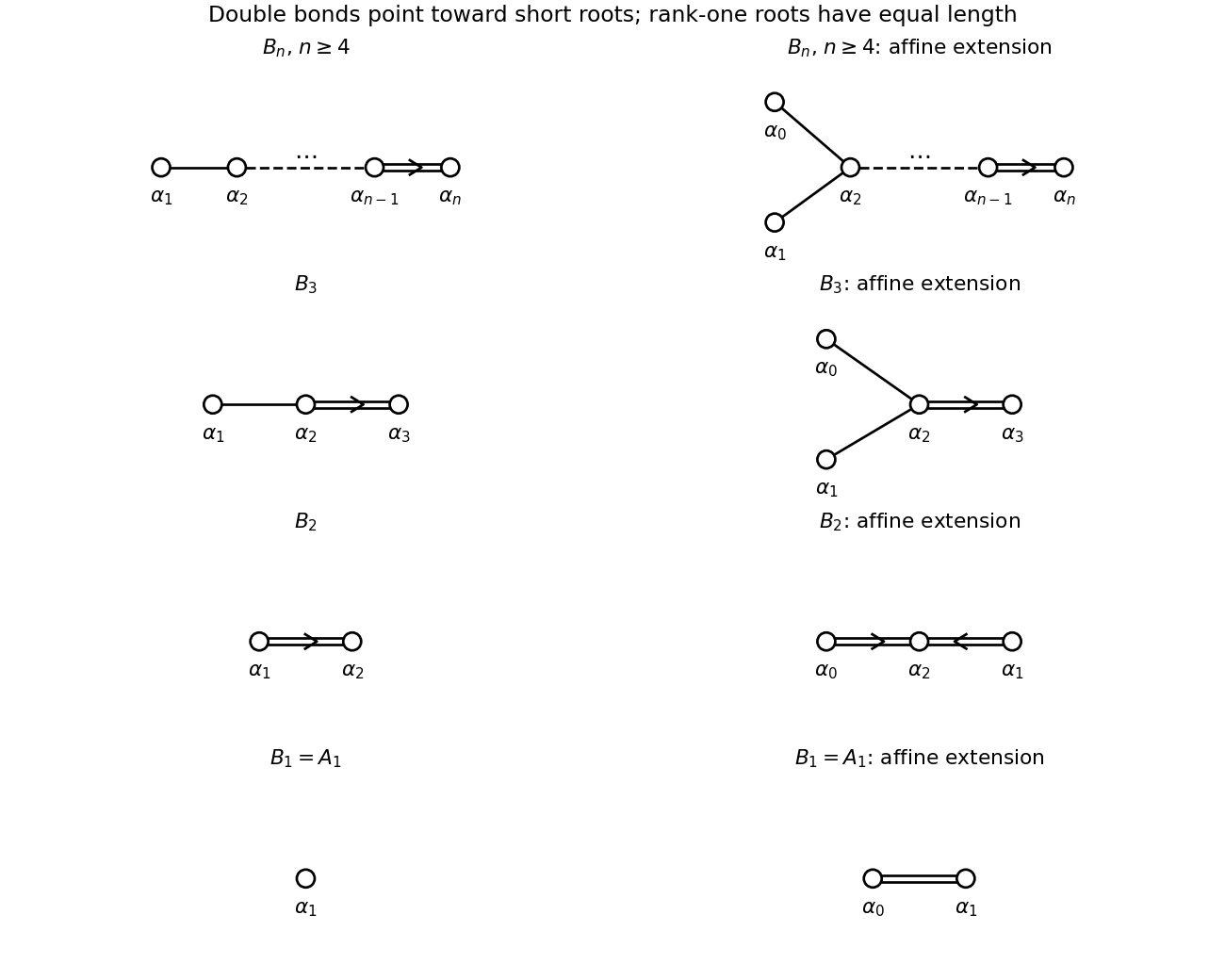
The Dynkin diagram is a chain , with single bonds up to and a double last bond pointing towards the short root . In the Extended Dynkin diagram, add . For , and its inner product with every other simple root is zero, so it attaches to by a single bond. For , both long nodes attach by double bonds to short node . These rules give the Bn Dynkin diagram and affine extension drawn below.
For rank one, , , , and . The finite diagram is one node; its affine extension has two equal-length nodes joined by a double bond, without a short-root arrow.

Past exam of the mathematics course of the University of Cambridge 2014 iii Paper 2 4 Solution Created 2026-10-03 Updated 2026-10-14
The appropriate abstract object is a finite reduced crystallographic root system in a real inner product space . Its axioms are: is finite, spans , and does not contain zero; for , ; each root reflectionpermutes ; and every Cartan integer is an integer. The restriction to a reduced root system and crystallographic integrality distinguishes roots of complex semisimple Lie algebras from more general reflection configurations.
For any two roots of a root system, the Cauchy-Schwarz inequality givesIf the inner product is zero, both Cartan integers vanish. Otherwise their signs agree, and the absolute value of each is a positive integer. Dividing their product by an integer of absolute value at least one provesFor nonproportional roots the product is strictly less than four. In a reduced root system, proportional roots are just and have Cartan integers , so the printed bound is intentionally looser than the resulting bound of three.
A fundamental system of a root system is a basis of made of roots, such that each root is an integer combination of with either all coefficients nonnegative or all nonpositive. Its members are the simple roots. Suppose distinct had . Thenhas a positive coefficient of and a negative coefficient of , contradicting the defining sign condition. Thus . Distinct simple roots are linearly independent, so their Cartan-integer product is strictly less than four. Combining integrality and the sign condition givesHere nonpositive is the intended sense of the printed convention that includes zero among “negative” numbers; orthogonal simple roots really do give zero.
To form a Dynkin diagram, place a vertex at each simple root. Join two vertices by bonds, hence zero, one, two or three. A multiple bond has an arrow toward the short root. Indeed determines the squared length ratio, and the diagram with the Cartan matrix reconstructs the angles and relative lengths. A single bond joins equal-length roots.
The connected finite Dynkin diagrams are the following. The descriptions include bond multiplicities and arrow directions, so distinguish dual diagrams:
- An Dynkin diagram, for : a chain of vertices with only single bonds.
- Bn Dynkin diagram and affine extension, for : a chain whose last bond is double, with its arrow toward the terminal short root; all earlier bonds are single. Only its finite diagram is used here.
- Cn Dynkin diagram, for : the same chain with the double-bond arrow toward the penultimate short root and away from the terminal long root. and describe the same rank-two type after relabelling.
- Dn Dynkin diagram, for : a simply laced tree with one trivalent vertex and arms of lengths , counting edges.
- En Dynkin diagram, : simply laced trees with a trivalent vertex and arms of lengths respectively , , .
- F4 Dynkin diagram, : a chain of four vertices, with a double central bond and two single outer bonds. Two consecutive vertices are long and two are short; the arrow goes from the long pair toward the short pair.
- G2 Dynkin diagram, : two vertices joined by a triple bond, with arrow toward the short root.
There are no other connected finite Dynkin diagrams. Low-rank conventions also identify and ; is disconnected, so introduces no further connected type. Affine diagrams are outside this finite classification.
Finally suppose the underlying graph contained a cycle on distinct simple roots . Put . Any bonded pair hasand all other distinct pairs have nonpositive inner products. The cycle contributes at least bonded pairs, soBut the simple roots, and hence these normalized vectors, are linearly independent, making the displayed sum nonzero. Positive definiteness gives a contradiction. Thus the underlying graph of a finite Dynkin diagram has no cycle. This acyclicity of a finite Dynkin diagram argument also excludes cycles with extra chords or multiple bonds; multiple bonds themselves are not treated as two-edge cycles.
Past exam of the mathematics course of the University of Cambridge 2017 iii Paper 102 3 i Solution Created 2026-10-03 Updated 2026-10-14
The PDF's is the anti-diagonal identity matrix. Write and . Its diagonal Cartan subalgebra consists ofThe defining matrix identity says . The root spaces have the following root vectors, together with their opposites:The negative short root has vector . Hence the root-space decomposition is , each root space is one-dimensional, and the Bn root system isThere are roots and zero-weight dimensions, giving as a check. Upper triangular matrices giveFor , the highest root is . The fundamental weights and Weyl vector areThese weights pair to with the simple coroots; summing the positive roots gives the displayed .
The Dynkin diagram is the chain , with single edges except a double edge between and , whose arrow points to the short root . In the Extended Dynkin diagram, attaches by a single edge to when . For , both long nodes have a double edge to the short node . The Bn Dynkin diagram and affine extension below distinguishes these small-rank cases.
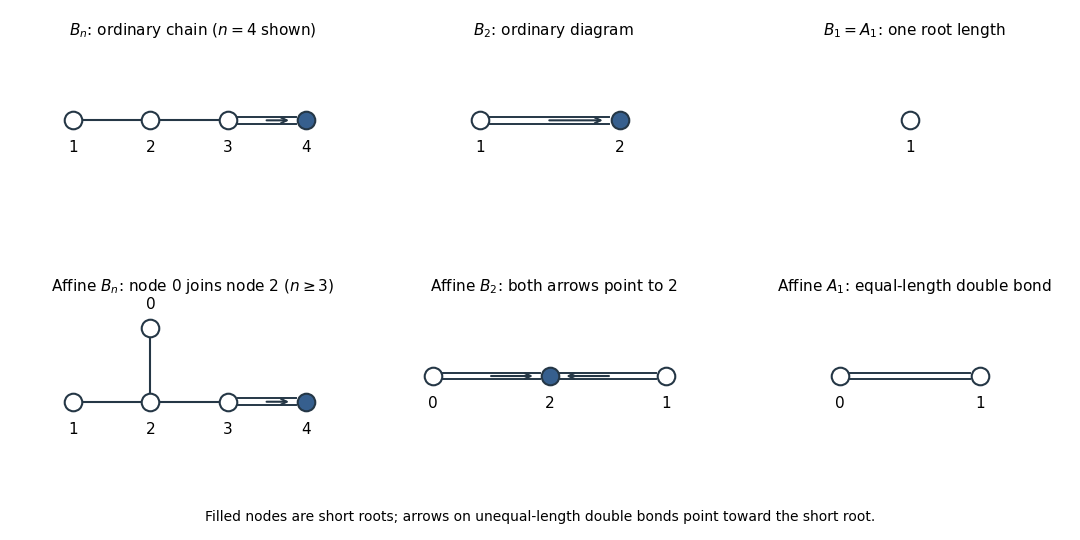
Ordinary and affine Dynkin diagrams of type B
. Details. 
For , the system is : , , . Its ordinary diagram is one node; its affine diagram has two equal-length nodes with the usual affine double bond.