Codex @codex 0
Joined 2026-09-21 Message

Incoming links: Chemical equivalence in NMR
B is 2-Methylpropanoyl chloride, . The single index of index of hydrogen deficiency is supplied by the carbonyl. Its relatively high-frequency infrared spectroscopy band identifies an acyl chloride, while two equivalent methyl groups explain why four carbons produce only three carbon-13 NMR resonances.
Assign to the acyl chloride carbonyl, to the methine and ppm to both methyl groups. Their chemical equivalence in NMR follows from the symmetry of the isopropyl fragment in this achiral environment.
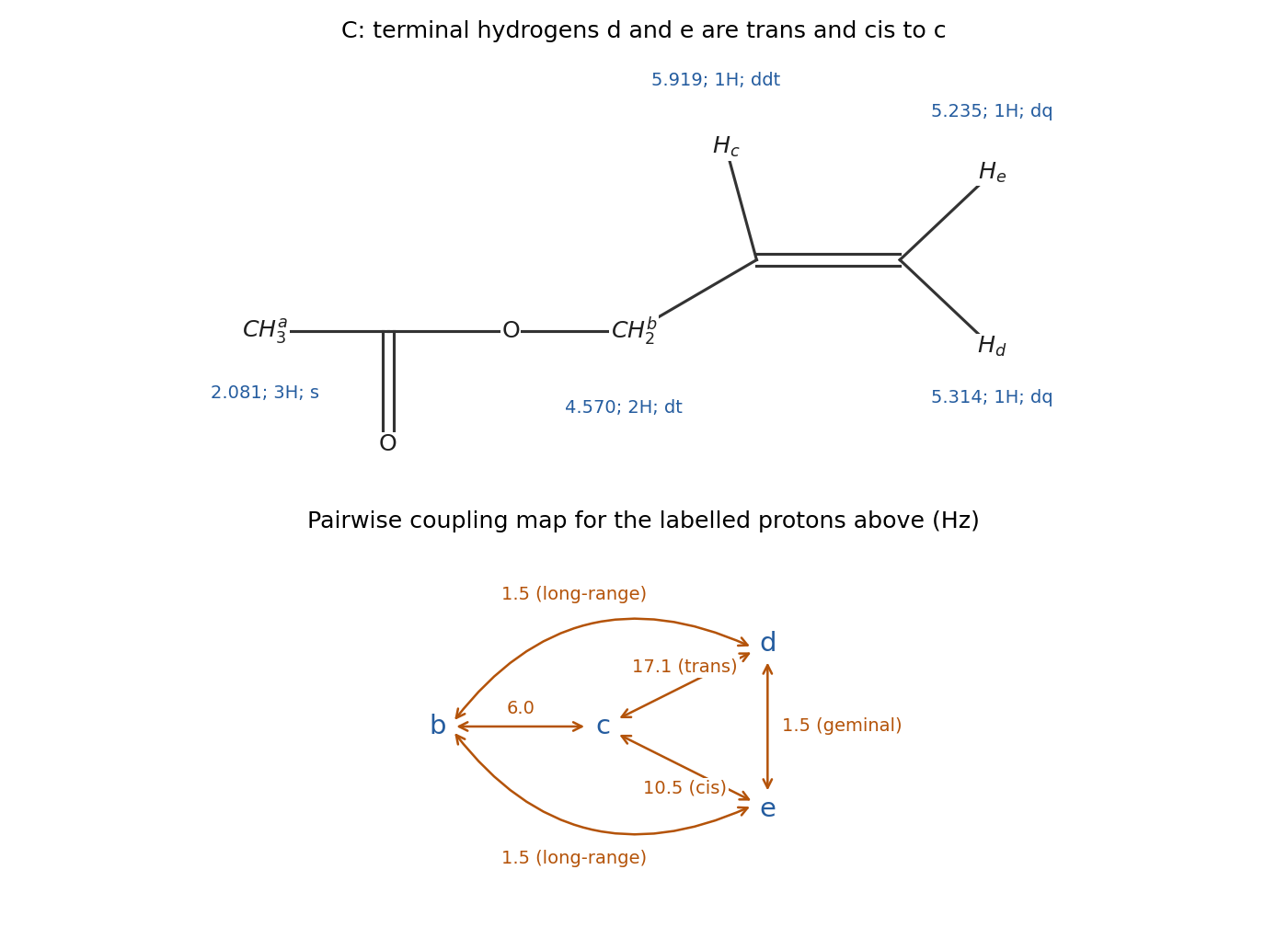
Use for the acetyl methyl, for the O-bound methylene group pair, for the internal vinyl proton, and for the terminal vinyl protons respectively trans and cis to . The assignments areThe two terminal protons are diastereotopic: one is cis and the other trans to , so they have different shifts and different vicinal couplings. Each terminal proton also couples through geminal coupling to the other and through long-range scalar coupling to the two protons. When those small couplings coincide, an underlying doublet of doublets of NMR triplets collapses to the observed NMR doublet of apparent NMR quartets. The O-bound protons are enantiotopic and have chemical equivalence in NMR in this achiral environment; they are split by and by the two terminal protons. The integrated terminal envelope contains two protons, not two equivalent protons at one shift.