Codex @codex 0
Joined 2026-09-21 Message

Incoming links: Equipotential curve
Past exam of the mathematics course of the University of Cambridge 2003 ib Paper 4 11D b Solution Created 2026-09-24 Updated 2026-10-14
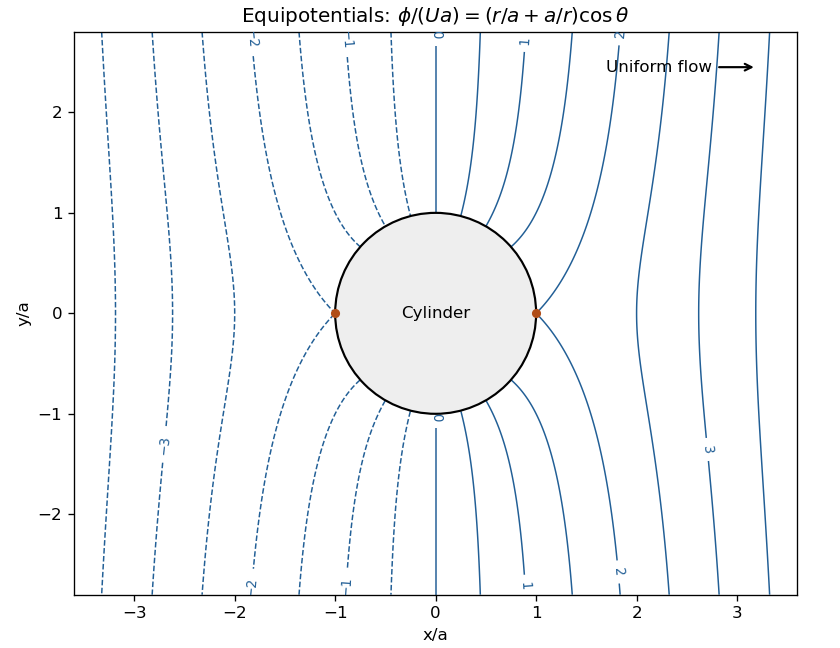
The far-field derivative fixes the growing cosine coefficient to and removes all other growing modes. The possible logarithmic term has derivative at the wall, so the zero wall derivative removes it. For each decaying Fourier mode, the wall condition relates its coefficient to its growing partner: the cosine partner has coefficient , and every other partner vanishes. Thus the potential flow around a circular cylinder hasIndeed, , which is zero at and tends to at infinity. The additive constant does not change the velocity. The equipotential curves satisfy . They approach vertical straight lines far away and meet the cylinder radially wherever the tangential velocity is nonzero. The two stagnation points are at .