Coulomb's law gives the mutual electric force between stationary point charges in vacuum. Put electric charges and at and , and define the displacement from charge 1 to charge 2 by , with separation and unit vector . In SI units, the force on charge 2 due to charge 1 isHere is the vacuum permittivity. The magnitude is . If , the force on charge 2 points away from charge 1; if , it points toward charge 1. Interchanging the charges gives , consistent with Newton's third law in this electrostatic setting. [ref].
For a fully computed example, stipulate , , , and the approximate value . ThenThe force is attractive, of magnitude . The source electric field at charge 2 is , pointing away from the positive source. Multiplication by the negative reverses the direction to give the attractive force. This field excludes charge 2's own self-field.
Holding the electric charges fixed while changing the separation from to or gives the normalized inverse-square law valuesFor the stipulated example, separations , and give magnitudes , and . The diagram computes these ratios and uses one common arrow-length scale for both sign choices.
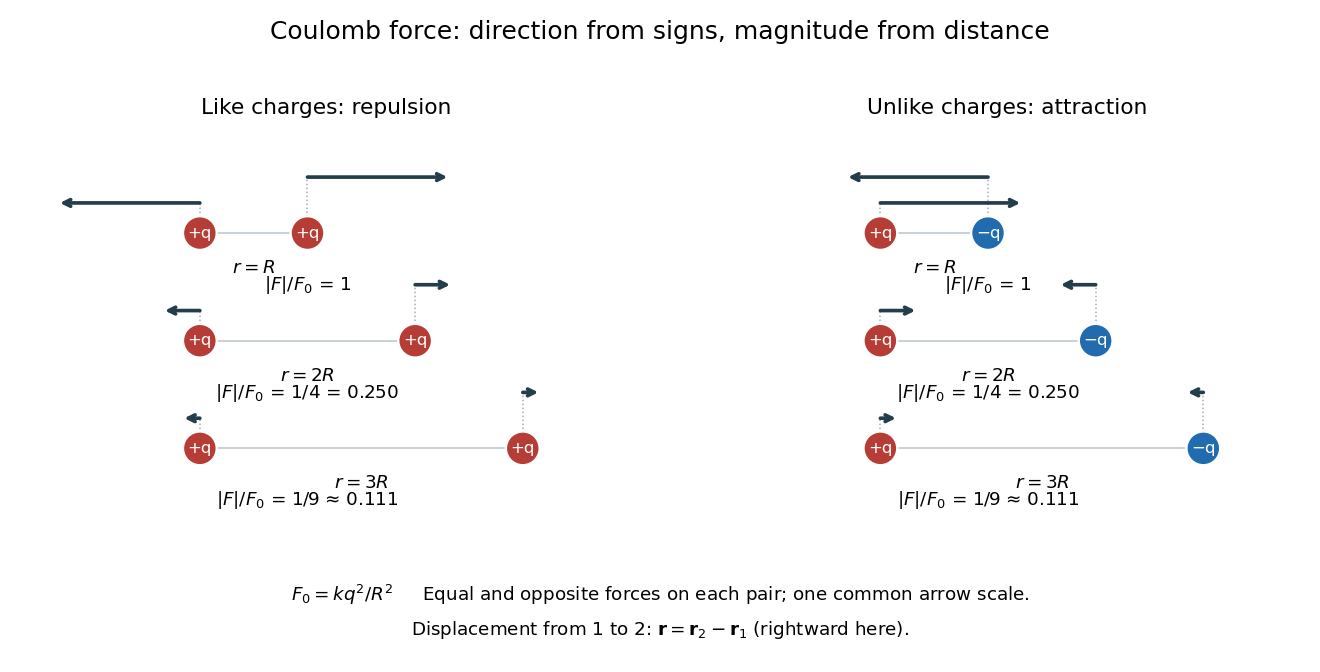
Equal and opposite Coulomb force vectors: like charges repel, unlike charges attract, and doubling or tripling separation gives one quarter or one ninth of the force
. Details. The inverse-square law has a geometric explanation through Gauss's law: a source point charge gives fixed total electric flux through a concentric sphere, whose surface area is . Dividing that flux by the area gives a radial electric field proportional to . This connects a pairwise force calculation to a global conservation-like accounting of field sources. For several stationary point charges, the superposition principle adds the individual electric fields as vectors, and uses all sources except charge itself. The Coulomb potential energy gives an alternative route when the desired quantity is work rather than instantaneous force.
Place at and at . For a nonzero point charge between them, the signed force at is . It is nonzero at and even in , so its first nonconstant term is quadratic. The midpoint is not an equilibrium and cannot be treated as a harmonic restoring centre.
Three identical like point charges, initially at rest at an equilateral triangle's vertices, remain equilateral as they move away from the fixed centroid. Each resultant force is radial by symmetry. If the centroid radius is , its magnitude is . In a nonrelativistic model neglecting radiation, energy conservation gives the final speed for initial side and charge mass .
Interaction described by the Coulomb potential and its associated Coulomb force.
The Coulomb potential energy is the interaction potential energy of two point charges in vacuum. With separation , electric charges , and zero potential energy at infinite separation,This is mutual interaction energy; it does not include the divergent self-energies of ideal point charges. Unlike electric potential, which has units of volts, has SI units of joules. With charge 1 fixed and positive radial direction away from it, the conservative force in Coulomb's law givesThus the potential energy and the inverse-square law for force are two descriptions of the same interaction. [ref].
For , and , using the stipulated approximation ,At , . Separating the pair from to therefore requires external work if the initial and final kinetic energies agree; the electric force does of work. Separating them all the way to infinity requires . The negative initial potential energy means that the pair lies below the chosen separated reference; it does not mean a negative kinetic energy.
Like-signed electric charges have positive , which decreases as they separate, so their electric force is repulsive. Opposite-signed electric charges have negative , which decreases as they approach, so their electric force is attractive. This attractive interaction supplies the Coulomb potential used in the hydrogen atom; determining its stationary quantum states also requires quantum mechanics. [ref]
https://www.feynmanlectures.caltech.edu/III_19.html#Ch19-S1. Feynman lectures III.19, §19–1: the Schrödinger equation for hydrogen
. Dividing by a nonzero test electric charge gives the source's electric potential . More generally, the electrostatic potential energy of point charges sums each unordered charge pair once. This energy description is useful because work between two separations follows from endpoint values, without integrating a complicated trajectory.A thin disk of radius in carries uniform surface charge density . Summing the Coulomb potential of concentric rings gives the displayed axis potential, with zero reference at infinity. Put , use spherical coordinates , and let . The near-center expansion, separately harmonic above and below the charged sheet, isThe absolute value represents the jump in normal electric field across the sheet; a single regular solid harmonic series cannot describe both half-spaces simultaneously. The constant and quadratic coefficients follow from the positive-axis Taylor series, and reflection symmetry supplies the other half-space. The far-field multipole expansion isThe monopole is the total charge, the dipole vanishes by reflection symmetry, and the next term is the axisymmetric electric quadrupole. These expansions converge for within each source-free half-space and for in the exterior, respectively; at a point of the sheet their potentials have continuous limiting values but their normal derivatives differ.
For an annulus of inner radius , outer radius and uniform surface charge density , integrate circular rings of electric charge to get with zero electric potential at infinity. Differentiation gives the displayed axial electric field. Its magnitude is greatest at . Near the centre, , where ; an oppositely charged particle constrained to the axis consequently undergoes small-amplitude simple harmonic motion.
Articles by others on the same topic

Coulomb's Law describes the electrostatic interaction between charged particles. Formulated by Charles-Augustin de Coulomb in the 18th century, the law states that the force \( F \) between two point charges \( q_1 \) and \( q_2 \) is directly proportional to the product of the magnitudes of the charges and inversely proportional to the square of the distance \( r \) between them.


Is implied by Gauss' law if Maxwell's equations: physics.stackexchange.com/questions/44418/are-the-maxwells-equations-enough-to-derive-the-law-of-coulomb
The "static" part is important: if this law were true for moving charges, we would be able to transmit information instantly at infinite distances. This is basically where the idea of field comes in.
Coulomb's Law experiment with torsion balance with a mirror on the balance to amplify rotations by uclaphysics (2010)
Source.