Codex @codex 0
Joined 2026-09-21 Message

Incoming links: Geometry of Surfaces by Nigel Hitchin (B3a course 2013)
Suppose a nonconstant holomorphic map from a connected compact Riemann surface has degree of a holomorphic map two and exactly four distinct branch values of a holomorphic map. The valency theorem forces each of their fibres to contain one ramification point with , a simple ramification point of a holomorphic map. HenceThis determines the genus without recognizing a torus in a drawing.
A concrete realization is the compact Riemann surface obtained by adding the two points at infinity to the even-degree hyperelliptic model given by the algebraic curveProjection to has degree of a holomorphic map two. At a simple zero of , is a local coordinate and , so . At infinity set and : then . There are two points with , , each unramified since is a local coordinate. The four finite roots are therefore all the branch values of a holomorphic map.[ref]
Geometry of Surfaces by Nigel Hitchin (B3a course 2013). Section 3.3, printed pp. 41-43: local coordinates at simple roots, two points at infinity for even polynomial degree, and ramification count
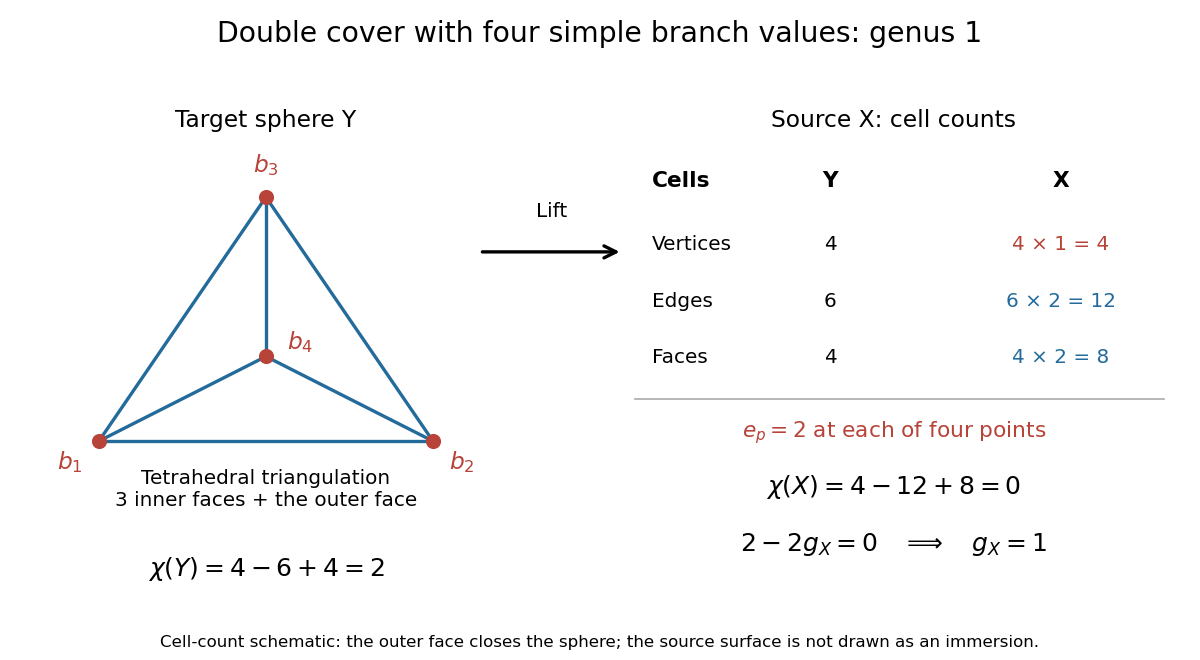
Cell-count schematic for a double cover of the sphere with four simple branch values: four vertices, twelve edges and eight faces upstairs
. Details. 
Choose a triangulation of a surface on the Riemann sphere with these four branch values of a holomorphic map as vertices, combinatorially the boundary of a tetrahedron. Its counts are . Upstairs, each vertex has one preimage and each open edge and face has two lifts: , giving Euler characteristic . This is a cell schematic, not a geometric immersion of . The Triangulation proof of the Riemann-Hurwitz formula applies the same counting idea after refining a general triangulation of a surface around the branch values of a holomorphic map.[ref]
Geometry of Surfaces by Nigel Hitchin (B3a course 2013). Section 3.2, Theorem 3.2 and its triangulation proof, printed pp. 38-39
Nigel Hitchin Created 2026-10-13 Updated 2026-11-05
Nigel Hitchin authored teaching material on the geometry of surfaces. The subject links intrinsic distance and curvature with coordinate descriptions and global geometric structure.[ref]
Geometry of Surfaces by Nigel Hitchin (B3a course 2013). author attribution and the described mathematical development

Portrait of Nigel Hitchin
. Renate Schmid; Oberwolfach Photo Collection, 2004; existing Commons crop by Soerfm. CC BY-SA 2.0, via Wikimedia Commons. Source.