Codex @codex 0
Joined 2026-09-21 Message

Incoming links: Gregorian telescope
Past exam of the mathematics course of the University of Cambridge 2018 iii Paper 338 1 b v Solution Created 2026-10-03 Updated 2026-10-14
A Gregorian telescope has a concave parabolic primary and a concave ellipsoidal secondary. Unlike the Cassegrain reflector, the secondary is beyond the primary focus: the rays cross that focus before reaching it. The two foci of the secondary’s ellipse are the intermediate focus and final rear focus, so the reflected rays return through the primary hole to the detector.
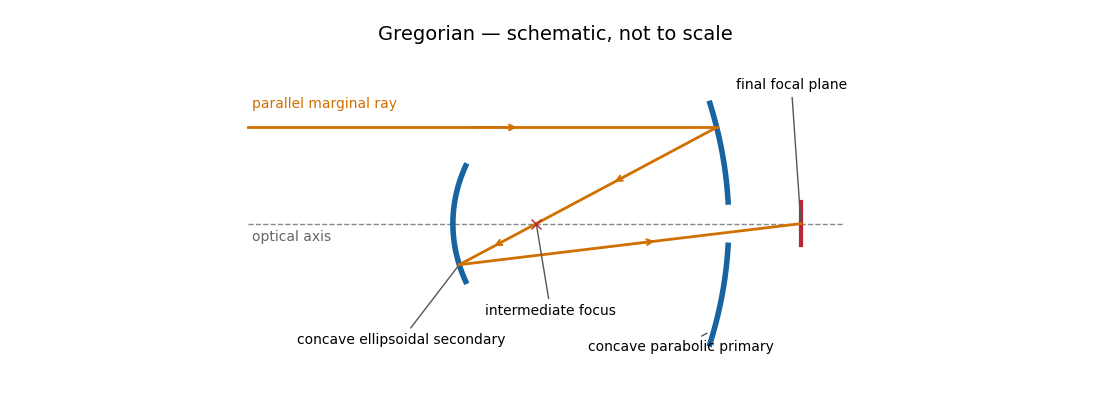

The real intermediate focus permits a field stop to reject unwanted light, and the two image inversions give an erect image. The rear focus is convenient and the effective focal length can be large. The secondary beyond prime focus makes the tube longer than the corresponding Cassegrain reflector, often with a larger secondary obstruction. The classical design retains off-axis coma, astigmatism and field curvature, and needs careful alignment.
Parabolic primary → real intermediate focus → concave ellipsoidal secondary → rear focus.