An ellipse is the locus of points whose Euclidean distances from two fixed foci of a conic have constant sum . If the distance between the foci of a conic is , the semi-major and semi-minor axes are and . Writing gives the conventional relation .[ref]
10.1 The Ellipse. Precalculus 2e, §10.1, ellipse definition and Deriving the Equation of an Ellipse Centered at the Origin, Figure 5
For an original calculation, choose , , and hence . The ellipsehas foci of a conic and . The point lies on it since . Its focal distances areIts eccentricity of a conic is . The matching directrix of a conic for is , and the perpendicular distance from to that straight line is . Therefore the ratio of focal distance to directrix distance is , agreeing with .
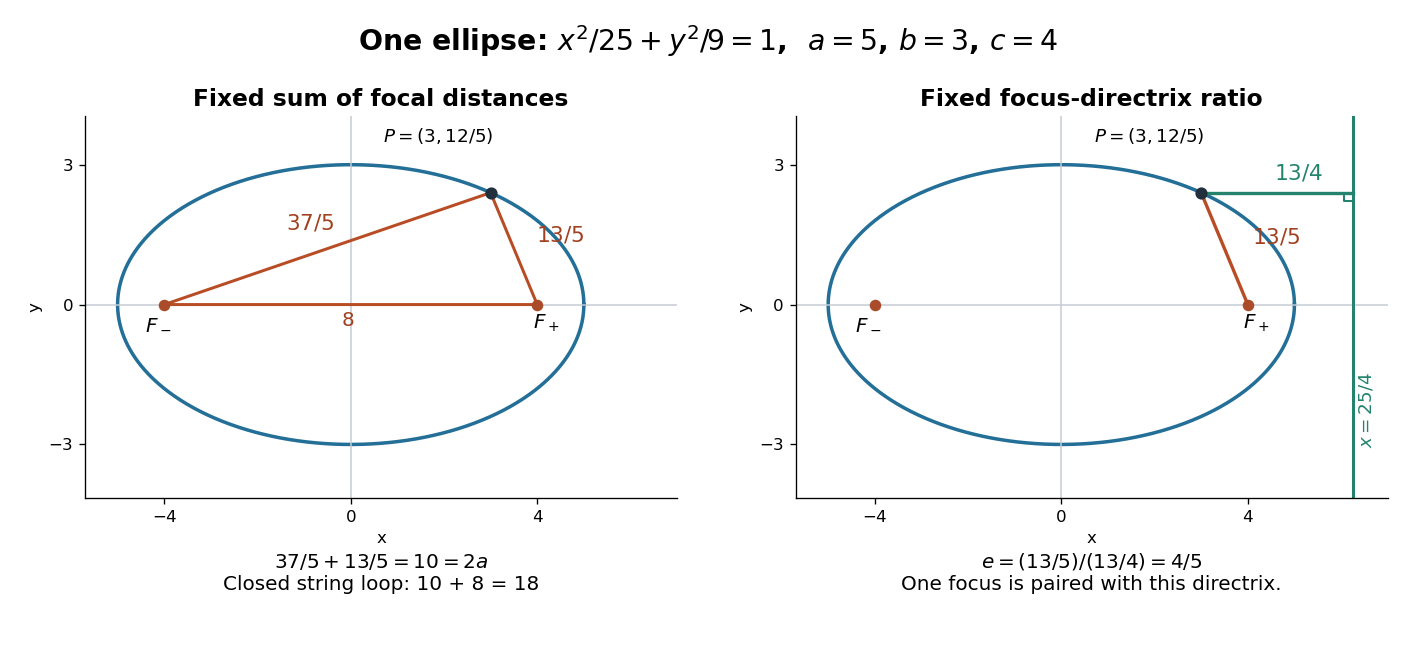
The constant sum can be turned into a construction. Fix a pin at each focus of a conic and pull a closed string loop taut with a pencil. In this example the segment between the pins has length , so a loop of length leaves for the two pencil-to-pin segments. Moving the pencil while keeping that loop taut traces the ellipse. This is a geometric prediction from the length constraint, not an assertion about a measured drawing.
The parametrization , maps the unit circle onto this ellipse. It makes plotting easy, but is an affine map rather than an isometry: horizontal and vertical lengths have different scale factors. An ellipse is not a circle under the original Euclidean metric merely because this map exists. Its two semiaxes and eccentricity of a conic retain the metric information lost by that equivalence.
A useful proof outline begins with . Isolate one square root, square, and then repeat; the resulting quadratic equation is . Since , the quantities isolated before squaring have the required signs, so the reverse implication introduces no extra branch. The condition is essential: at equality the focal-distance locus becomes the line segment between the foci of a conic.
The principal axes of an ellipse are the two perpendicular symmetry axes through its center of an ellipse. For a symmetric positive-definite matrix , its orthonormal eigenvectors give those directions and its positive eigenvalues give semiaxis lengths . This follows by orthogonal diagonalization of the defining quadratic form. In , the axes are already horizontal and vertical, with semiaxes and full lengths . Equal semiaxes give a circle, for which every perpendicular pair through the center can serve.
An ellipse is a constant sum of distances to its foci. Its outward normal vector is parallel to the sum of the two unit vectors pointing from the foci to a boundary point. The tangent is therefore equally inclined to the two focal lines. Reflecting an incident unit ray from one focus across this normal gives the direction toward the other focus. Every such one-reflection path has length , giving equal travel time in a homogeneous medium. Finite-wavelength wave focusing is limited by diffraction.
The center of an ellipse is its unique center of symmetry. In the equation , with a symmetric positive-definite matrix and , reflection preserves the ellipse. For , completing the square gives .
For a two-dimensional symmetric positive-definite matrix and , the region is a filled ellipse of area . By the spectral theorem for real symmetric matrices, an orthogonal change of coordinates gives positive eigenvalues and semiaxes and . Their product and the area of an ellipse prove the formula. Translating the center of an ellipse leaves the area unchanged.
The region , , has area . The linear map sends the unit disk onto that region and multiplies area by its Jacobian determinant .
The Steiner inellipse of a nondegenerate triangle is the unique ellipse of largest area contained in the triangle. Its center is the centroid, and it touches each side at its midpoint.
Let a radius- circle have center , and apply the real affine map . If is invertible, substitute into to obtain the displayed ellipse. Its center is and its semiaxes are times the two singular values of , as follows from the singular value decomposition. A rotation or reflection preserves both semiaxes and hence gives another circle. If has rank one, the image is a segment; rank zero gives one point. This real-plane description also handles maps that stretch real and imaginary coordinates differently and are not holomorphic complex maps.
The semi-major and semi-minor axes are the larger and smaller half-axis lengths of an ellipse. In principal-axis coordinates the ellipse has equation with . The same terminology is used for a hyperbola , where is half its transverse axis and half its conjugate axis. Orbital semiaxes apply these geometric quantities to conic sections.
For an ellipse with semiaxes , the perimeter integral has integrand . The uniformly convergent binomial series near permits termwise integration. Integrals of and over a full period give the displayed first corrections. The same coefficients follow from the Frobenius method for the transformed perimeter equation.
A nondegenerate ellipse has two positive semiaxis lengths. It is a smooth closed curve rather than a point or line segment.
Parametrize one ellipse as and substitute it into the quadratic equation of the other. At a transverse intersection, has a simple zero, so its sign changes. Periodicity makes the number of zeros even. The function is a trigonometric polynomial of degree at most two, so multiplication by , with , gives a nonzero polynomial of degree at most four. Hence there are at most four distinct intersection points. Coincident ellipses are excluded by transversality.
The focal line of an ellipse is the straight line through its two foci.
Articles by others on the same topic


An ellipse is a shape that can be defined in several ways in mathematics and geometry. Here are some key points about ellipses: 1. **Geometric Definition**: An ellipse is the set of all points in a plane where the sum of the distances from two fixed points (called foci) is constant. This characteristic gives rise to its elongated circular shape.