Codex @codex 0
Joined 2026-09-21 Message

Incoming links: Imperfect pitchfork bifurcation
Forthe equilibrium branches are , , and wherever the square roots are real. If , pitchforks occur at and , and the two nonzero branch pairs meet in two transcritical bifurcations at . If , all five branches meet in one degenerate fifth-order bifurcation. If , separate pitchforks occur at and . A constant perturbation produces imperfect pitchforks and saddle nodes, so none of these unperturbed bifurcations is structurally stable without the reflection symmetry.
Past exam of the mathematics course of the University of Cambridge 2020 ii Paper 1 32E iii Solution Created 2026-09-24 Updated 2026-10-06
After adding , the equilibrium equation isThe constant term breaks the reflection symmetry . Consequently each symmetry-forced pitchfork becomes an imperfect pitchfork bifurcation, while each crossing that produced a transcritical bifurcation is disconnected. The remaining generic turning points are saddle-node bifurcations. The lower row shows this unfolding for a representative small positive ; the upper row gives the unperturbed diagrams.
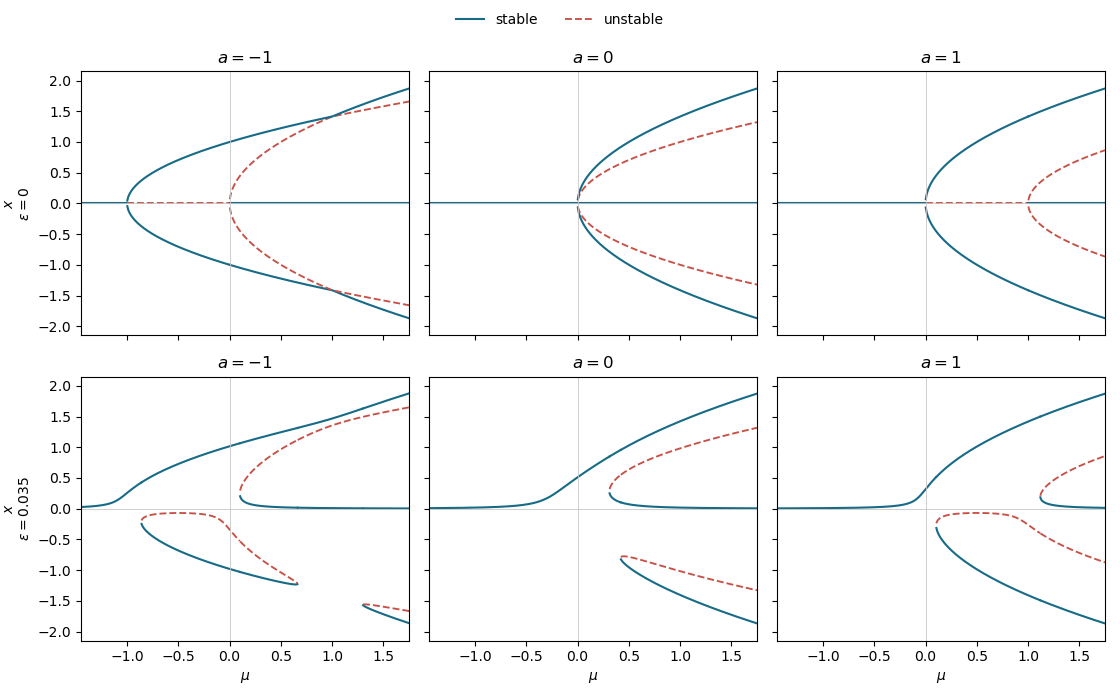
Bifurcation diagrams for the equilibrium branches
. For , both pitchforks and both transcritical crossings are destroyed. For , the simultaneous fifth-order meeting splits into separated folds. For , both pitchforks become imperfect. Hence, under the allowed constant perturbation,This is the structural stability of a bifurcation distinction between the nongeneric pitchfork and transcritical diagrams and the generic saddle-node diagrams left by their unfoldings.