
Routine outcome monitoring has made the results of IAPT services unusually visible and has created opportunities to improve care. Its benefits should be separated into three claims: measurement is more complete, the resulting information supports clinical and organisational decisions, and acting on that information improves patient outcomes. The first two do not automatically prove the third. A service can record a recovery accurately without the act of recording being its cause.
The historical IAPT programme expanded psychological treatment for depression and anxiety, using evidence-based interventions and stepped care where appropriate. Repeated measures allow a trajectory to be examined instead of relying on a clinician's general impression at discharge. Depression, general anxiety and disorder-relevant symptoms can be monitored alongside functioning and the person's own goals. A symptom questionnaire is a useful indicator, but a cutoff-based service definition of recovery is not identical to a blinded diagnostic interview or to complete restoration of everyday life.
David M. Clark and colleagues' evaluation of the Doncaster and Newham demonstration sites showed that session-by-session collection could achieve unusually complete before-and-after information in routine care. Reported recovery was about 55–56% among patients seen at least twice, and a follow-up examined maintenance beyond the last session. These prospective service cohorts demonstrated feasibility and informed implementation, but were not randomised tests of monitoring itself. Their denominator also excluded people who never progressed beyond an initial contact.[ref]
Improving access to psychological therapy: Initial evaluation of two UK demonstration sites by David M. Clark and others. Behaviour Research and Therapy 47, 910–920; Doncaster and Newham prospective service cohorts, sessional monitoring and ten-month follow-up
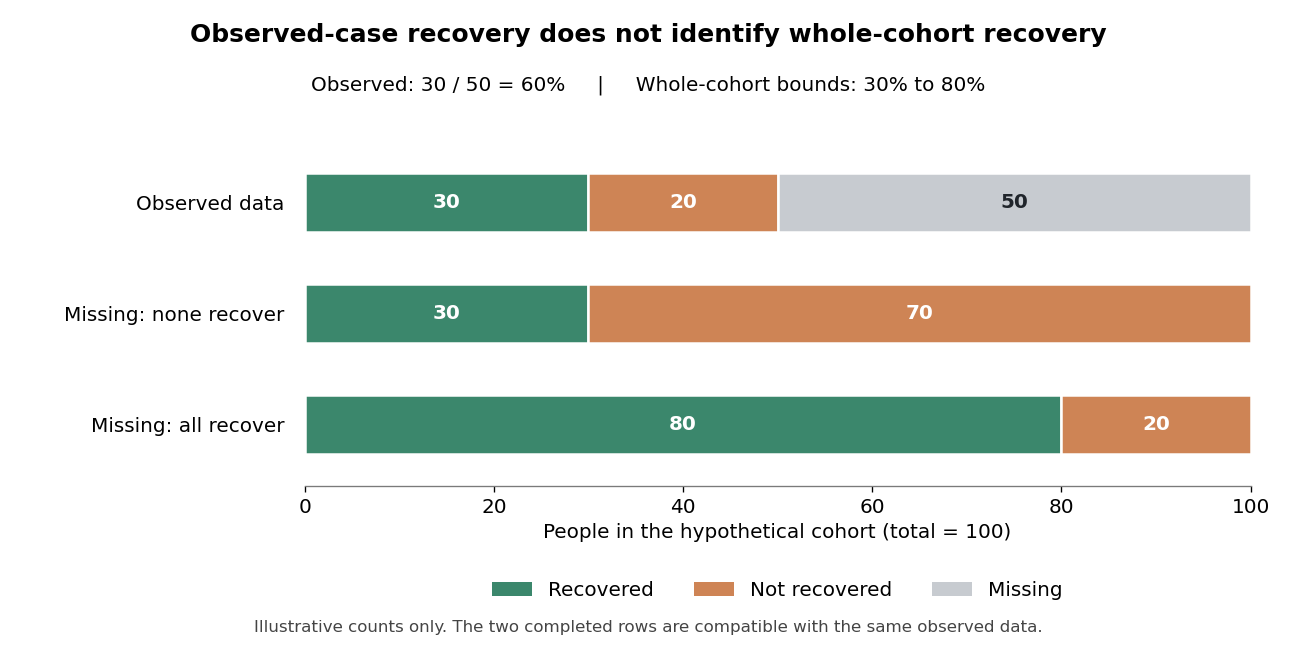
Completeness matters because selective follow-up can substantially distort apparent success. Consider a purely hypothetical cohort of one hundred baseline cases: fifty have an endpoint recorded and thirty of those meet the chosen recovery criterion. The observed-case recovery rate is 60%. If none of the fifty missing cases recovered, the whole-cohort rate is 30%; if all recovered, it is 80%. The missing-outcome bounds for a binary endpoint are sharp: both extremes fit exactly the observed data. Without assumptions or additional measurements, the observations alone cannot identify where within those bounds the cohort lies. This example is not an estimate of any IAPT service.

Sessional collection reduces dependence on a separate final questionnaire: a last available observation often exists even when a planned final appointment is missed. It does not make all missingness harmless. A last attended session can occur earlier for someone who disengages, and is not automatically equivalent to a common long-term endpoint. Outcomes should therefore be reported with clear eligibility, timing, completion and missing data definitions. Monitoring treated patients very thoroughly still does not describe those who were referred but never entered treatment.
David M. Clark and colleagues' 2018 analysis reported approximately 98% before-and-after symptom coverage among treated IAPT patients. It related public service outcomes to organisational characteristics and examined whether those characteristics also predicted changes between years. Waiting, missed appointments and the organisation of treatment were associated with outcomes; deprivation remained relevant. This made variation actionable and generated specific implementation hypotheses. Nevertheless, service-level associations and longitudinal prediction remain vulnerable to case mix, selection and unmeasured organisational differences.[ref]
Transparency about the outcomes of mental health services (IAPT approach): an analysis of public data by David M. Clark and others. Lancet 391, 679–686; 98% outcome coverage among treated patients, organisational predictors and between-year analyses
At the individual level, a visible trajectory can identify deterioration or lack of progress earlier than an end-of-treatment assessment. This provides a reason to review the formulation, barriers, intervention fidelity or level of care. It can make supervision concrete: a supervisor and therapist can examine which patients are not improving and whether the active treatment has actually been delivered. A score should initiate inquiry rather than automatically trigger a uniform decision, since transient distress, measurement error and contextual crises can change a session's result.
There is experimental evidence for an additional feedback system. Jaime Delgadillo and colleagues randomised therapists to automated outcome feedback or usual psychological treatment across eight NHS trusts. Seventy-seven therapists participated and 2233 patients were included. The system flagged people who were not on track and prompted supervisory review. Among those classified as not on track, feedback was associated with modestly better depression and anxiety outcomes, with effect sizes around 0.23 and 0.19 respectively. The trial tested feedback and its linked clinical response within services already collecting measures, not questionnaire collection versus no monitoring.[ref]
Feedback-informed treatment versus usual psychological treatment for depression and anxiety: a multisite, open-label, cluster randomised controlled trial by Jaime Delgadillo and others. Lancet Psychiatry 5, 564–572; 77 participating therapists, 2233 patients, cluster allocation and not-on-track outcomes
This distinction is central to interpreting the benefits. Data make a problem detectable; feedback makes it salient; a feasible clinical action must then address it. An alert that repeatedly identifies nonresponse without available treatment alternatives may add burden without improvement. Cluster allocation appropriately recognises that therapists change their practice across patients, while open-label delivery and quasi-random patient allocation to available therapists still qualify the causal interpretation. The modest subgroup effects should not be presented as proof that monitoring transforms every case.
At service level, routinely available outcomes support accountability, training evaluation and investigation of inequalities. Comparisons can identify where referral pathways, waiting times or treatment delivery need examination. However, unadjusted league tables can penalise services treating more complex or disadvantaged populations. Risk adjustment should be transparent and should not erase the very inequalities that require attention. Process measures, symptom outcomes, functioning and reach together give a fuller picture than one recovery percentage.
Targets can also create incentives to select easier cases, change denominators or emphasise crossing a threshold over a person's priorities. A reliable change index scales change by expected measurement error. Reliable improvement distinguishes such a change from a small numerical movement, while reliable recovery additionally considers caseness; neither removes the need to monitor deterioration and residual disability. Questionnaire accessibility, language and the validity of comparing groups require attention. Patients should understand why information is collected and how it contributes to care.
By May 2022, the clearest benefits were high outcome coverage, a transparent basis for improving implementation and a modest experimentally supported benefit from targeted feedback. Routine data had narrowed the gap between trial evidence and what services actually achieved. Further progress required responding intelligently to trajectories, preserving inclusive denominators and testing organisational changes, rather than treating measurement or a rising aggregate recovery figure as self-validating evidence of effectiveness.
Session-by-session outcome monitoring 2026-10-25
Obtaining outcome measures at successive attended sessions. It can supply a last available score when a planned final contact is missed, while differing endpoint timing and people who never enter treatment remain important limitations.[ref]
Improving access to psychological therapy: Initial evaluation of two UK demonstration sites by David M. Clark and others. Behaviour Research and Therapy 47, 910–920; Doncaster and Newham prospective service cohorts, sessional monitoring and ten-month follow-up