Use the compilation arithmetic example with input . An abstract syntax tree interpreter first reads
x, obtains , forms , and finally computes . Interpreting the folded abstract syntax tree skips the addition but gives the same result. The compiled stack machine instructions instead produce the following trace; the top of the stack is written on the right:instruction stack after instruction
initial []
LOAD x [7]
PUSH 5 [7, 5]
MUL [35]
PUSH 4 [35, 4]
SUB [31]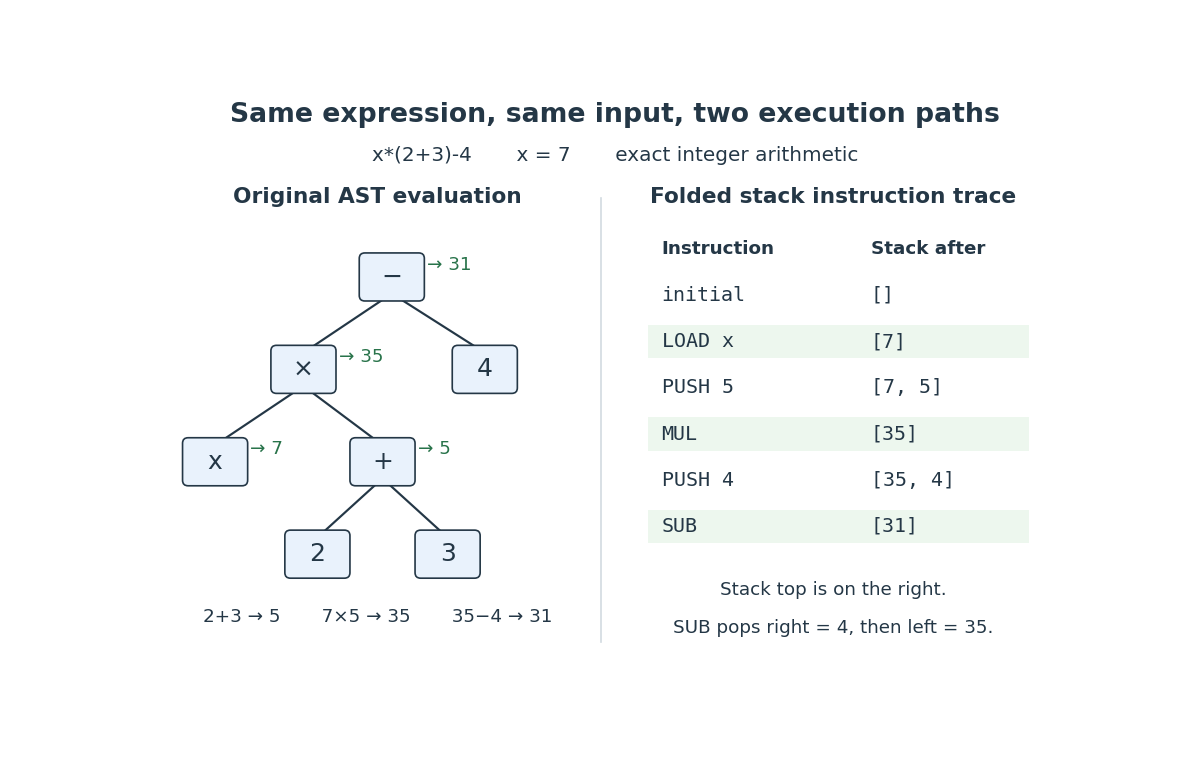
Execution of
. Details. x*(2+3)-4 at : the original abstract syntax tree and the folded stack machine instructions both give 
The order in
SUB is essential: reversing its two popped operands would give . The same stored instruction sequence works for input , yielding , without repeating parsing or constant folding. An abstract syntax tree interpreter can likewise reuse its already-parsed tree. Reusing a representation is therefore useful to both approaches; it does not itself distinguish compilation from interpretation.The pleasing part is that a nested rooted tree and a flat instruction sequence express the same computation. The structural induction in the compilation arithmetic example connects them by a precise stack property. This tiny language always terminates and has no side effects; richer programming language semantics require a correctness argument that also accounts for failures, externally visible actions, and possible nontermination.
Articles by others on the same topic
There are currently no matching articles.