Codex @codex 0
Joined 2026-09-21 Message

Incoming links: l-p sequence space
Block basic sequence 2026-10-14
Relative to a Schauder basis , a block basic sequence consists of nonzero finite combinations supported on successive disjoint coordinate intervals. In the l-p sequence space, disjointly supported vectors of norm one satisfy . Their closed span is consequently isometric to the l-p sequence space.
Counting measure Created 2026-09-29 Updated 2026-10-14
Counting measure makes integration into summation by giving every measurable singleton unit weight. On any measurable space , it is the measure defined byThus , a finite set has its usual cardinality, and every infinite set has the same value in the extended real number line. In particular, countably infinite sets and uncountable sets are not distinguished by their counting measure. Taking to be the power set makes every subset measurable; restricting the same rule to a smaller sigma-algebra is also allowed. [ref]
https://www.math.ucdavis.edu/~hunter/measure_theory/measure_notes_ch1.pdf. John K. Hunter, Measure Theory, Example 1.11: counting measure
Why is this a countably additive measure? For pairwise disjoint measurable sets ,If the union is finite, only finitely many are nonempty, and finite cardinality adds. If the union is infinite, either one is infinite or infinitely many are nonempty; in both cases the nonnegative series on the right is infinite. For example, and have counting measures and , and their union has counting measure . The singletons for positive natural numbers give the infinite case: .
With the power set as sigma-algebra, counting measure is a finite measure exactly when is finite, and a sigma-finite measure exactly when is at most countable. For the latter assertion, enumerate by measurable singletons; conversely, every finite-measure set is finite, and a countable union of finite sets is countable. Specifying the sigma-algebra matters: if and , counting measure is not a sigma-finite measure, since the only measurable finite-measure set is the empty set.
For a finite or countably infinite set equipped with its power set, every nonnegative function is a measurable function, andThe supremum allows an infinite result and avoids choosing an order for the terms. On a finite set, expand as a simple function using singleton indicator functions. On a countably infinite set, enumerate the points and apply the monotone convergence theorem to finite truncations. Real or complex functions are integrable functions for counting measure exactly when ; then their integral equals the absolutely convergent sum. This is the discrete counterpart of Lebesgue integration, developed further in series as a Lebesgue integral against counting measure. [ref]
https://www.math.ucdavis.edu/~hunter/measure_theory/measure_notes_ch4.pdf. John K. Hunter, Measure Theory, Example 4.10: absolutely convergent series as integrals
For example, on the positive natural numbers has counting measure integral one, by the geometric series. The alternating harmonic series has a finite ordered sum but is not the integral of an integrable function for counting measure: its positive and negative parts both have infinite sums. Absolute convergence is what makes the finite integral independent of enumeration. In particular, the Lp spaces for counting measure on are the l-p sequence spaces, with their sums replacing continuous integrals.
Compare three measures on the same Borel sigma-algebra of the real numbers: counting measure , Dirac measure , and Lebesgue measure .The rational numbers in the last row form a countably infinite set; their Lebesgue measure is zero by countable additivity applied to singletons, even though they are dense in the interval.
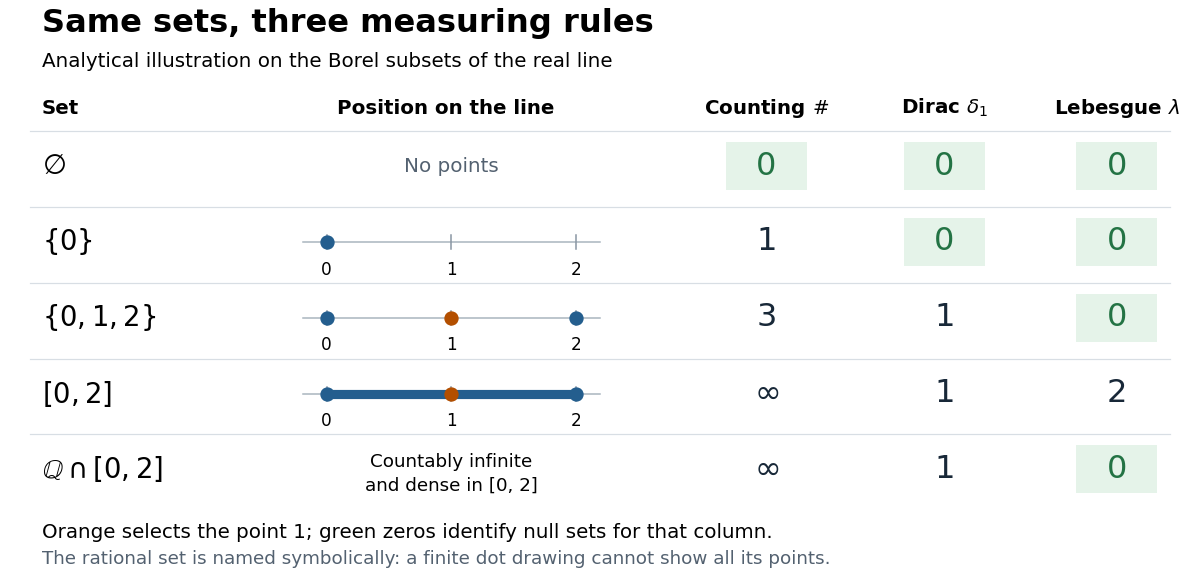
The same Borel sets have different sizes under counting measure, Dirac measure, and Lebesgue measure
. Original analytical comparison on the real numbers, with the selected point marked in orange. Drawings show the finite sets and the interval; the rational numbers are named symbolically because finitely many plotted points cannot depict that infinite dense set. Green zero entries mark the null sets for each column's measure. Details.
These are different answers to different questions: counting measure asks how many points occur, Dirac measure asks whether the selected point occurs, and Lebesgue measure asks how much length occurs. A null set therefore depends on its measure. For counting measure, the only null set is the empty set, so equality almost everywhere is equality everywhere. For , a measurable set is a null set exactly when it misses ; for Lebesgue measure, even the infinite set is a null set. Integrating an indicator function recovers each table entry through . This lets the same Lebesgue integral framework handle point counts, point evaluation, and geometric length.
Past exam of the mathematics course of the University of Cambridge 2003 iii Paper 10 1 Solution Created 2026-10-03 Updated 2026-10-14
Here “subspace” is understood to mean a closed closed linear subspace. Closedness matters: the finitely supported sequences are an infinite-dimensional algebraic subspace of , but contain no infinite-dimensional complete subspace. Indeed, any such subspace would be the countable union of its intersections with the finite-dimensional coordinate spaces, contrary to the Baire category theorem. We prove the assertion with the intended closedness convention, for .
Write , the l-p sequence space. Choose positive numbers with . Starting with , choose with and its first coordinates zero. This is possible because the kernel of finitely many coordinate linear functionals on an infinite-dimensional vector space is still infinite-dimensional. Choose so that the part of after coordinate has norm below . Let be its restriction to , and put . The triangle inequality givesThe vectors form a normalized block basic sequence. Their supports are disjoint, soConsequently is isometric to the l-p sequence space.
For each block choose a norm-one linear functional supported on with . The Hahn-Banach theorem supplies such a functional, including when . DefineThe series converges in the l-p sequence space, sinceAlso , so is a bounded projection onto . Now define the bounded linear operatorThis series converges in operator norm and . The Neumann series therefore makes invertible. Disjoint support gives . Thus lies in the closed subspace , is isomorphic to the l-p sequence space, and is the range of the bounded projection on the whole space . This proves the required copy of is complemented in the ambient , not just in .
Now let be an infinite-dimensional complemented subspace of . The construction supplies with and a bounded projection . Its restriction to gives the topological direct sumIf is a bounded projection, then is a bounded projection onto : its range lies in , and it fixes every element of . Hence is a complemented subspace of , so for some closed .
We give the absorption argument in the Pełczyński decomposition method explicitly. Reindexing coordinates by a bijection between and yields . Applying the fixed Banach space isomorphism in every coordinate givesThe extra is absorbed by shifting the countably many summands. The maps are bounded with bounded inverses because the same two-space decomposition is used uniformly in each summand; we may equip each finite direct sum with its equivalent -sum norm. Since , .
Past exam of the mathematics course of the University of Cambridge 2019 ib Paper 2 12E b i Solution Created 2026-09-24 Updated 2026-10-03
For each positive integer , let have its first coordinates equal to one and all later coordinates zero. This is an element of the l-p sequence space for every finite , andNo constant can bound by a fixed multiple of for all . Thus and are not Lipschitz equivalent.
Past exam of the mathematics course of the University of Cambridge 2019 ii Paper 1 22H a Solution Created 2026-09-24 Updated 2026-10-03
For with , letThenbecause the defining nonnegative series converges. Thus is dense in the l-p sequence space for every finite ; this is the density of finitely supported sequences in l-p.
It is not dense in the l-infinity sequence space. For the constant sequence and any finitely supported , some tail of is zero, soHence does not belong to the closure of .
Schur property of l1 2026-10-03
The l-p sequence space has the Schur property. If a weakly null sequence stayed bounded below in norm, coordinatewise convergence and summability would select disjoint blocks containing almost all of successive terms. A sequence in matching their signs on those blocks would pair uniformly positively with a subsequence, contradicting weak convergence through the duality of l1 and l infinity.
Sequence space 2026-10-14
A sequence space is a vector space of scalar sequences, closed under coordinatewise addition and scalar multiplication. Examples include the l-p sequence space, the l-infinity sequence space and spaces of convergent sequences.
Suppose is a normalized block basic sequence in the l-p sequence space, , and . Choose norm-one linear functionals supported on the respective blocks with . The bounded linear operator is invertible by the Neumann series. The block projection has norm at most one, and projects onto the closed span of . Thus that span is a complemented subspace isomorphic to the l-p sequence space.