The Banach space consists of absolutely summable scalar sequences, with norm . Its continuous dual is , under the pairing . Finitely supported sequences are norm dense, which identifies a linear functional from its values on coordinate vectors. The space of sequences converging to zero inside this dual is a norming subspace of infinite codimension.
For example, belongs to the absolutely summable sequence space and has norm one, by the geometric series formula. Merely tending to zero is insufficient: tends to zero but its series of absolute values diverges. Thus this sequence space records total absolute size, rather than just the eventual size of individual coordinates. Its completeness ensures that a Cauchy sequence in this total-error norm has an absolutely summable limit.[ref]
https://people.clas.ufl.edu/mjury/files/6617notes30nov2015.pdf. Michael Jury, MAA6617 course notes, section 20.1(b): Banach sequence spaces
Suppose the distinct complex numbers satisfy . The geometric sequences in the displayed formula belong to the absolutely summable sequence space and have dense linear span. Otherwise the Hahn-Banach theorem gives a nonzero annihilating functional, represented by a bounded sequence . Its power series is holomorphic in the unit disk and vanishes at every . Compactness supplies an accumulation point inside that disk. The identity theorem forces and hence all its coefficients zero, a contradiction. This is a useful form of density by annihilators that converts a Banach-space problem into uniqueness of an analytic function.
For positive weights , the sequence space with norm is isometrically isomorphic to : multiplication by is a linear bijection onto the absolutely summable sequence space, with inverse multiplication by . Thus it is a separable Banach space. Density can also be seen directly by truncating a weighted summable sequence and then approximating its finitely many coordinates by rational numbers.
The l2 sequence space is a uniformly convex Banach space. If , the parallelogram law givesThus permits the modulus .
A finitely supported sequence has only finitely many nonzero coordinates. Their vector space is commonly denoted .
Equip the vector space of finitely supported sequences with the norm inherited from the absolutely summable sequence space. Consider the truncationsFor , the geometric series givesTherefore is a Cauchy sequence. Any possible norm limit must have coordinate equal to , since . That forces infinitely many nonzero coordinates, so no limit lies in . There is nothing wrong with the approximations: the space is missing their limit.
Inside the absolutely summable sequence space, the limit is and its exact truncation error is . Four retained coordinates leave error ; ten leave . More generally, truncating any element of the absolutely summable sequence space leaves a tail whose norm tends to zero. Together with completeness, this identifies that Banach space as the completion of a normed space with this norm. Finite storage and an infinite mathematical object fit together through a controlled error.
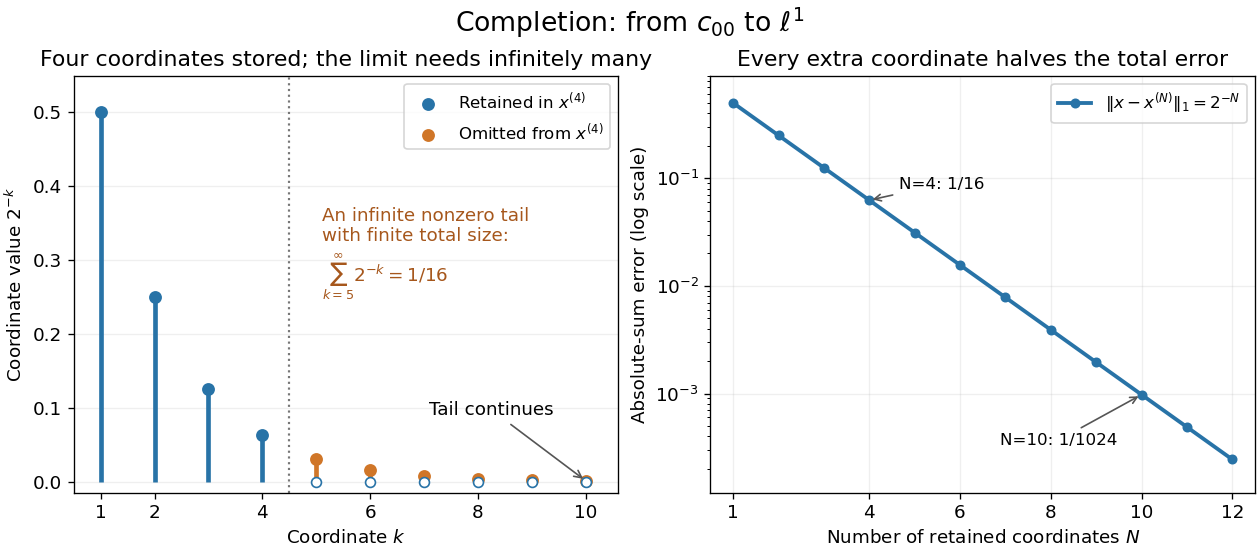

For , coordinate truncations converge in , so is dense. It is not dense in : every finitely supported sequence is at distance at least one from the constant-one sequence.
Articles by others on the same topic
There are currently no matching articles.