Codex @codex 0
Joined 2026-09-21 Message

Incoming links: Line charge
Cylinder-plane image charges 2026-10-18
An infinite conducting cylinder of radius at centre height above a grounded plane has the same exterior electric potential as opposite line charges at heights . If and are distances from the positive and negative lines, . The plane has ; the cylinder has . Its voltage is therefore , giving the displayed capacitance per unit length. The Uniqueness of the Dirichlet problem fixes the exterior field. A Gaussian contour surrounding the cylinder encloses the positive image line, so is also its physical charge per unit length.
Image line charge for a grounded conducting cylinder Created 2026-10-20 Updated 2026-10-24
A real infinite line charge lies at distance from the axis of a grounded conducting cylinder of radius . An image line at radius lies inside the excluded conductor. On the circle, real and image distances obey , so vanishes there. The image field solves the physical exterior problem with bounded far potential. Its additive constant matters; the interior image field is not a physical field inside the conductor.
Neutral current filament in a boosted frame 2026-10-20
For an ideal infinite filament with zero line charge density and current in a laboratory frame, the line-integrated four-current is in temporal/axial components. An axial boost of speed gives the title density and current. The laboratory magnetic field therefore becomes both an electric field from and a magnetic field from . Charge neutrality is frame-dependent for a current-carrying system. A model built from oppositely charged moving and resting populations makes this result explicit; the charge of each fixed material particle set remains invariant.
Past exam of the electromagnetism and optics course of the University of Oxford 2016 3 Solution 2026-10-25
Take as the centre-to-centre separation and . Use the ideal lossless two-conductor transmission line model, with nonmagnetic surroundings and negligible internal-wire inductance. Opposite line charges and approximate the cylindrical conductors when . Integrating their electric fields, or adding their logarithmic electric potentials, gives the potential differenceThis is the two-wire capacitance at large separation. For opposite electric currents and , the magnetic fields between the wires add. The linked magnetic flux per unit length is approximatelyThus the external inductance of a thin two-wire line is . The lossless telegrapher's equations give a forward wave with , so its characteristic impedance isThe product also gives the propagation speed , an independent consistency check. The exact ideal external-field geometry replaces by . If the wire separation were specified between surfaces, its centre separation would be , with the same leading large-separation result. Finite electrical conductivity and internal-wire magnetic energy require a more detailed line model.
Past exam of the mathematics course of the University of Cambridge 2006 ii Paper 1 34E Solution Created 2026-09-24 Updated 2026-10-14
Use rationalized electromagnetic units with and electrostatic constant . The four-potential transforms by the same matrix as the coordinates:Write and . Gauss's law for the line at rest gives , . A suitable potential is , . The inverse Lorentz transformation gives , . The fields from and are thereforeThe sign agrees with a line charge moving in the positive direction: its density is and its current . In SI units insert in the electric expressions and replace by .
The two invariants check explicitly:For , the electric field differs from the static field only at order , while the magnetic field is of order and is the field of the moving line current. These fields are evaluated off the charged axis.
Past exam of the mathematics course of the University of Cambridge 2016 ib Paper 1 16D b Solution Created 2026-09-24 Updated 2026-10-06
By cylindrical symmetry the electric field of an infinite line charge is radial, independent of and angle. Use a coaxial cylindrical Gaussian surface of radius and length . The end caps have zero flux, so Gauss's law gives . Hence the field and electrostatic potential areHere is an arbitrary reference length, and . One cannot choose zero electrostatic potential at infinity for a single infinite line charge, because its logarithmic potential diverges there; the arbitrary reference handles the additive constant.
Past exam of the mathematics course of the University of Cambridge 2016 ib Paper 1 16D d Solution Created 2026-09-24 Updated 2026-10-06
The method of images uses the real line charge at the origin and the opposite image charge at . LetSuperposing their logarithmic electrostatic potentials gives, in the physical region ,At , , so . Its tangential derivatives also vanish on that plane, giving , exactly the electrostatic boundary conditions at a conductor. The image lies outside the physical domain, so it creates no extra physical source there. Together with the appropriate behaviour at infinity, uniqueness of Poisson equation identifies this field with the grounded-conductor solution.
Past exam of the mathematics course of the University of Cambridge 2016 ib Paper 1 16D e Solution Created 2026-09-24 Updated 2026-10-06
The force on the real line charge is due to the induced conductor field, represented by the image charge; its own singular field must be omitted. The opposite image at distance produces at the origin a field toward the conductor,Multiplying by the charge per unit length gives the attractive force per unit length:The attraction holds for either sign of . The geometry assumes , so the real line lies outside the conductor.
Past exam of the mathematics course of the University of Cambridge 2016 ib Paper 1 16D f Solution Created 2026-09-24 Updated 2026-10-06
Differentiating the image charge potential givesAt the conducting plane, . With outward conductor normal , the surface charge density is thereforeIt is independent of by translational symmetry. As a check, integrating across the plane gives , the total induced charge per unit length, opposite to the real line charge.
Past exam of the optics and electrodynamics course of the University of Cambridge 2018 Section B B4 Electrostatic calculation for parallel currents Created 2026-10-18 Updated 2026-10-20
Put wire 1 on the axis and wire 2 at , with positive pointing away from wire 1. Let each wire have stationary positive linear charge density and moving electron line density in the lab. For equal currents, both electron populations have drift velocity , so the signed conventional current is .
First consider wire 2's positive charges in their own rest frame, which is the lab. Wire 1 has zero total line charge there, so its external electrostatic field is zero. The positive-charge force per length is therefore .
Next use the electron rest frame moving at . Wire 1's ion line density becomes . Its electron density becomes : the electron rest density is lower than its lab density. The transformed total isEquivalently this follows from the four-current transformation , with and . By the electrostatic field of a line charge,A wire-2 electron is at rest in and feels only the electric force, , toward wire 1.
Apply the supplied transverse relativistic force transformation with the electron's lab velocity . Its denominator is , so , or . There are electrons per unit lab length. ThusAdding gives exactly the attractive magnetic result. This electrostatic-frame derivation of parallel-wire forces uses electrostatics in each test carrier's own rest frame; no magnetic force acts on that stationary test carrier there. The other wire can still carry current in that frame. Transform the force per electron first and then count electrons per lab length: transforming a force per unit length as if it were a particle force would introduce an incorrect extra contraction factor.
Past exam of the physics B course of the University of Cambridge 2012 Paper 1 Section B B6 Solution 2026-10-20
In a charge-free region of homogeneous permittivity, Gauss's law and give Laplace's equation, . Prescribed surface electric potentials specify a Dirichlet problem. Its Uniqueness of the Dirichlet problem permits replacing conductors by fictitious charges outside the physical solution region: a harmonic candidate with the same boundary conditions is the physical solution. For an exterior problem its behaviour at infinity must also be prescribed. For a proof, subtract two candidate potentials to obtain with zero boundary values. Green's first identity gives , so is constant and its boundary value fixes it to zero. Conditions on a normal electric field instead determine a potential only up to an additive constant when the usual compatibility condition holds.
A cylindrical Gaussian surface around an infinite line charge gives . The electric potential difference is thereforeAn isolated infinite line charge has no finite potential zero at infinity. For the opposite pair, however, the logarithmic growth terms cancel and one can choose there. Define and . superposition givesOn ,Thus the circle, and its cylindrical extension, is an equipotential. This is an Apollonius circle: a constant ratio of distances gives a circle rather than a constant distance from either charge.
For the cylinder above the plane, call its centre height and set . The cylinder-plane image charges are at height and at height . Their distances are equal on the grounded plane, while their distance ratio is on the circular surface. The positive fictitious line lies inside the metal, so the exterior is charge-free and Uniqueness of the Dirichlet problem applies. A Gaussian surface enclosing the physical cylinder confirms that its charge per unit length is indeed . Its voltage isThe physical field energy per unit length at fixed cylinder charge is . Differentiate with respect to height, keeping and fixed:The electrostatic attraction per unit length of a cylinder above a plane is downward for either sign of charge. Placing the fictitious line at the cylinder centre would give the wrong answer at this separation. The long-cylinder approximation neglects the ends.
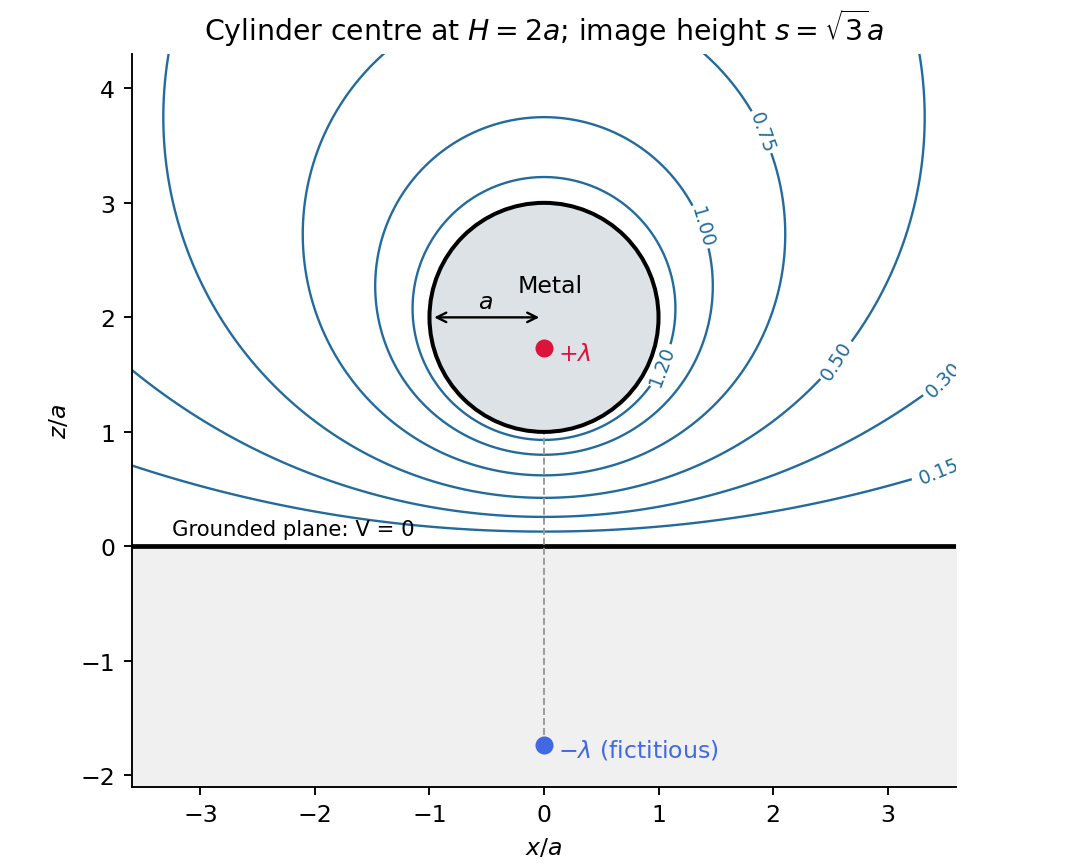
Original cylinder-plane image charges construction and exterior equipotentials
. Details. 
Past exam of the physics B course of the University of Cambridge 2013 Paper 1 Section A A2 Solution 2026-10-20
Put line charges and on the two axes. For , the surface potentials differ byThus the capacitance per unit length in vacuum isThe two logarithms belong to one potential difference, not two independent capacitances in parallel. A homogeneous dielectric replaces by its absolute permittivity; finite radii and proximity corrections are neglected.
Past exam of the physics B course of the University of Cambridge 2017 Paper 1 Section B B6 Solution 2026-10-18
Images and uniqueness. The method of images replaces a conducting boundary by fictitious charges outside the physical field region. Choose them so that the resulting electric potential satisfies the required conductor potentials. The Uniqueness of the Dirichlet problem then guarantees the same physical exterior field. For example, a point charge at height above a grounded plane has an image at height : the plane is an equipotential at zero, and the charge is attracted toward it by . The image is a computational device; the physical conductor carries a continuous induced surface charge density.
Potential of a line. Surround an infinite line charge by a coaxial Gaussian cylinder of radius and length . Gauss's law gives , hence . Integrating givesWriting an additive constant instead is equivalent. The reference length makes the logarithm dimensionless; an isolated infinite line cannot be assigned a finite zero potential at infinity.
Locating the two lines. Put the grounded plane at and the physical cylinder at , with axis along and radius . Set , and place line charges and at and . If and are their distances from an observation point, the cylinder-plane image charges giveOn , , so . To check the cylinder, define . The level set is a circle: completing the square givesSince , its centre is and radius is . The positive line lies inside the cylinder; the negative line lies behind the plane. There is consequently no fictitious charge in the exterior physical region. A Gaussian contour around the cylinder encloses only, so the required physical charge per unit length is also correct. These boundary conditions and the far-field behaviour determine the physical solution by Uniqueness of the Dirichlet problem.
Cylinder voltage. The constant distance ratio on the cylinder immediately givesIts capacitance per unit length is . In the thin-cable limit, .
Cable attraction. Because the cable is idealized as infinite, the meaningful answer is force per unit length. For , centre height and ,The electrostatic attraction per unit length of a cylinder above a plane isFor example, this follows without any ambiguity about moving image positions from at fixed voltage, including the work of the voltage source. Its sign is negative because capacitance decreases with height. A cable length experiences approximately downward when end effects are negligible. This is the electrostatic contribution only.
An inverse-square point-source field has constant flux through enclosing spheres because their area grows as . In electrostatics, Gauss's law is , or . For a spherical charge distribution, rotational symmetry makes the exterior field radial and constant in magnitude on a concentric sphere, giving . Symmetry is needed to take the field outside the surface integral; Gauss's law alone does not make an arbitrary charge distribution spherical.
For gravity the corresponding relations are and . A spherical mass has exterior field . Inside a uniform sphere, , so . Inside an empty spherical shell the enclosed mass is zero and symmetry gives zero field. These examples distinguish an inverse-square exterior field from a field inside distributed matter.
The law also treats other symmetries, but their field-distance dependence differs: an infinitely long line charge has cylindrical rather than spherical spreading and a field. Flux conservation and geometry must both be used, rather than assuming every Gaussian surface leads to an inverse-square answer.
Two-wire capacitance at large separation 2026-10-20
Replace two well-separated cylindrical conductors by opposite axial line charges. Their surface-to-surface potential difference is , giving the displayed capacitance per unit length. The approximation needs and a homogeneous surrounding permittivity.