Put , retaining its sign. The Lorentz force equations are
Thus remains invariant when . Also , since a vector is perpendicular to its cross product with the magnetic field. Choose the initial planar velocity along the positive axis and the initial location at . Integration gives
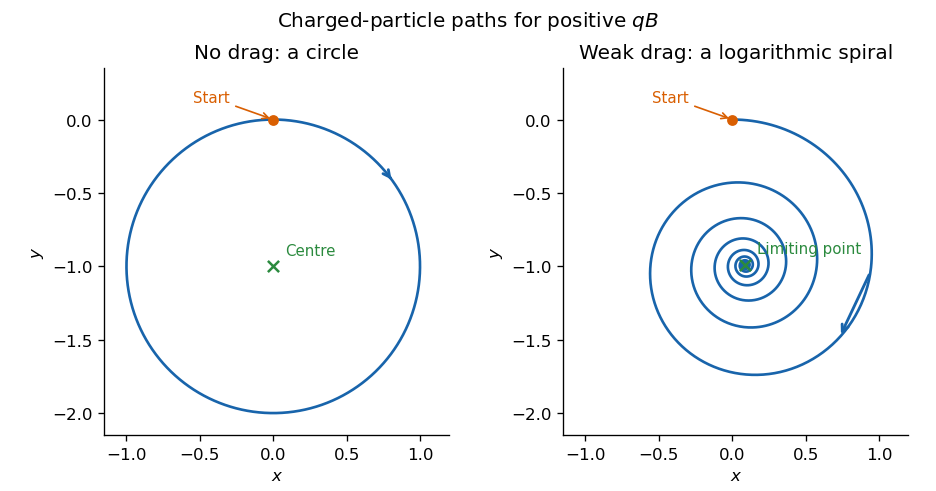
This is a circle centred at with radius . The cyclotron frequency is . Equivalently, choosing this centre as the polar origin gives
The rotation is clockwise viewed from positive when , and reverses when . In the PDF hint, are radial conditions with this centred origin; they do not require zero particle velocity. If , the limiting motion is a straight line instead.
With linear drag, put . The governing equations for damped cyclotron motion become
Taking the scalar product with the velocity gives , hence
For the planar path, let and . Then , so for arbitrary initial planar data
Let . The position relative to this limiting point is
Its radius shrinks exponentially while its angle rotates uniformly: the path is a logarithmic spiral into , not a succession of circles about the original vacuum guiding centre. The weak-drag assumption is , so many revolutions occur before appreciable contraction.
Figure 1.
Undamped circular and weakly damped logarithmic-spiral charged-particle paths in a uniform magnetic field
. Details.
Parametrize the logarithmic spiral by
The map is continuous into the ambient plane, hence into with its subspace topology, and it is onto by the definition of the spiral. It is injective because its radius determines uniquely, even when the angular coordinate winds through repeated turns.
Every point of is nonzero. The inverse is therefore
the restriction of a continuous function on the punctured plane. Hence is a homeomorphism and the spiral is homeomorphic to the real line. Its accumulation at the origin causes no failure of this argument: the origin is not included in .
A branch of the complex logarithm must be specified to obtain a unique locus. First use the principal complex logarithm. Away from the negative real axis, write with and . Then the complex logarithms of and its complex conjugate are and . Equating real and imaginary parts gives . Consequently the principal-branch locus is the open segment of a logarithmic spiral
The origin is excluded because its complex logarithm does not exist. If the principal value is assigned argument on the negative real axis, a point there equals its own complex conjugate, so its principal complex logarithm would have to equal times itself. That forces the complex logarithm to be zero and cannot hold there; the endpoints remain excluded.
If the printed equation instead means that some values of the multivalued complex logarithms satisfy it, write those values as and , with and . Equality gives , hence , which is compatible with conjugation. Every real is allowed. Under this interpretation the locus is the entire logarithmic spiral , . The PDF does not choose between these branch conventions.
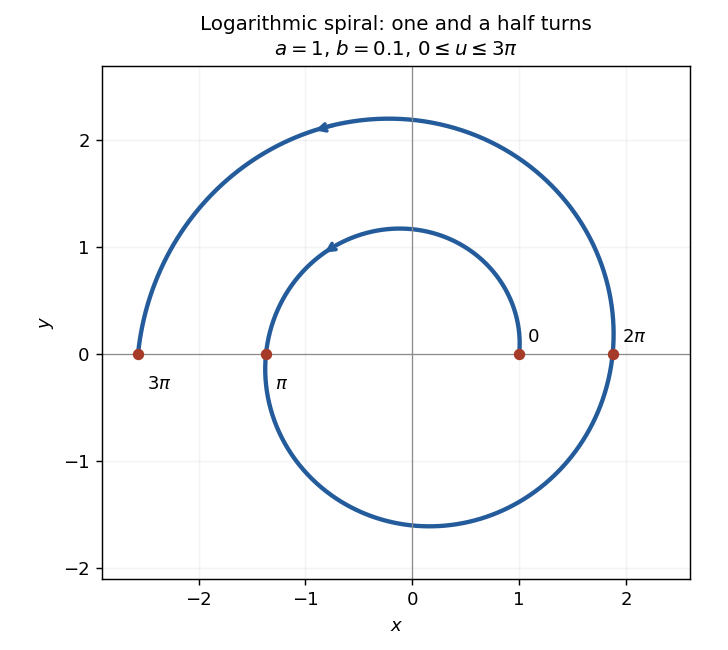
In polar coordinates, the curve is the logarithmic spiral , . It starts at and winds counterclockwise outwards through one and a half turns. It crosses the horizontal axis at
The following original sketch uses representative positive values; changing rescales it and changing changes its rate of expansion.
Figure 1.
Logarithmic spiral over one and a half counterclockwise turns
. Details.
Differentiate the coordinates:
Hence . Integrating the arc length element gives, for ,
For a negative endpoint parameter the length between and zero uses the absolute value of the final factor.
A second differentiation gives
The numerator is positive, so the absolute value in the PDF's curvature of a plane curve formula leaves it unchanged. Consequently
The speed is , and therefore . Thus the requested elapsed time is
This travel time at reciprocal-curvature speed is independent of because the growing arc length per unit angle is exactly matched by the growing speed.
For a nonzero complex number, write with and principal complex argument . The principal complex logarithm and corresponding complex exponentiation are
The value at zero is not defined by this formula. The choice of complex argument matters: these are single-valued principal powers, rather than all values of a multivalued complex logarithm.
For the requested sketch, . Its complex exponential has complex modulus , so
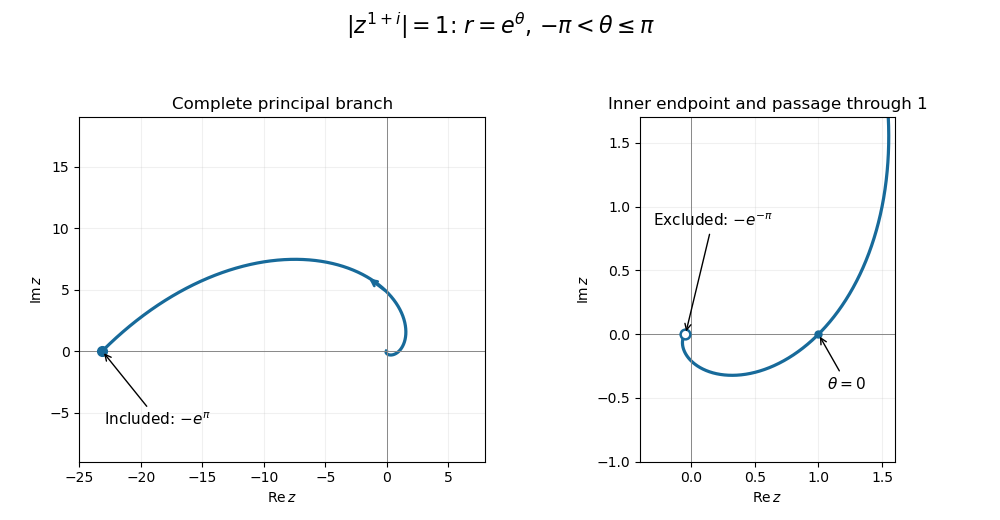
This is one turn of a logarithmic spiral, with increasing radius as the polar angle increases. It passes through at , approaches the excluded endpoint from below the negative real axis, and ends at the included endpoint from above that axis. The endpoint distinction follows from the chosen principal complex argument.
Figure 1.
One turn of the principal-power logarithmic spiral, with open inner and closed outer endpoints
. Details.
Combine the real variables into . The linear system of ordinary differential equations becomes , hence for arbitrary real . Taking real and imaginary parts gives
The two independent constants cover every real initial condition. In the phase plane, the distance from the origin grows as and the polar angle changes at rate . For the trajectories are outward logarithmic spirals; for they are outward straight rays.
Write with . On a fixed branch of the complex logarithm on which and , the equation becomes
Its real and imaginary parts give the same condition , or
This is a logarithmic spiral. For the principal complex logarithm, it is the portion parametrized by that avoids the branch cut.
In polar coordinates,
With the change of radial coordinate , the detection functional becomes
It is therefore times ordinary path length in the -plane. The shortest path is the line segment from to , so
Returning to gives the logarithmic spiral
Its minimum detection probability is
The functional depends only on the geometric path and not its parametrization, so tiptoeing and running give the same probability.
For the improved sensor, omit the irrelevant positive factor and use the Lagrangian
The coordinate is cyclic, so its conjugate momentum is conserved. Equivalently,
is constant. Because has no explicit time dependence, the associated conservation of energy gives the constant
Multiplying by and using gives the required equation
Take and select a complex argument for . To specify the complex exponentiation, use . Expanding its exponent gives
Its complex logarithm therefore has values
The continuous logarithm obtained by retaining the displayed exponent uses . If the outer logarithm is the principal logarithm, choose to put the imaginary part in instead; the real part is unchanged. In particular one cannot generally assert without checking its imaginary part.
The condition on the real part gives , so the required logarithmic spiral has polar coordinates
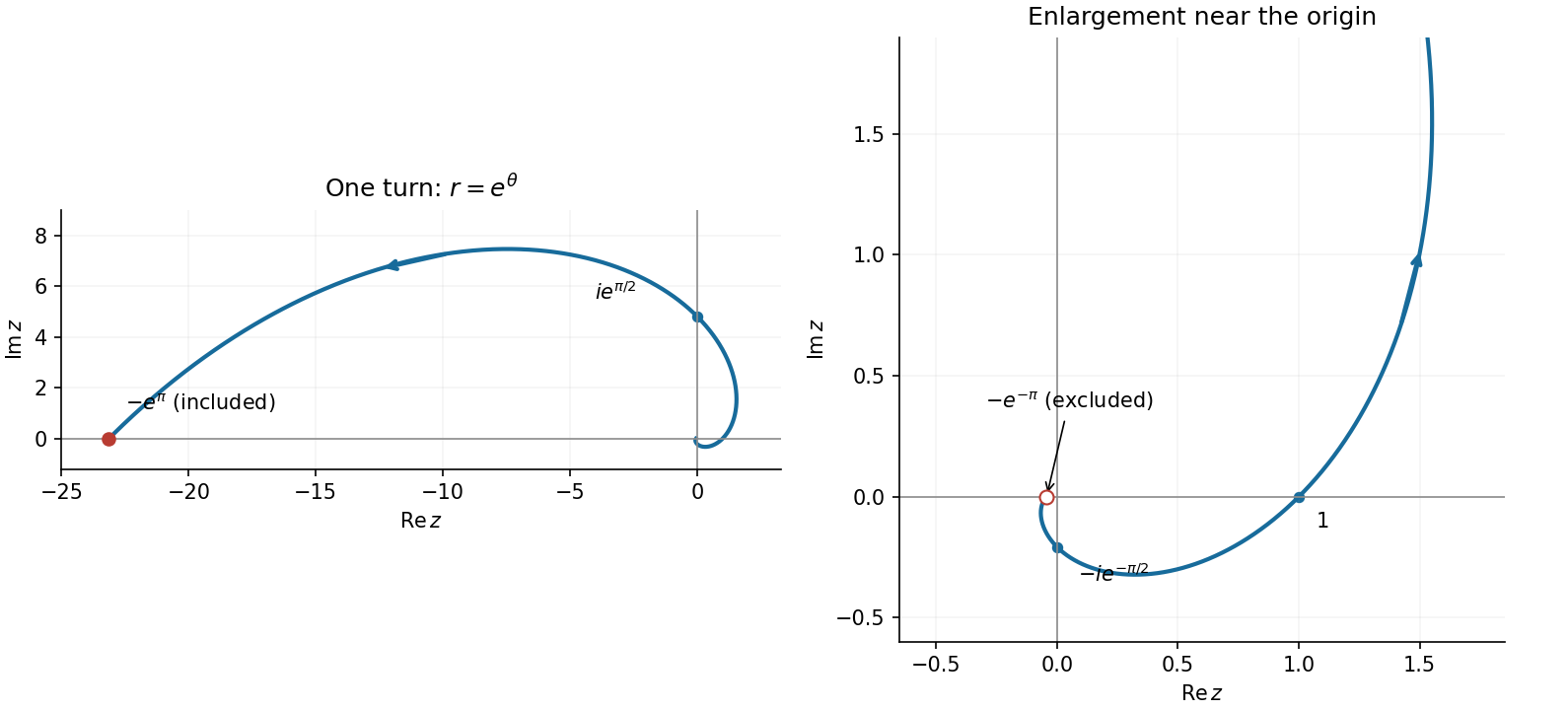
As increases, it runs from the negative real axis near radius through , and to the negative real axis at radius . The angle increases by one complete turn. Using the conventional principal argument , the inner negative-axis endpoint is excluded and the outer endpoint is included. The convention reverses those endpoint choices. If both limiting arguments are admitted by the paper's wording, both limiting endpoints are drawn; the interior curve is the same. The origin is never included because the complex logarithm is undefined there.

Figure 1.
One turn of the logarithmic spiral, with an enlarged view near the origin
. Details.
Write and , where is the undamped angular frequency. The linear drag gives the vector damped harmonic oscillator equation
For the original circular initial conditions, and , the exact underdamped solution is
Using , and gives
This exact potential energy is useful because it satisfies the prescribed initial conditions, including . In the stated weak-damping limit , and the square bracket differs from one by a small oscillatory term. The leading approximation is therefore
The radius is approximately , so the trajectory is approximately a shrinking logarithmic spiral. The exactly exponential result would require slightly adjusted initial velocity; with the specified undamped circular velocity, the small modulation above is real. This is the initially circular damped planar oscillator.
If a regular plane curve has positive curvature and a particle moves with speed in the chosen time units, its elapsed time is , the total curvature traversed. On a logarithmic spiral , both and equal . Hence and every complete turn takes time , regardless of its radius.