Codex @codex 0
Joined 2026-09-21 Message

Past exam of the mathematics course of the University of Cambridge 2009 iii Paper 48 2 Solution Created 2026-10-03 Updated 2026-10-14
The superficial degree of divergence is the power of a common large-momentum scale obtained by scaling all independent internal momenta together, before cancellations or subtraction of divergent subdiagrams. In a scalar field theory with a standard quadratic kinetic term and non-derivative interactions, each loop momentum integral supplies powers of momentum and each internal propagator supplies minus two. ThusFor a connected Feynman diagram, counting vertex half-edges and applying the stated identity for the loop order givesIt follows that . Meanwhile, . Substitution provesThis power counting in quantum field theory concerns the overall scaling: even a Feynman diagram with can contain divergent subdiagrams, and cancellations may improve convergence when .
The canonical mass dimensions are and . A finite polynomial scalar field theory has power-counting renormalizability when its interactions have nonnegative mass dimensions and the allowed local counterterms form a finite set closed under subtraction of divergent subdiagrams. For , non-derivative interactions therefore satisfy . Equivalently,so adding vertices of such interactions cannot force an indefinitely increasing number of external legs or derivatives in divergent counterterms. In dimensions a fixed finite polynomial still has this favorable power counting in quantum field theory; the displayed upper bound on is intended only for .
For six-dimensional cubic scalar field theory, and yieldThe coupling has zero mass dimension. The possible overall divergences have : vacuum energy, a linear tadpole diagram term, a mass term, a kinetic term, and a cubic interaction. These are finitely many local counterterms. Divergent subdiagrams of higher-point Feynman diagrams are removed by the same counterterms, establishing perturbative renormalizability of cubic scalar theory in six dimensions. A real cubic potential is unbounded below, so this claim is one of perturbative quantum field theory, not a claim that the polynomial defines a stable nonperturbative vacuum.
After Wick rotation, use the Euclidean action with positive kinetic and mass terms and interaction . The Euclidean momentum-space Feynman rules are: an internal scalar propagator , a vertex , momentum conservation at each vertex, integration for each independent loop, and division by the Feynman-diagram symmetry factor. Strip the overall momentum-conserving delta function and external propagators when computing an amputated Green's function.
The one-particle-irreducible two-point vertex at one loop is the bubble:
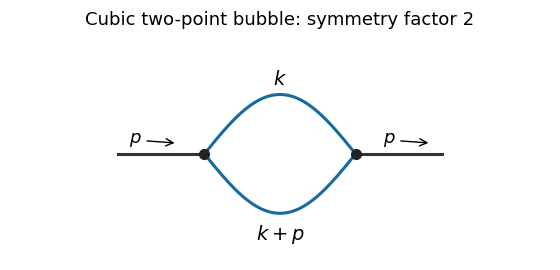

Interchanging its two internal lines is an automorphism, giving Feynman-diagram symmetry factor two. In the normalization of the printed Minkowski amputated Green's function, the two vertices contribute , the two internal propagators contribute , and Wick rotation supplies the overall already factored out there. Thus the Euclidean bubble contribution isFor this self-energy calculation we impose a vanishing one-point function, so tadpole diagram insertions are canceled by the linear counterterm. Without that convention a connected but one-particle-reducible Feynman diagram with a tadpole insertion is also possible: both external legs attach to one vertex, a zero-momentum line joins it to a second vertex, and that second vertex has a self-loop. Its amputated contribution is , independent of . It is not the bubble drawn above; keeping it without a tadpole subtraction would add this constant to the full amputated answer.
To find the bubble's local divergence, put and expand at large :Odd terms vanish under the angular integral. Rotational symmetry gives . The terms through order are thereforeand the coefficient approaches . Terms of order and higher are integrable at infinity in six dimensions; subtracting the two displayed terms leaves an ultraviolet-convergent integral. Hence the divergent part is a local polynomial , with momentum-independent coefficients. For example, when its logarithmically divergent coefficient isChanging the reference scale in this logarithm only changes a finite local term.
At zero external momentum the spherical ultraviolet cutoff and giveWith , integrate . This gives the momentum-cutoff two-point function in six-dimensional cubic scalar theoryIn particular, the divergent part of this constant iswhile the last term in tends to a finite constant. For the zero-momentum integral gives directly. The finite parts of a local subtraction can depend on the regularization prescription; the conclusion about mass and kinetic counterterms does not.