At leading order in quantum electrodynamics, the electron-positron pair annihilates into one virtual photon, which produces the muon-antimuon pair. This is an s-channel Feynman diagram with and . No QED vertex changes an electron directly into a muon, so there is no corresponding single-photon t-channel flavor-changing diagram.
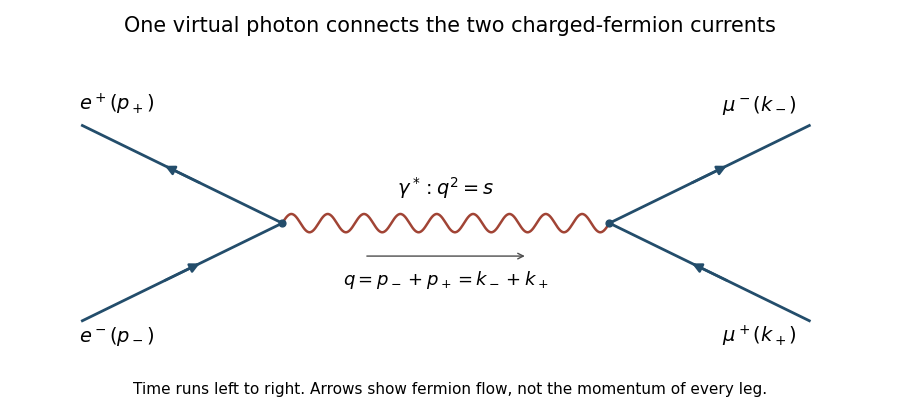

Each charged-fermion vertex contributes , the internal photon contributes in Feynman gauge, and external legs supply incoming and outgoing . Their ordered contraction gives the stated amplitude. The overall convention-dependent phase does not affect its squared modulus.
For unpolarized scattering, average over the two spin choices of each incoming particle and sum over outgoing spins. The identities and , together with , convert the products into fermion spin sums:The factor averages the initial spins; there is no additional average over the final ones. In the massless limit the first trace is , with the analogous expression for the outgoing current. Contracting givesIn the centre-of-mass frame, every external energy is . Choose along and let make angle with it. The dot products are and . HenceThe electron-positron annihilation into a muon pair cross-section is thereforeUsing givesIn ordinary units this becomes . It is the leading high-energy QED result: finite masses, radiative corrections and weak-interaction exchange modify the prediction outside that approximation.
Cross-section measurements can test spin assignments when the interaction and charges are specified. For example, keeping spin-half electrons but replacing the final muons by minimally coupled charged spin-zero particles replaces the fermion current by a momentum-difference current. In the massless limit, scalar-pair production by fermion annihilation gives and total . Its central angular peak differs from the fermionic distribution.
Thus angular distributions, polarization information and suitably modeled rates distinguish spin hypotheses. A single total rate without assumptions about the couplings or the initial species does not independently establish both spins; changing interactions can mimic normalizations. The predicted fermion result is a testable consequence of the spin-half QED model, rather than a model-independent inference of spin from any one observed cross-section.
Articles by others on the same topic
There are currently no matching articles.