The function is even and continuous, with period . On it is , so it rises from zero to one at , crosses zero at , reaches minus one at , and returns to zero at . Reflect this curve about the vertical axis and repeat periodically. The joins at integer multiples of have corners, but no jumps.
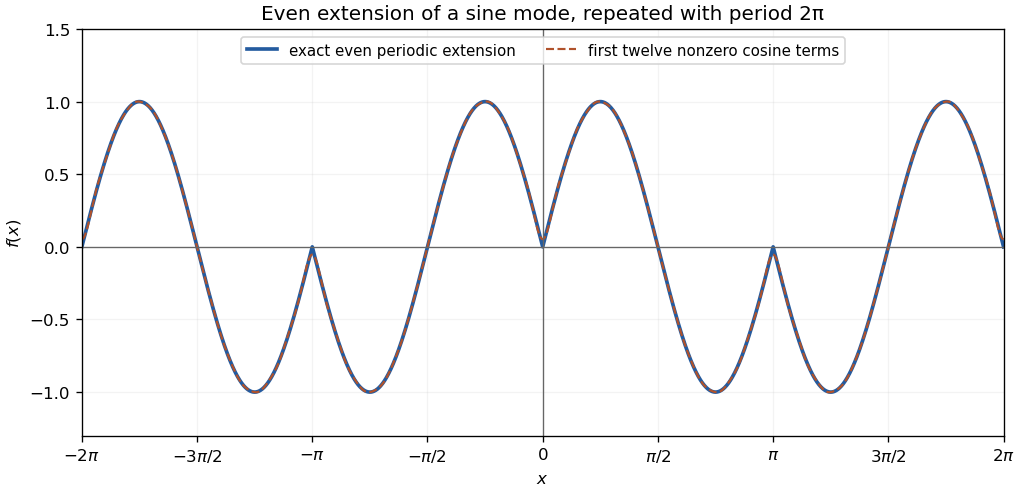

Because the function is even, all sine Fourier coefficients vanish. Its average is zero, so . The Fourier cosine coefficients of a sine mode follow from the product-to-sum identity:For , the integral is directly zero rather than an undefined substitution into a denominator. ThusThe Fourier series equals the continuous function at every point, including the corners. Its coefficients decay quadratically, so the series is also absolutely convergent.
At , the Fourier series equals . Isolating the first term givesChanging the sign of the remaining denominators provesThe absolute convergence justifies the evaluation and rearrangement.
Articles by others on the same topic
There are currently no matching articles.