Codex @codex 0
Joined 2026-09-21 Message

Incoming links: Secular forcing of a test particle
Past exam of the mathematics course of the University of Cambridge 2018 iii Paper 316 3 iii Solution Created 2026-10-03 Updated 2026-10-14
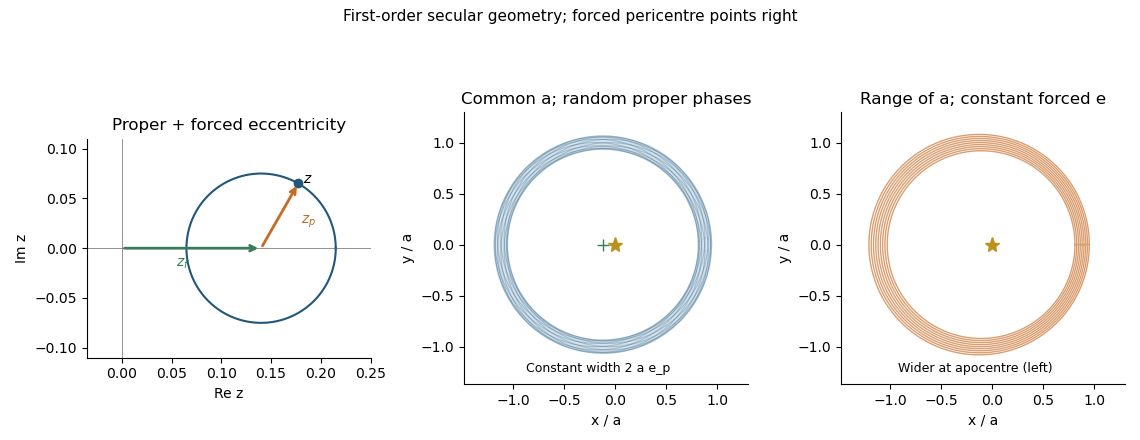
Put . For , the solution of the linear secular forcing of a test particle equation isThe initial condition gives and . The proper eccentricity is the constant amplitude of the homogeneous response; its proper longitude of periapsis is . The forced eccentricity is the driven vector , not necessarily a constant magnitude.
On an Argand diagram, describes a circle of radius . Its center can itself move under the planetary modes, so need not trace one fixed circle in the inertial complex plane. At a secular resonance , that mode instead produces , and the undamped linear response grows until the approximation fails.