Codex @codex 0
Joined 2026-09-21 Message

Incoming links: Strong connectivity
Past exam of the mathematics course of the University of Cambridge 2024 iii Paper 124 2 iii Solution Created 2026-09-24 Updated 2026-09-25
Membership follows from . A directed graph is not strongly connected exactly when there is a pair for which is not reachable from . Guessing the pair and using the NL procedure for non-reachability puts non-strong-connectivity in NL, hence strong connectivity is in co-NL and therefore in NL.
For NL-hardness, reduce directed reachability. Given , form by retaining all edges of , adding for every vertex , and adding for every vertex . If is reachable from in , then any reaches any in alongConversely, if is strongly connected then reaches . A simple -to- path cannot use an added edge out of before arriving at , and every added edge into merely returns the path to its starting vertex; deleting the resulting cycle leaves an -to- path made from edges of . The construction is computable in logarithmic space, so deciding strong connectivity is
Strong orientation 2026-10-14
A strong orientation is an orientation of a graph with strong connectivity: for every ordered pair of vertices, there is a directed path from to . A length-zero directed path permits . Ordinary connectivity of the underlying undirected graph is necessary, but does not ensure this two-way reachability after directions are chosen. The acyclic is not a strong orientation; the cyclic is, since a journey can continue around its directed cycle.
Attach a new vertex to that triangle in a graph by the single edge . This edge is a bridge in a graph. If oriented , no directed path leaves for the triangle in a graph; if oriented , no directed path from the triangle in a graph reaches . Neither choice gives a strong orientation, even when the triangle in a graph itself is cyclically oriented. By contrast, the four-vertex cycle graph has the strong orientationFollowing this directed cycle reaches any requested vertex in at most three steps. Removing any one of its undirected edges leaves a graph path through all four vertices, so it has no bridge in a graph.
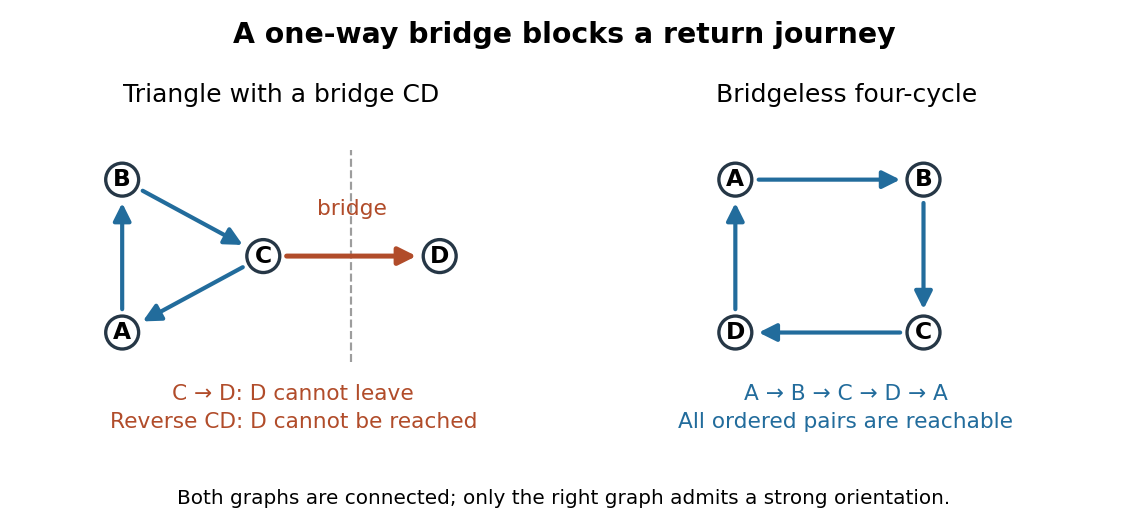

For more than one vertex, a strong orientation cannot also be an acyclic orientation: directed paths from to and back give a nonempty closed directed walk, from which removing repeated portions leaves a directed cycle. A directed graph containing one directed cycle need not have strong connectivity, as the attached shows.