A strong orientation is an orientation of a graph with strong connectivity: for every ordered pair of vertices, there is a directed path from to . A length-zero directed path permits . Ordinary connectivity of the underlying undirected graph is necessary, but does not ensure this two-way reachability after directions are chosen. The acyclic is not a strong orientation; the cyclic is, since a journey can continue around its directed cycle.
Attach a new vertex to that triangle in a graph by the single edge . This edge is a bridge in a graph. If oriented , no directed path leaves for the triangle in a graph; if oriented , no directed path from the triangle in a graph reaches . Neither choice gives a strong orientation, even when the triangle in a graph itself is cyclically oriented. By contrast, the four-vertex cycle graph has the strong orientationFollowing this directed cycle reaches any requested vertex in at most three steps. Removing any one of its undirected edges leaves a graph path through all four vertices, so it has no bridge in a graph.
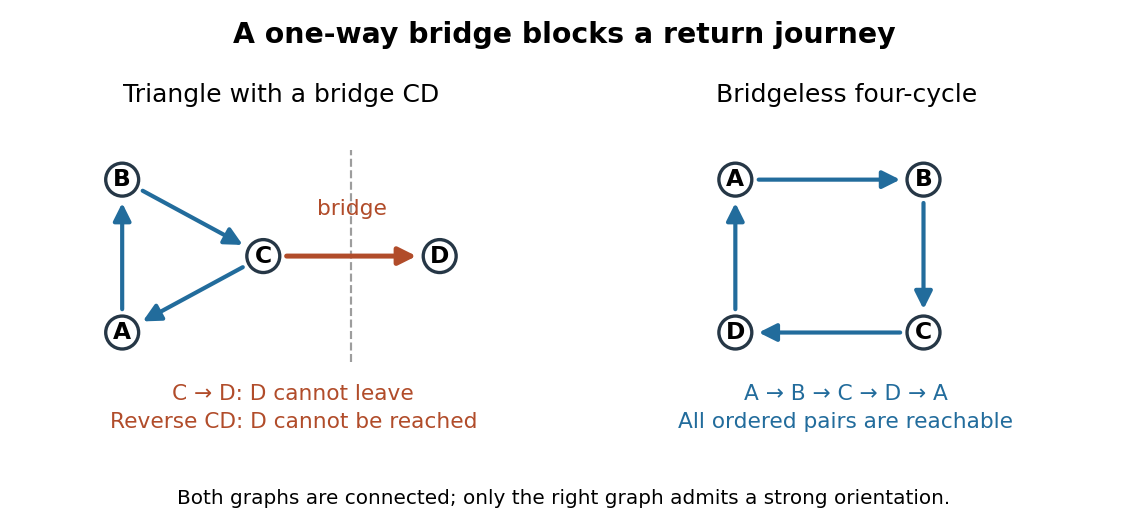
For more than one vertex, a strong orientation cannot also be an acyclic orientation: directed paths from to and back give a nonempty closed directed walk, from which removing repeated portions leaves a directed cycle. A directed graph containing one directed cycle need not have strong connectivity, as the attached shows.
A finite nonempty connected graph whose edges are undirected admits a strong orientation if and only if it has no bridge in a graph. This statement holds for finite multigraphs as well as finite simple graphs; self-loops do not help connect distinct vertices. The single-vertex case is allowed, with length-zero directed paths.[ref]
On Orientations and Shortest Paths by Refael Hassin and others. Hassin and Megiddo, On Orientations and Shortest Paths (1989), printed pp. 591–592: bridge-connectedness, strong connectivity and Theorem 2.6 (Robbins)
Necessity comes from the two sides separated by deleting a bridge in a graph: its chosen arrow crosses in only one direction. For sufficiency, the cited constructive proof uses depth-first search to find a cycle in a graph, orients it cyclically, contracts it, and repeats. Undoing the contractions replaces junctions by directed cycles, retaining two-way reachability. Contraction can produce multiple edges, so these must remain distinct. This is a construction outline; the input graph is finite and bridgeless, and remaining edges within contracted pieces can receive arbitrary directions.[ref]
On Orientations and Shortest Paths by Refael Hassin and others. Hassin and Megiddo (1989), Theorem 2.6 proof, printed p. 592: cycle orientation and contraction, explicitly described as a different constructive proof from Robbins's
Articles by others on the same topic


"Strong orientation" can refer to various concepts depending on the context in which it is used. Here are a few potential interpretations: 1. **Psychological Context**: In psychology, strong orientation might refer to having a clear and well-defined sense of direction or purpose in one’s life or career. Individuals with strong orientation may exhibit high levels of motivation and focus.