
Cesàro summation 2026-10-14
Cesàro summation assigns a value to a series when the arithmetic means of its partial sums approach a finite limit of a sequence. Here we use the first-order method, often written . For a real or complex series beginning at index zero, defineIt is Cesàro summable to when . The averaging is applied to the partial sums , rather than to the original terms . This distinction is essential: the terms can average to zero while their accumulated sum keeps growing. [ref]
For Grandi's series , the partial sums alternate between one and zero. The series is not a convergent series, but the two values occupy asymptotically equal proportions of the averaging window. In the declared index convention,so its first-order Cesàro sum is . This names a particular summation method; it does not turn the oscillating partial sums into an ordinarily convergent sequence.
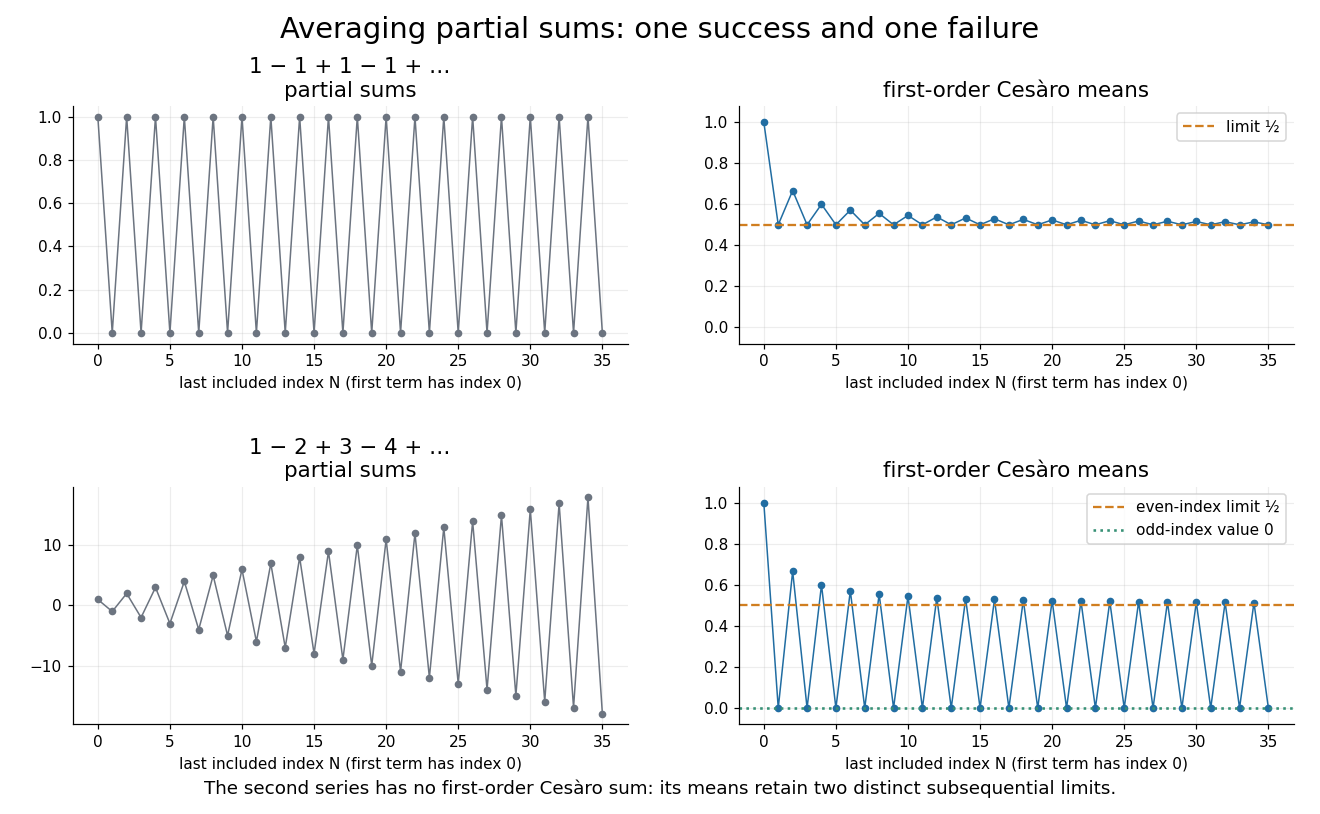

Why is this useful? An oscillating approximation can retain stable information when its cumulative average settles. Because the Cesàro theorem for convergent sequences preserves an existing limit of a sequence, this adds some new cases without changing the sum of any ordinarily convergent series. For Fourier series, averaging the Fourier partial sums gives a Fejér sum; the existing Fejér kernel and approximation articles explain its effect on reconstruction. Averaging does not guarantee success for every oscillating sequence, as the bounded partial sums need not be Cesàro summable example shows.
One historical motivation was the multiplication of series. In 1918, A. F. Andersen recalled Ernesto Cesàro's product theorem and cited his 1890 publication at the start of a study of products involving Cesàro summable series. This connects the theory with preserving useful operations on sums, as well as with assigning a value to an isolated example. His paper treats several orders of summability; the examples here use only .[ref]