Virginia Alonso Roldán is an ecologist whose research includes the measurement of wild-animal populations. In a 2015 study of Dolichotis patagonum, she and collaborators evaluated a two-step monitoring design: first locate communal warrens, then use continuously recording video to count associated adults. The paper credits her with study design, fieldwork, analysis and writing.[ref]
Sources of Variation in a Two-Step Monitoring Protocol for Species Clustered in Conspicuous Points: Dolichotis patagonum as a Case Study by Virginia Alonso Roldán and others. Abstract, Methods and Author Contributions; VAR denotes Virginia Alonso Roldán
The scientific difficulty is that an observed count combines animal abundance with the observation process. The study distinguished finding a warren, deciding whether it was active, and detecting the animals using it. Its field checks combined transect searches with an intensive second search, while video observations tested how observation duration affected counts. Abandoned warrens were an important source of error.[ref]
Sources of Variation in a Two-Step Monitoring Protocol for Species Clustered in Conspicuous Points: Dolichotis patagonum as a Case Study by Virginia Alonso Roldán and others. Methods: warren detectability and active warrens; Discussion: false-positive bias
For an invented illustration, suppose active warrens each have associated adults. If the detection probability for an active warren is and the conditional detection probability for each adult at a found warren is , the expected observed total isalthough the actual total is . Correcting only the video count gives , still missing animals associated with undetected warrens. Conversely, treating abandoned warrens as active could overestimate abundance. This simplified calculation assumes identical detection rates, distinct adult memberships and no double counting; it illustrates the observation problem rather than reproducing the study's estimator or data. Repeated, independently checked observations help distinguish a change in animal numbers from a change in detection probability.
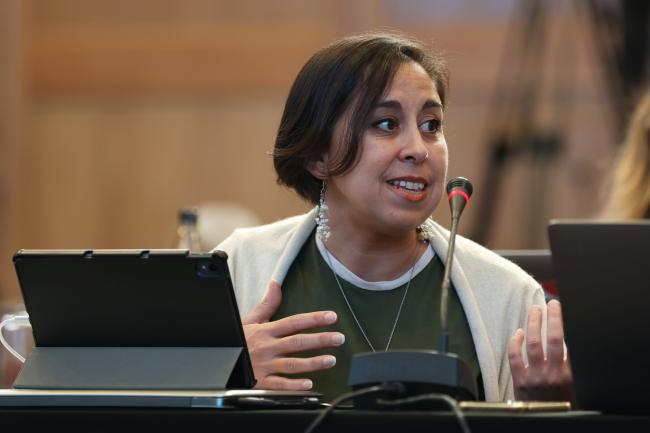
Virginia Alonso Roldán
. Named photograph by Kiara Worth, IISD Earth Negotiations Bulletin, 17 December 2024. Original caption and credit. Articles by others on the same topic
There are currently no matching articles.