
Restricted Hartree–Fock incorrectly retains ionic configurations when a homonuclear bond dissociates. As overlap vanishes, its symmetry-preserving occupied orbital approaches . The doubly occupied spatial product containsThe first and last terms place both electrons on one separated atom. Their combined probability remains one half, while the correct neutral singlet has one electron on each atom. The resulting spurious Coulomb repulsion raises the restricted dissociation limit. This is missing static electron correlation, not a failure of the Born-Oppenheimer approximation.
A two-configuration expansion using both and can cancel the ionic terms and recover the Heitler–London separated-atom singlet. Configuration interaction in the appropriate active space or a multiconfigurational self-consistent treatment supplies this remedy. The Unrestricted Hartree-Fock method can instead localize opposite spins on different atoms and give the correct separated-atom energy, but its single determinant breaks spin symmetry and is not the pure singlet at intermediate separation. The distinction between restricted and symmetry-broken descriptions of stretched hydrogen is treated in the original analysis of Coulson and Fischer.[ref]
XXXIV. Notes on the molecular orbital treatment of the hydrogen molecule by Charles Alfred Coulson and Inga Fischer-Hjalmars. Philosophical Magazine 40 (1949), 386–393, molecular-orbital treatment of hydrogen and its dissociation
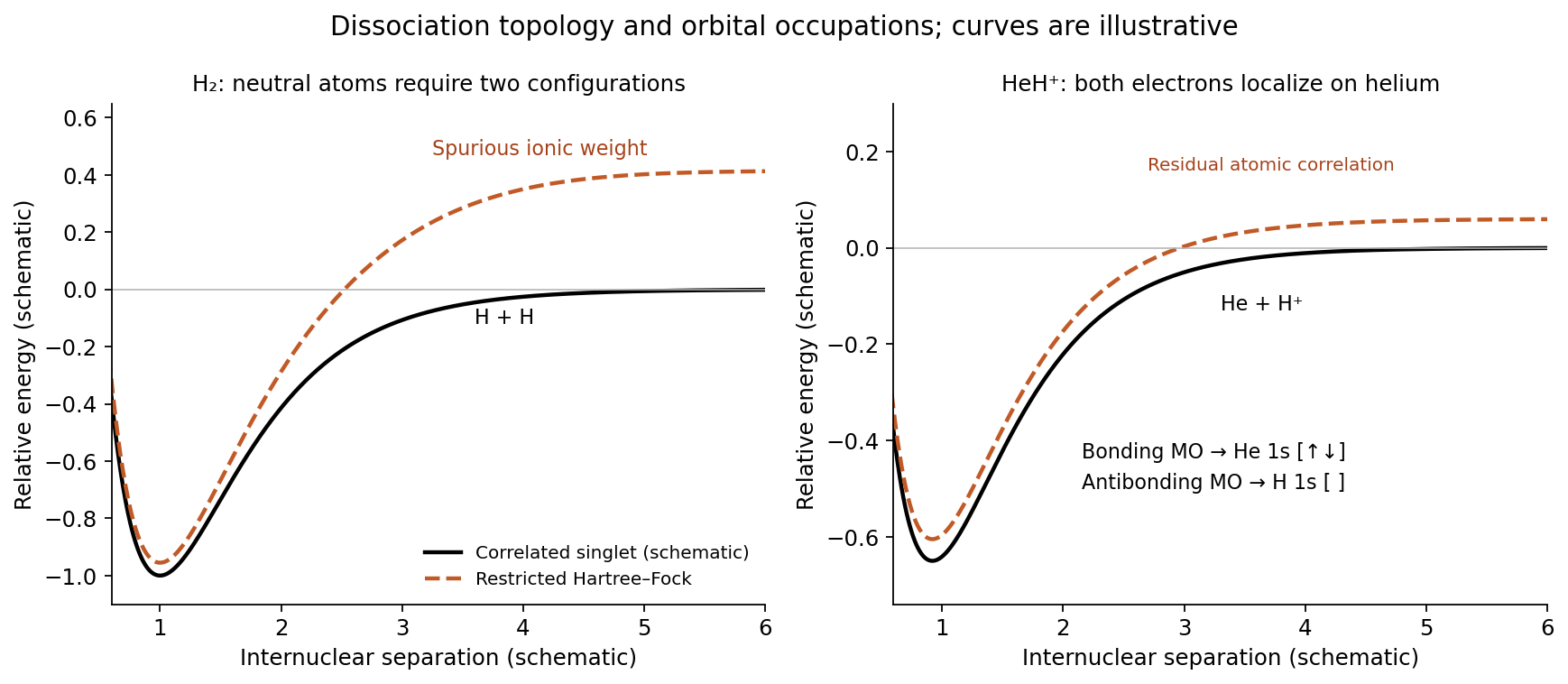

At this separation the orbital overlap and interatomic two-electron exchange integrals are negligible. Each localized electron then contributes essentially the isolated hydrogen energy, while the interatomic electrostatic terms cancel to leading order for neutral fragments. Including nuclear repulsion in the molecular energy givesThe closed-shell RHF determinant instead doubly occupies . It retains ionic configurations with both electrons on the same atom, even at dissociation. Using atomic units and the Hartree energy in the stated unrelaxed hydrogenic 1s basis, the same-atom two-electron Coulomb integral is . Consequently at infinite separationwhere energies and integrals inside the first expression are in atomic units. It is much too high compared with two neutral atoms. Retaining the leading intersite Coulomb term at gives , still about above UHF. The numerical RHF estimates specify the supplied fixed 1s basis; a larger optimized orbital space changes them. If nuclear repulsion is excluded by an electronic-energy convention, subtract the same from both quoted total molecular energies. The restricted/unrestricted comparison and their dissociation behaviour are unchanged.[ref]
XXXIV. Notes on the molecular orbital treatment of the hydrogen molecule by Charles Alfred Coulson and Inga Fischer-Hjalmars. 1949, pp. 386–393, minimal atomic-1s molecular-orbital treatment