The determinant assigns a scalar to a square matrix. For a linear map on the real plane, it measures signed area scaling: its absolute value tells how much area grows, and its sign records whether the orientation of a vector space is preserved or reversed. In three dimensions, the same idea measures signed volume. Over a field, a square matrix is an invertible matrix exactly when its determinant is nonzero. These are two views of one phenomenon: losing an independent direction collapses full-dimensional volume and makes the original input impossible to recover uniquely.[ref]
https://www.math.ucla.edu/~rse/algebra_book.pdf#page=716. Elman, Lectures on Abstract Algebra, section 121: determinant and inverse
Start with an explicit matrix and its action on a vector:The columns are the images of the standard basis vectors: Ae1=(2,1)T and Ae2=(1,3)T. Consequently the unit square with corners (0,0),(1,0),(1,1),(0,1) becomes the parallelogram with corners (0,0),(2,1),(3,4),(1,3). Its area is five. Every small patch of this square undergoes the same linear map, so the factor describes the whole deformation, rather than just one specially chosen boundary. The matrix mixes horizontal and vertical components, but its determinant compresses that combined effect into one area factor.[ref]
A=(2113),A(xy)=(2x+yx+3y),det(acbd)=ad−bc,detA=2⋅3−1⋅1=5.
https://ocw.mit.edu/ans7870/18/18.013a/textbook/HTML/chapter04/section01.html. MIT calculus notes, section 4.1: determinants and area
Now exchange the columns:The parallelogram occupies exactly the same region, but its generating vectors arrive in the opposite order. Moving from the first column to the second now turns clockwise rather than counterclockwise. Ordinary area remains five; the oriented volume in two dimensions changes sign. A negative determinant therefore signals reversed orientation of a vector space, not a negative amount of material. Keeping the sign makes successive reversals calculable: two reversals restore the original orientation of a vector space.
Aswap=(1321),detAswap=1⋅1−2⋅3=−5.
Compare a singular matrix:Its columns are linearly dependent: the second is twice the first. The unit square collapses onto the segment from (0,0) to (3,6), which has zero area despite nonzero length. Since C(−2,1)T=0, the kernel of a linear map contains a nonzero vector; inputs differing by that vector have identical outputs. The collapsed picture explains why an inverse matrix cannot exist.
C=(1224),detC=1⋅4−2⋅2=0,C(xy)=(x+2y)(12).
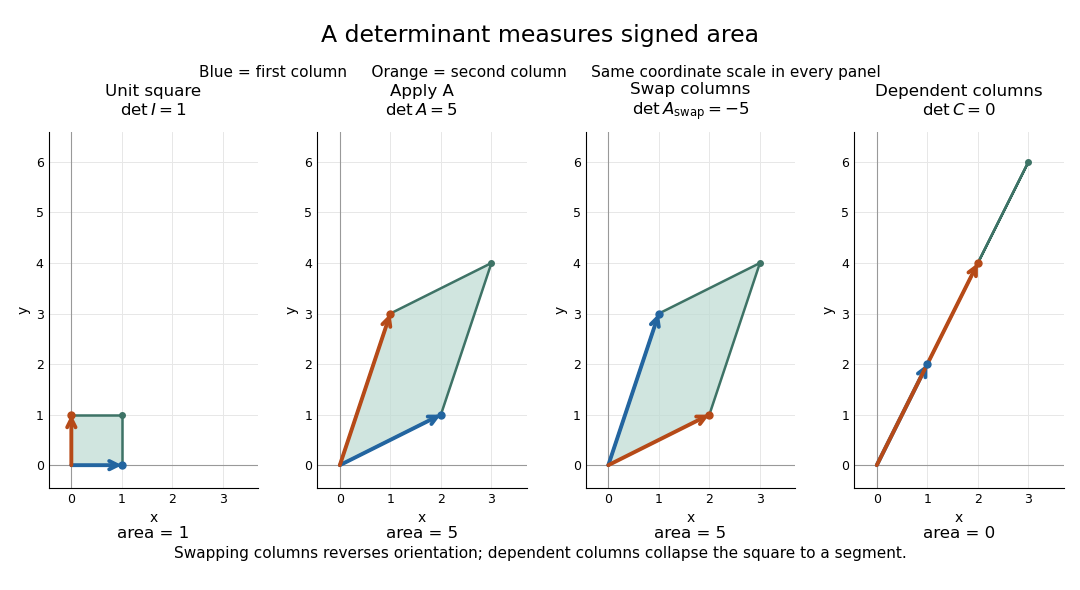
For A, recovery is possible, and the complete matrix multiplication check isHere I is the identity matrix. The inverse matrix restores the original square, shrinking its area by 1/5. Generally, the adjugate identity gives A−1=adj(A)/detA whenever the determinant is nonzero over a field; this is why the denominator matters.[ref]
A−1=51(3−1−12),AA−1=51(2⋅3+1(−1)1⋅3+3(−1)2(−1)+1⋅21(−1)+3⋅2)=(1001)=I.
https://ocw.mit.edu/ans7870/18/18.013a/textbook/HTML/chapter04/section04.html. MIT calculus notes, section 4.4: determinant and inverse
The multiplicativity of the determinant describes two successive deformations. Matrix multiplication means that AB applies B first, then A. TakeThe first linear map doubles area; the second multiplies the resulting area by five. Thus the unit square passes through areas 1,2,10, with the last parallelogram bounded by (0,0),(2,1),(4,7),(2,6). Direct calculation agrees:This explains physically why area factors multiply instead of adding. The general identity holds for square matrices of the same size, including singular matrices. If either stage loses a direction, later processing cannot recover the discarded information.[ref]
B=(1002),AB=(2⋅1+1⋅01⋅1+3⋅02⋅0+1⋅21⋅0+3⋅2)=(2126).
detB=2,det(AB)=2⋅6−2⋅1=10=detAdetB.
https://ocw.mit.edu/ans7870/18/18.013a/textbook/HTML/chapter32/section04.html. MIT calculus notes, section 32.4: determinant products
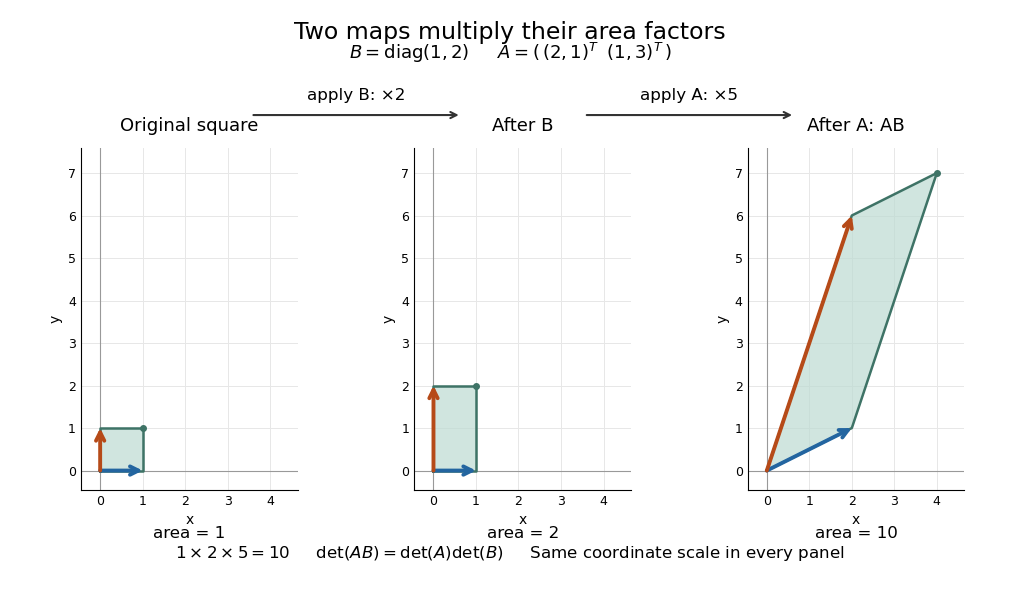
Successive linear maps multiply area factors: one becomes two, then ten
. Details. The same interpretation works in three dimensions without drawing a new picture. The diagonal matrixsends the unit cube to a rectangular box with side lengths two, three, and one. Its ordinary volume is six. The minus sign comes from reversing the third direction, so the oriented volume is minus six. Replacing the last diagonal entry by zero flattens the cube into a planar region: its area may be positive, but its three-dimensional volume is zero. This distinction matters whenever a linear map changes shape: the determinant measures size in the full input dimension, rather than the size of whichever lower-dimensional object remains.
D=20003000−1,detD=2⋅3⋅(−1)=−6
The determinant measures neither trace nor perimeter. For A, the trace happens also to be five, but the identity matrix in two dimensions has trace two and determinant one. The first parallelogram above has perimeter 2(5+10), compared with four for the unit square; boundary length follows a different rule. Nor does determinant one require every length to stay fixed: the diagonal matrix diag(2,1/2) preserves area while stretching one direction and compressing the other.
These properties make the determinant useful when coordinates obscure what a deformation does. A nonzero determinant certifies that linearly independent input directions remain distinguishable; its magnitude counts the area or volume represented by a transformed cell. That second role reappears in the change of variables formula, where the Jacobian determinant corrects the sizes of small cells. Signed volume also separates a deformation that reverses the orientation of a vector space from one that merely stretches it, even when both give identical ordinary volume factors.[ref]
https://ocw.mit.edu/ans7870/18/18.013a/textbook/HTML/chapter24/section02.html. MIT calculus notes, section 24.2: the Jacobian area factor
For general n, regard the columns v1,…,vn as ordered arguments. The determinant is the unique alternating multilinear map to the scalar field normalized by detI=1. The multilinearity of the determinant means linearity in each column separately, with all others held fixed:Alternation means equal columns give zero; exchanging columns negates the result. Normalization sets the oriented volume of the standard basis to one. These properties also hold in rows. For real three-dimensional columns, their determinant is the scalar triple product, and its absolute value is the enclosed volume. Over other fields, the algebraic definition still works even without a geometric notion of positive volume.[ref]
det(…,αu+βv,…)=αdet(…,u,…)+βdet(…,v,…).
https://web.mit.edu/18.06/www/Spring16/lecture22.pdf. Barwick, MIT 18.06 Lecture 22: the determinant axioms
Separate linearity does not mean the determinant is a linear map on the whole matrix. Scaling every column of an n-by-n matrix by t gives det(tA)=tndetA. For our two-dimensional example, det(2A)=4detA=20: doubling both directions quadruples area. The power records how many independent directions are being scaled together.
The properties suggest practical computations. Adding a multiple of one column to another preserves the determinant: the extra term has repeated columns and vanishes. This is the algebra behind an area-preserving shear mapping. Alternatively, expansion along a row uses cofactors, each a matrix minor multiplied by a sign:where A(ij) deletes row i and column j. The Leibniz formula for determinants supplies the general entry formula. Both calculations encode the same geometric invariant; the defining properties explain their structure without requiring memorization of a separate recipe for every size.[ref]
detA=∑j=1naij(−1)i+jdetA(ij),
https://ocw.mit.edu/ans7870/18/18.013a/textbook/HTML/chapter04/section03.html. MIT calculus notes, section 4.3: cofactor expansion
In the Leibniz formula for a determinant of a block diagonal matrix, a term is zero unless its permutation maps every block's row indices onto that same block's column indices. The surviving permutations are precisely independent permutations within the blocks; their signs and products of entries factor over the blocks. Summing therefore gives the product of the individual determinants. Applied to tI−T, this also proves that the characteristic polynomial of a block diagonal linear operator is the product of the characteristic polynomials of its blocks.
Two side vectors span a parallelogram whose signed area is their determinant. Its two congruent triangles give the factor one-half, and the absolute value removes orientation. Reversing the vertex order changes the sign but not the area; collinear vertices give zero.
A determinantal function on Mn(F) is an alternating multilinear map of the n columns, normalized to take value one at the identity matrix. It is uniquely the determinant. Indeed, expand each column in the standard basis. Terms with a repeated basis vector vanish, and all remaining terms differ from the value on the standard basis only by the sign of a permutation. Thus an alternating multilinear map of n columns is determined by its value on the identity matrix.
For planar vectors u=(ux,uy) and v=(vx,vy), the scalar u×v=uxvy−uyvx is the determinant of their coordinate columns. It equals the perpendicular component of the three-dimensional cross product after embedding the plane in three dimensions. Its sign records orientation, and its absolute value is twice the area of the triangle spanned by u,v.
For planar points A,B,P, the sign of (B−A)×(P−A), using the two-dimensional cross product, determines which side of the directed line from A to B contains P. Zero means collinearity. A point is strictly inside a nondegenerate triangle exactly when these signs for its three cyclically ordered sides are all strictly positive or all strictly negative.
For A=B=I2, det(A+B)=det(2I2)=4, while detA+detB=2. The determinant is multilinear in its separate columns, rather than a linear function of the matrix as a whole. Expanding the columns of a sum introduces mixed terms that the proposed additive identity omits.
Expand the determinant along any fixed row i using the displayed formula, where A(i,j) deletes row i and column j. The signed matrix minors are its cofactors. Applying the same formula to the transpose gives the column expansion. The row formula follows from the Leibniz formula for determinants by grouping permutations according to the selected column in row i. For a lower triangular matrix, expanding along the first row reduces the determinant to A11 times a smaller triangular determinant; induction gives the product of all diagonal entries, even when some vanish.
For a weighted acyclic directed graph, let Mij be the sum of path weights from Aj to Bi. Expanding detM gives a signed sum of path families. At the first intersection in a fixed topological order, swap the two path tails. The operation preserves weight and reverses the endpoint permutation's sign, so intersecting families cancel. Only vertex-disjoint families remain. If planarity forces these families to join identically indexed endpoints, their sum has positive sign. Applied to northeast paths with horizontal weight xr at height r, this gives the skew Jacobi–Trudi identity.
Let L be the triangular matrix with Lij=1 for j≤i and zero otherwise. Then (LLT)ij=min(i,j) and detL=1, so the determinant of LLT is one. More generally, for 0=t0<t1<⋯<tn, the matrix with entries min(ti,tj) factors as Ldiag(tk−tk−1)LT and has determinant ∏k(tk−tk−1). This is the finite-dimensional structure behind the Brownian covariance kernel.
For matrices A∈Rr×m and B∈Rm×r with r≤m,where the indices of S are taken in increasing order. To prove it, write the jth column of AB as ∑qBqjA:,q and expand its determinant by multilinearity. Terms with a repeated q vanish by alternation. For each remaining index set S={s1<⋯<sr}, collect all permutations qj=sσ(j). The factor from A is sgn(σ)detA:,S; the sum of the products sgn(σ)∏jBsσ(j),j is detBS,:. This proves the formula. Applying it to selected rows and columns proves that a product of compatible totally nonnegative matrices is totally nonnegative.
det(AB)=∑S⊆{1,…,m}∣S∣=rdetA:,SdetBS,:,
For an invertible square matrix A and Ax=b, replace column i by b to form Ai. Multilinearity of the determinant and b=∑jxjA⋅j give detAi=xidetA: all other summands have repeated columns and vanish. Division gives the formula. With integer coefficients this supplies explicit rational solutions and, together with the Hadamard determinant inequality, bounds their numerators and denominators.
For a square matrix with row vectors ri, the absolute determinant is at most the product of the Euclidean norms of its rows. If the rows are dependent the determinant is zero. Otherwise Gram-Schmidt process leaves the determinant unchanged and replaces each row by its component orthogonal to its predecessors. The resulting orthogonal rows have lengths no greater than the original rows, and their volume is their product. This proves the inequality; equality holds for mutually orthogonal rows.
For an antisymmetric 2n×2n matrix, the Pfaffian is Pf(A)=(2nn!)−1∑σ∈S2nsgn(σ)∏j=1nAσ(2j−1),σ(2j). Equivalently, it is the coefficient of the top exterior power of the associated alternating form, with the usual factorial normalization. Its square is the determinant. In size four it is a12a34−a13a24+a14a23, so its vanishing characterizes the simple nonzero bivectors of the Klein quadric.
The block matrix M=(AB−BA) is similar over C to diag(A+iB,A−iB) via T=(I−iIIiI). Therefore its determinant is det(A+iB)det(A−iB) for arbitrary square matrices A,B. The argument uses a constant change-of-basis matrix and multiplicativity of the determinant.
For a differentiable invertible matrix A(t), dtdlogdetA=tr(A−1A˙) wherever a consistent logarithm is defined. In particular a positive spatial metric tensor satisfies hijh˙ij=h˙/h. This separates its local volume change from shape change.
For an invertible matrix A and any matrix H,Indeed det(A+tH)=det(A)det(I+tA−1H), and multilinearity shows that the linear coefficient of det(I+tB) is trB. At a singular matrix the derivative is instead written tr(adj(A)H); this polynomial formula holds for all A.
D(det)A(H)=det(A)tr(A−1H).
For an arbitrary square matrix A, the derivative of the determinant in direction H is the displayed expression. Differentiating the determinant's multilinear expansion gives the sum of entries of H weighted by their cofactors, equal to the displayed trace. If A is invertible, adj(A)=(detA)A−1 gives (detA)tr(A−1H), and division by detA gives the Jacobi determinant derivative formula for the logarithmic derivative. The adjugate expression remains valid at singular matrices.
The derivative of the determinant at an invertible matrix is DdetA(K)=detAtr(A−1K). At A=I+H, use det(I+H)=1+trH+O(∥H∥2) and (I+H)−1=I−H+O(∥H∥2). Differentiating the first derivative gives the displayed symmetric bilinear map. More generally D2detA(H,K)=detA[tr(A−1H)tr(A−1K)−tr(A−1HA−1K)].
On positive-definite matrices, the log-determinant has differential dlogdetA=Tr(A−1dA) and is a strictly concave function.
The determinant is linear in each row and in each column when all the others are held fixed.
For diagonal entries ai, superdiagonal entries bi, and subdiagonal entries ci, the leading principal determinants satisfy
dn=andn−1−bn−1cn−1dn−2,d0=1,d1=a1.
For N equal masses joined to fixed walls by equal springs, the stiffness matrix has diagonal 2k and adjacent entries −k. Its characteristic determinant obeys DN=dDN−1−k2DN−2, d=2k−mω2, D0=1, D1=d. If β1+β2=d and β1β2=k2, then DN=(β1N+1−β2N+1)/(β1−β2) for distinct roots. At a repeated root β=±k, the correct limit is (N+1)βN, which is nonzero. Thus the apparent ratio solution β1/β2=1 must be excluded. Writing d=2kcosq gives DN=kNsin[(N+1)q]/sinq, the Chebyshev polynomial of the second kind. There are exactly N distinct positive normal frequencies 2k/msin[jπ/(2(N+1))], 1≤j≤N.
For N identical masses between fixed walls with equal springs, the dimensionless stiffness matrix has diagonal entries 2 and adjacent entries −1. Its normalized eigenvectors and eigenvalues areExtend each vector by a0=aN+1=0. The sine addition identity gives 2ai−ai−1−ai+1=λjai, including the fixed-end rows. The finite sine orthogonality identity supplies the normalization and makes distinct vectors orthogonal. The normal mode angular frequencies are ωj=kλj/m for mass m and spring constant k. This complements the fixed-end spring-chain determinant and its repeated-root limit with the spatial mode shapes.
ai(j)=N+12sinN+1ijπ,λj=2−2cosN+1jπ,1≤i,j≤N.
Ancestors (6)
Incoming links (1205)
- ABCD law for Gaussian beams
- Accretive complex quadratic reciprocal Fourier transform
- Active planar rotation
- Adjacent sums of a cyclic basis
- Affine map
- Alexander breadth bound on Seifert genus
- Alternant orthogonality on a unitary torus
- Alternating bilinear form
- Analytic determinant square root for accretive symmetric matrices
- Antisymmetric tensor vacuum stabilizer in SU(4)
- Area-preserving map
- Area-preserving seasonal predator-prey map
- Automorphism of a one-dimensional complex torus
- Balanced two-mode fermion antibunching
- Bareiss algorithm
- Basis
- Block diagonal matrix
- Block elimination
- Cartan–Dieudonné theorem
- Cartesian and oblique coordinate reconstruction
- Cartesian second-rank tensor
- Cauchy–Binet formula
- Centralizer of the standard SU2 subgroup in SU3
- Change-of-basis matrix
- Change of variables formula
- Chemotactic instability on a rectangular domain
- Chemotactic instability with logistic growth and saturating production
- Chemotactic pattern-instability criterion
- Chirality (chemistry)
- Chirped Gaussian wave packet
- Circular-eigenmode Jones propagator
- Closed fermion loop sign
- Closest point on the intersection of two planes
- Cofactor
- Complex-linear map
- Complex plane
- Complex special linear group in dimension two
- Configuration interaction with singles and doubles
- Conformal automorphism of the upper half-plane
- Conic discriminant
- Conic type discriminant
- Constant-modulus holomorphic function
- Constraint reaction in hyperelastic stress
- Contact-interaction Bose-gas field integral
- Contact time of translating line segments
- Continuation predictor-corrector step
- Coplanarity
- Counterterm closure of a massive Yukawa theory
- Cramer's rule
- Cross-ratio normalization of four projective points
- Cubic fast-slow reaction-diffusion model
- Cusp holomorphy under rational slash operators
- Deformation gradient
- Degenerate metric tensor
- Degree drop in a specialized resultant
- Determinant
- Determinantal form of a symmetric-group character
- Determinantal function
- Determinantal point process
- Determinant description of the theta divisor
- Determinant formula for triangle area
- Determinant is not additive
- Determinant line bundle
- Determinant-normalized slash operator
- Determinant of a block diagonal matrix
- Determinant of a complex block representation
- Determinant of Hermitian congruence
- Determinant of the minimum-index matrix
- Determinant twist
- Determinant-twist projection in odd dimension
- Diagonal matrix entry
- Differentiation on an exponential-polynomial space
- Direct-product decomposition of the cube symmetry group
- Discriminant quintic of a cubic surface conic bundle
- D-optimal design
- Double integrator
- Dual lattice
- Dust gravitational dispersion relation with gas drag
- Eigenvalue
- Eigenvalue equation for heat conduction in two joined slabs
- Elementary column operation
- Elementary row operation
- Elliptical potential bound
- Error modes of a three-variable Jacobi iteration
- Euclidean invariance of the shape operator
- Euler's volume identity
- Evaluation determinant on a product of curves
- Exact error contraction of a two-variable Gauss-Seidel iteration
- Exterior algebra
- Exterior power
- Exterior product
- Extraordinary wave
- Fekete interpolation sites for a continuous function space
- Field norm
- Finite observations do not certify Richardson extrapolation accuracy
- Fixed-end spring-chain determinant and its repeated-root limit
- Fixed-point congruence for an involution on an odd-sphere connected sum
- Fixed-quota harvesting of Lotka-Volterra populations
- Fold and Hopf thresholds of a directly forced cubic amplitude
- Four-vector scalar triple product identity
- Full-row-rank matrix manifold
- Future-null spinor factorization
- Gaussian curvature
- Gaussian elimination with a row swap
- Gaussian free-energy logarithms at integer singular powers
- Gaussian path integral
- Gaussian specific-heat infrared threshold
- Gaussian unitary ensemble
- Gershgorin exclusion for a matrix-pencil parameter
- Ghost coupling in a linear Cartesian Abelian Higgs gauge
- Givens rotation
- Growth tensor
- Haar sampling by Gaussian QR decomposition
- Hadamard determinant inequality
- Harmonic conjugate points
- Hartree-Fock method
- Hermitian-matrix double cover of SO0(3,1)
- Hessian criterion for a flex
- Hessian determinant
- Hessian matrix
- Highest-weight classification of rational GL representations
- Holomorphic volume form
- Hopf thresholds in a two-pool calcium model
- Horizontal-field magnetoconvection dispersion relation
- Image parity in gravitational lensing
- Imperfect soft Duffing-van der Pol oscillator
- Implicit function theorem
- Indefinite special unitary group
- Ingoing Kerr-Schild coordinates for Schwarzschild spacetime
- Instability of the Nicholson-Bailey equilibrium
- Instanton fluctuation prefactor
- Integer determinant and sublattice index
- Integer inverse criterion for a unimodular matrix
- Integral basis for coprime biquadratic radicands congruent to two and one
- Invertibility forced by a polynomial product identity
- Invertible anticommuting matrices have even dimension and zero traces
- Invertible cup-product direction for a line bundle on a curve
- Invertible matrix
- Invertible three-channel opponent transform
- Isotropic third-rank tensor
- Jacobian determinant
- Jacobi's formula
- K1 of a ring
- Keller--Segel aggregation threshold
- Kernel of the cube face-axis action
- Lagrange multiplier determinant condition in two variables
- Lagrange optical invariant
- Lake-coupled Röthlisberger drainage instability
- Laplace expansion
- Leading coefficient of an exponential alternant
- Leslie-Gower predator-prey model
- Linear flow
- Linear Stark effect in the first excited hydrogen eigenspace
- Liouville formula for a fundamental matrix
- Low-degree evaluation rank on a uniform layer
- Lower triangular matrix
- Lozi map
- Matrix determinant lemma
- Matrix exponential determinant identity
- Matrix inverse
- Matrix model of anti-de Sitter three-space
- Matrix similarity invariants
- Matrix trace
- Maximal-order Runge-Kutta methods are A-stable
- Metaplectic correction
- Minor (linear algebra)
- Monodromy matrix of a periodic linear system
- Monomial alternant
- Multilinear map
- NaCl conventional cell and coordination
- N-dimensional Levi-Civita symbol
- Negative self-response excludes two-species Turing instability
- Nondegenerate bilinear form
- Nondegenerate stationary points of a planar harmonic function
- Nonlinear shear map
- Normal modes of a spring-mounted pendulum cart
- Norm for a finite free ring extension
- Odd-dimensional orthogonal determinant splitting
- Odd-dimensional real matrix with positive determinant has a positive eigenvalue
- Odd-dimensional skew-symmetric singularity theorem
- Odd dimension of a periodic Chebyshev system
- Optimal experimental design
- Ordered Grassmann Gaussian contractions
- Orientability
- Orientability of a regular fibre
- Orientation-preserving general linear group
- Orthogonal polynomial projection kernel
- Orthogonal skew-symmetric matrix
- Paired coordinates of a symplectic basis
- Parallelepiped
- Parallel obstruction to a transversal of three skew lines
- Parallelogram
- Past exam of the advanced fluid dynamics course of the University of Oxford / 2024 / 1 / e / Solution
- Past exam of the advanced quantum field theory for particle physics course of the University of Oxford / 2017 / 3 / a / i / Solution
- Past exam of the advanced topics in statistical machine learning course of the University of Oxford / 2025 / 1 / a / iii / Solution
- Past exam of the advanced topics in statistical machine learning course of the University of Oxford / 2025 / 2 / b / ii / Solution
- Past exam of the algebra 1 and differential equations 1 course of the University of Oxford / 2014 / 2 / b / i / Solution
- Past exam of the algebra 1 and differential equations 1 course of the University of Oxford / 2014 / 2 / c / ii / Solution
- Past exam of the algebra 1 and differential equations 1 course of the University of Oxford / 2014 / 3 / b / ii / Solution
- Past exam of the algebra 1 and differential equations 1 course of the University of Oxford / 2015 / 2 / a / Solution
- Past exam of the algebra, analysis and differential equations II course of the University of Oxford / 2011 / Algebra / 1 / c / Solution
- Past exam of the algebra, analysis and differential equations II course of the University of Oxford / 2011 / Differential Equations / 8 / Solution
- Past exam of the algebra, analysis and differential equations II course of the University of Oxford / 2012 / 1 / a / Solution
- Past exam of the algebra, analysis and differential equations II course of the University of Oxford / 2012 / 1 / b / Solution
- Past exam of the algebra, analysis and differential equations II course of the University of Oxford / 2012 / 1 / c / Solution
- Past exam of the algebra and analysis II for mathematics and philosophy course of the University of Oxford / 2013 / 6 / b / Solution
- Past exam of the algebra and analysis II for mathematics and philosophy course of the University of Oxford / 2013 / 6 / d / Solution
- Past exam of the algebra course of the University of Oxford / 2007 / A / 4 / iii / Solution
- Past exam of the algebra course of the University of Oxford / 2010 / A / 1 / c / Solution
- Past exam of the algebra course of the University of Oxford / 2011 / 3 / c / i / Solution
- Past exam of the algebra course of the University of Oxford / 2011 / 6 / b / Solution
- Past exam of the algebraic curves course of the University of Oxford / 2023 / 2 / b / Solution
- Past exam of the algebraic curves course of the University of Oxford / 2023 / 2 / c / Solution
- Past exam of the algebraic curves course of the University of Oxford / 2023 / 2 / d / Solution
- Past exam of the algebraic curves course of the University of Oxford / 2023 / 3 / e / Solution
- Past exam of the algebraic number theory course of the University of Oxford / 2023 / 1 / c / iii / Solution
- Past exam of the algebraic number theory course of the University of Oxford / 2023 / 1 / c / ii / Solution
- Past exam of the algebraic number theory course of the University of Oxford / 2023 / 2 / a / Solution
- Past exam of the algebraic number theory course of the University of Oxford / 2023 / 3 / a / Solution
- Past exam of the chemistry A course of the University of Cambridge / 2022 / Paper 1 / A4 / b / ii / Solution
- Past exam of the chemistry course of the year 3 of the natural sciences course of the University of Cambridge / 2022 / Paper 2A / Section A / 17 / a / Solution
- Past exam of the chemistry course of the year 3 of the natural sciences course of the University of Cambridge / 2022 / Paper 2A / Section A / 17 / b / Solution
- Past exam of the chemistry course of the year 3 of the natural sciences course of the University of Cambridge / 2022 / Paper 2A / Section A / 17 / c / Solution
- Past exam of the chemistry course of the year 3 of the natural sciences course of the University of Cambridge / 2022 / Paper 2A / Section A / 19 / a / ii / Solution
- Past exam of the chemistry course of the year 3 of the natural sciences course of the University of Cambridge / 2022 / Paper 2A / Section A / 19 / a / i / Solution
- Past exam of the chemistry course of the year 3 of the natural sciences course of the University of Cambridge / 2022 / Paper 2A / Section A / 19 / b / Solution
- Past exam of the collisionless plasma physics course of the University of Oxford / 2025 / 1 / b / Solution
- Past exam of the commutative algebra course of the University of Oxford / 2017 / 2 / c / Solution
- Past exam of the computer science course of the University of Oxford / 2015 / Computer graphics / 2 / b / i / Solution
- Past exam of the computer science course of the University of Oxford / 2015 / Geometric modelling / 1 / a / Solution
- Past exam of the computer science course of the University of Oxford / 2015 / Geometric modelling / 3 / e / Solution
- Past exam of the computer science course of the University of Oxford / 2023 / Quantum information / 3 / c / ii / Solution
- Past exam of the differential equations 1 course of the University of Oxford / 2021 / 1 / b / i / Solution
- Past exam of the differential equations and applications course of the University of Oxford / 2007 / A / 1 / Solution
- Past exam of the differential equations and applications course of the University of Oxford / 2007 / B / 5 / Solution
- Past exam of the elasticity and plasticity course of the University of Oxford / 2011 / 1 / a / Solution
- Past exam of the elasticity and plasticity course of the University of Oxford / 2011 / 2 / d / Solution
- Past exam of the elasticity and plasticity course of the University of Oxford / 2011 / 2 / h / Solution
- Past exam of the flows, fluctuations and complexity and symmetry and relativity paper of Part B of the physics course of the University of Oxford / 2011 / 3 / 3 / Solution
- Past exam of the fluids and waves course of the University of Oxford / 2017 / 1 / a / ii / Solution
- Past exam of the functional Analysis and Banach and C*-Algebras course of the University of Oxford / 2007 / B / 7 / Solution
- Past exam of the further mathematical biology course of the University of Oxford / 2023 / 2 / a / ii / Solution
- Past exam of the further mathematical biology course of the University of Oxford / 2023 / 3 / d / Solution
- Past exam of the further quantum theory course of the University of Oxford / 2023 / 2 / c / Solution
- Past exam of the general relativity II course of the University of Oxford / 2015 / 2 / b
- Past exam of the general relativity II course of the University of Oxford / 2017 / 2 / b / i / Solution
- Past exam of the general relativity II course of the University of Oxford / 2017 / 3 / a / Solution
- Past exam of the general relativity II course of the University of Oxford / 2021 / 3 / a / Solution
- Past exam of the geometry course of the University of Oxford / 2010 / A / 2 / i / Solution
- Past exam of the geometry course of the University of Oxford / 2010 / B / 4 / a / Solution
- Past exam of the geometry course of the University of Oxford / 2010 / B / 4 / c / Solution
- Past exam of the geometry of surfaces course of the University of Oxford / 2023 / 3 / a / Solution
- Past exam of the geometry of surfaces course of the University of Oxford / 2023 / 3 / b / Solution
- Past exam of the groups and representations course of the University of Oxford / 2018 / 2 / a / Solution
- Past exam of the groups and representations course of the University of Oxford / 2019 / 3 / a / Solution
- Past exam of the groups and representations course of the University of Oxford / 2020 / 3 / d / Solution
- Past exam of the groups and representations course of the University of Oxford / 2020 / 4 / a / Solution
- Past exam of the groups and representations course of the University of Oxford / 2021 / 4 / d / Solution
- Past exam of the groups and representations course of the University of Oxford / 2022 / 3 / b / Solution
- Past exam of the groups and representations course of the University of Oxford / 2024 / 2 / a / Solution
- Past exam of the groups and representations course of the University of Oxford / 2024 / 3 / a / Solution
- Past exam of the groups and representations course of the University of Oxford / 2024 / 3 / e / Solution
- Past exam of the groups and representations course of the University of Oxford / 2024 / 4 / b / Solution
- Past exam of the groups and representations course of the University of Oxford / 2025 / 2 / a / Solution
- Past exam of the history of mathematics course of the University of Oxford / 2023 / 3 / Solution
- Past exam of the history of mathematics course of the University of Oxford / 2023 / 8 / Solution
- Past exam of the integer programming course of the University of Oxford / 2010 / 2 / a / Solution
- Past exam of the integer programming course of the University of Oxford / 2011 / 3 / a / Solution
- Past exam of the laser science and quantum information processing course of the University of Oxford / 2021 / 6 / d / Solution
- Past exam of the lie Groups and Differentiable Manifolds course of the University of Oxford / 2008 / A / 3 / b / iii / Solution
- Past exam of the linear algebra course of the University of Oxford / 2017 / 1 / a / ii / Solution
- Past exam of the linear algebra course of the University of Oxford / 2017 / 1 / a / i / Solution
- Past exam of the linear algebra course of the University of Oxford / 2021 / 3 / b / ii / Solution
- Past exam of the mathematical and Computational Biology course of the University of Cambridge / 2024 / Paper 1 / B3 / c / Solution
- Past exam of the mathematical mechanical biology course of the University of Oxford / 2023 / 3 / b / i / Solution
- Past exam of the mathematical methods I course of the University of Oxford / 2013 / 11 / a / Solution
- Past exam of the mathematical methods I course of the University of Oxford / 2013 / 5 / Solution
- Past exam of the mathematical methods I course of the University of Oxford / 2013 resit / 10 / a / ii / Solution
- Past exam of the mathematical methods I course of the University of Oxford / 2013 resit / 5 / Solution
- Past exam of the mathematical methods I course of the University of Oxford / 2013 resit / 9 / a / Solution
- Past exam of the mathematical methods I course of the University of Oxford / 2014 / 12 / vi / Solution
- Past exam of the mathematical methods I course of the University of Oxford / 2014 / 2 / Solution
- Past exam of the mathematical methods I course of the University of Oxford / 2014 / 7 / i / Solution
- Past exam of the mathematical methods I course of the University of Oxford / 2014 resit / 12 / iii / Solution
- Past exam of the mathematical methods I course of the University of Oxford / 2014 resit / 12 / i / Solution
- Past exam of the mathematical methods I course of the University of Oxford / 2014 resit / 12 / viii / Solution
- Past exam of the mathematical methods I course of the University of Oxford / 2014 resit / 2 / Solution
- Past exam of the mathematical methods I course of the University of Oxford / 2014 resit / 3 / iii / Solution
- Past exam of the mathematical methods I course of the University of Oxford / 2014 resit / 3 / i / Solution
- Past exam of the mathematical methods I course of the University of Oxford / 2015 / 7 / Solution
- Past exam of the mathematical methods I course of the University of Oxford / 2015 / 8 / iii / Solution
- Past exam of the mathematical methods I course of the University of Oxford / 2015 / 8 / ii / Solution
- Past exam of the mathematical methods I course of the University of Oxford / 2015 / 8 / iv / Solution
- Past exam of the mathematical methods I course of the University of Oxford / 2015 / 9 / Solution
- Past exam of the mathematical methods I course of the University of Oxford / 2015 resit / 11 / d / Solution
- Past exam of the mathematical methods I course of the University of Oxford / 2015 resit / 5 / Solution
- Past exam of the mathematical methods I course of the University of Oxford / 2015 resit / 7 / i / Solution
- Past exam of the mathematical methods I course of the University of Oxford / 2015 resit / 7 / iv / Solution
- Past exam of the mathematical methods I course of the University of Oxford / 2016 / 10 / Solution
- Past exam of the mathematical methods I course of the University of Oxford / 2016 resit / 2 / Solution
- Past exam of the mathematical methods I course of the University of Oxford / 2017 / 4 / b / Solution
- Past exam of the mathematical methods I course of the University of Oxford / 2017 / 5 / Solution
- Past exam of the mathematical methods I course of the University of Oxford / 2017 / 6 / Solution
- Past exam of the mathematical methods I course of the University of Oxford / 2017 resit / 4 / i / Solution
- Past exam of the mathematical methods I course of the University of Oxford / 2017 resit / 5 / a / Solution
- Past exam of the mathematical methods I course of the University of Oxford / 2017 resit / 5 / b / Solution
- Past exam of the mathematical methods I course of the University of Oxford / 2019 / 11 / c / iv / Solution
- Past exam of the mathematical methods I course of the University of Oxford / 2019 / 12 / c / Solution
- Past exam of the mathematical methods I course of the University of Oxford / 2019 / 2 / Solution
- Past exam of the mathematical methods I course of the University of Oxford / 2019 / 7 / Solution
- Past exam of the mathematical methods I course of the University of Oxford / 2019 resit / 11 / b / i / Solution
- Past exam of the mathematical methods I course of the University of Oxford / 2019 resit / 12 / a / Solution
- Past exam of the mathematical methods I course of the University of Oxford / 2019 resit / 3 / Solution
- Past exam of the mathematical methods I course of the University of Oxford / 2019 resit / 9 / Solution
- Past exam of the mathematical methods I course of the University of Oxford / 2021 / 6 / Solution
- Past exam of the mathematical methods I course of the University of Oxford / 2021 resit / 4 / a / Solution
- Past exam of the mathematical methods I course of the University of Oxford / 2021 resit / 4 / b / Solution
- Past exam of the mathematical methods I course of the University of Oxford / 2021 resit / 8 / b / Solution
- Past exam of the mathematical methods I course of the University of Oxford / 2021 resit / 8 / c / iii / Solution
- Past exam of the mathematical methods I course of the University of Oxford / 2021 resit / 8 / c / ii / Solution
- Past exam of the mathematical methods I course of the University of Oxford / 2021 resit / 9 / iii / a / Solution
- Past exam of the mathematical methods I course of the University of Oxford / 2022 / 5 / ii / Solution
- Past exam of the mathematical methods I course of the University of Oxford / 2022 / 5 / i / Solution
- Past exam of the mathematical methods II course of the University of Oxford / 2015 / 10 / a / i / Solution
- Past exam of the mathematical methods II course of the University of Oxford / 2015 / 9 / c / Solution
- Past exam of the mathematical methods II course of the University of Oxford / 2015 resit / 4 / Solution
- Past exam of the mathematical methods II course of the University of Oxford / 2017 resit / 11 / c / Solution
- Past exam of the mathematical methods II course of the University of Oxford / 2017 resit / 6 / Solution
- Past exam of the mathematical methods II course of the University of Oxford / 2019 resit / 10 / a / ii / Solution
- Past exam of the mathematical methods II course of the University of Oxford / 2019 resit / 10 / a / i / Solution
- Past exam of the mathematical methods II course of the University of Oxford / 2021 resit / 11 / b / Solution
- Past exam of the mathematical methods II course of the University of Oxford / 2022 / 10 / a / Solution
- Past exam of the mathematical methods II course of the University of Oxford / 2022 / 11 / a / Solution
- Past exam of the mathematical physiology course of the University of Oxford / 2023 / 3 / d / Solution
- Past exam of the mathematics and the environment and mathematical physiology course of the University of Oxford / 2009 / A / 1 / v / Solution
- Past exam of the mathematics and the environment and mathematical physiology course of the University of Oxford / 2009 / B / 5 / d / Solution
- Past exam of the mathematics course of the University of Cambridge / 2001 / ia / Paper 1 / 5C / Solution
- Past exam of the mathematics course of the University of Cambridge / 2001 / ia / Paper 2 / 5B / Solution
- Past exam of the mathematics course of the University of Cambridge / 2001 / ia / Paper 2 / 6B / Solution
- Past exam of the mathematics course of the University of Cambridge / 2001 / ia / Paper 2 / 7B / Solution
- Past exam of the mathematics course of the University of Cambridge / 2001 / ia / Paper 2 / 8B / Solution
- Past exam of the mathematics course of the University of Cambridge / 2001 / ia / Paper 3 / 1F / Solution
- Past exam of the mathematics course of the University of Cambridge / 2001 / ia / Paper 3 / 5F / Solution
- Past exam of the mathematics course of the University of Cambridge / 2001 / ia / Paper 3 / 9C / Solution
- Past exam of the mathematics course of the University of Cambridge / 2001 / ib / Paper 1 / 5C / Solution
- Past exam of the mathematics course of the University of Cambridge / 2001 / ib / Paper 3 / 16E / b / Solution
- Past exam of the mathematics course of the University of Cambridge / 2001 / ib / Paper 4 / 6C / Solution
- Past exam of the mathematics course of the University of Cambridge / 2001 / ib / Paper 4 / 8F / Solution
- Past exam of the mathematics course of the University of Cambridge / 2001 / ib / Paper 4 / 9F / Solution
- Past exam of the mathematics course of the University of Cambridge / 2001 / iii / Paper 30 / 4 / Solution
- Past exam of the mathematics course of the University of Cambridge / 2001 / iii / Paper 31 / 2 / Solution
- Past exam of the mathematics course of the University of Cambridge / 2001 / iii / Paper 31 / 3 / ii / Solution
- Past exam of the mathematics course of the University of Cambridge / 2001 / iii / Paper 3 / 5 / b / Solution
- Past exam of the mathematics course of the University of Cambridge / 2001 / iii / Paper 3 / 5 / c / Solution
- Past exam of the mathematics course of the University of Cambridge / 2001 / iii / Paper 45 / 1 / ii / Solution
- Past exam of the mathematics course of the University of Cambridge / 2001 / iii / Paper 48 / 2 / Solution
- Past exam of the mathematics course of the University of Cambridge / 2001 / iii / Paper 51 / 3 / a / Solution
- Past exam of the mathematics course of the University of Cambridge / 2001 / iii / Paper 52 / 1 / b / Solution
- Past exam of the mathematics course of the University of Cambridge / 2001 / iii / Paper 62 / 2 / Solution
- Past exam of the mathematics course of the University of Cambridge / 2001 / iii / Paper 67 / 1 / i / Solution
- Past exam of the mathematics course of the University of Cambridge / 2001 / iii / Paper 68 / 1 / Solution
- Past exam of the mathematics course of the University of Cambridge / 2001 / iii / Paper 68 / 3 / b / Solution
- Past exam of the mathematics course of the University of Cambridge / 2001 / iii / Paper 74 / 3 / Solution
- Past exam of the mathematics course of the University of Cambridge / 2001 / iii / Paper 75 / 3 / Solution
- Past exam of the mathematics course of the University of Cambridge / 2001 / iii / Paper 75 / 5 / Solution
- Past exam of the mathematics course of the University of Cambridge / 2001 / iii / Paper 75 / 6 / Solution
- Past exam of the mathematics course of the University of Cambridge / 2001 / iii / Paper 77 / 2 / Solution
- Past exam of the mathematics course of the University of Cambridge / 2001 / iii / Paper 77 / 5 / Solution
- Past exam of the mathematics course of the University of Cambridge / 2001 / iii / Paper 77 / 6 / Solution
- Past exam of the mathematics course of the University of Cambridge / 2001 / iii / Paper 77 / 7 / Solution
- Past exam of the mathematics course of the University of Cambridge / 2001 / iii / Paper 77 / 8 / Solution
- Past exam of the mathematics course of the University of Cambridge / 2001 / iii / Paper 8 / 2 / Solution
- Past exam of the mathematics course of the University of Cambridge / 2001 / iii / Paper 8 / 3 / Solution
- Past exam of the mathematics course of the University of Cambridge / 2002 / ia / Paper 1 / 1B / b / Solution
- Past exam of the mathematics course of the University of Cambridge / 2002 / ia / Paper 1 / 2D / Solution
- Past exam of the mathematics course of the University of Cambridge / 2002 / ia / Paper 1 / 7B / a / Solution
- Past exam of the mathematics course of the University of Cambridge / 2002 / ia / Paper 3 / 1A / Solution
- Past exam of the mathematics course of the University of Cambridge / 2002 / ia / Paper 3 / 5E / Solution
- Past exam of the mathematics course of the University of Cambridge / 2002 / ia / Paper 3 / 7A / Solution
- Past exam of the mathematics course of the University of Cambridge / 2002 / ia / Paper 3 / 8B / b / Solution
- Past exam of the mathematics course of the University of Cambridge / 2002 / ia / Paper 3 / 9A / Solution
- Past exam of the mathematics course of the University of Cambridge / 2002 / ib / Paper 1 / 17F / Solution
- Past exam of the mathematics course of the University of Cambridge / 2002 / ib / Paper 1 / 4E / Solution
- Past exam of the mathematics course of the University of Cambridge / 2002 / ib / Paper 2 / 7B / Solution
- Past exam of the mathematics course of the University of Cambridge / 2002 / ib / Paper 3 / 17F / Solution
- Past exam of the mathematics course of the University of Cambridge / 2002 / ib / Paper 3 / 19F / Solution
- Past exam of the mathematics course of the University of Cambridge / 2002 / iii / Paper 13 / 5 / Solution
- Past exam of the mathematics course of the University of Cambridge / 2002 / iii / Paper 14 / 1 / Solution
- Past exam of the mathematics course of the University of Cambridge / 2002 / iii / Paper 14 / 2 / Solution
- Past exam of the mathematics course of the University of Cambridge / 2002 / iii / Paper 14 / 6 / Solution
- Past exam of the mathematics course of the University of Cambridge / 2002 / iii / Paper 1 / 5 / Solution
- Past exam of the mathematics course of the University of Cambridge / 2002 / iii / Paper 17 / 4 / Solution
- Past exam of the mathematics course of the University of Cambridge / 2002 / iii / Paper 19 / 3 / Solution
- Past exam of the mathematics course of the University of Cambridge / 2002 / iii / Paper 30 / 3 / Solution
- Past exam of the mathematics course of the University of Cambridge / 2002 / iii / Paper 32 / 1 / a / Solution
- Past exam of the mathematics course of the University of Cambridge / 2002 / iii / Paper 32 / 1 / c / iii / Solution
- Past exam of the mathematics course of the University of Cambridge / 2002 / iii / Paper 34 / 2 / Solution
- Past exam of the mathematics course of the University of Cambridge / 2002 / iii / Paper 38 / 1 / Solution
- Past exam of the mathematics course of the University of Cambridge / 2002 / iii / Paper 38 / 2 / Solution
- Past exam of the mathematics course of the University of Cambridge / 2002 / iii / Paper 39 / 6 / Solution
- Past exam of the mathematics course of the University of Cambridge / 2002 / iii / Paper 40 / 3 / b / i / Solution
- Past exam of the mathematics course of the University of Cambridge / 2002 / iii / Paper 56 / 1 / a / Solution
- Past exam of the mathematics course of the University of Cambridge / 2002 / iii / Paper 56 / 2 / a / Solution
- Past exam of the mathematics course of the University of Cambridge / 2002 / iii / Paper 56 / 2 / c / Solution
- Past exam of the mathematics course of the University of Cambridge / 2002 / iii / Paper 56 / 3 / b / Solution
- Past exam of the mathematics course of the University of Cambridge / 2002 / iii / Paper 56 / 4 / b / Solution
- Past exam of the mathematics course of the University of Cambridge / 2002 / iii / Paper 57 / 1 / Solution
- Past exam of the mathematics course of the University of Cambridge / 2002 / iii / Paper 57 / 2 / a / Solution
- Past exam of the mathematics course of the University of Cambridge / 2002 / iii / Paper 57 / 4 / Solution
- Past exam of the mathematics course of the University of Cambridge / 2002 / iii / Paper 57 / 5 / Solution
- Past exam of the mathematics course of the University of Cambridge / 2002 / iii / Paper 69 / 2 / d / Solution
- Past exam of the mathematics course of the University of Cambridge / 2002 / iii / Paper 69 / 2 / Solution
- Past exam of the mathematics course of the University of Cambridge / 2003 / ia / Paper 1 / 2D / Solution
- Past exam of the mathematics course of the University of Cambridge / 2003 / ia / Paper 1 / 5B / a / Solution
- Past exam of the mathematics course of the University of Cambridge / 2003 / ia / Paper 1 / 5B / b / ii / Solution
- Past exam of the mathematics course of the University of Cambridge / 2003 / ia / Paper 1 / 6A / Solution
- Past exam of the mathematics course of the University of Cambridge / 2003 / ia / Paper 1 / 7B / Solution
- Past exam of the mathematics course of the University of Cambridge / 2003 / ia / Paper 2 / 7D / Solution
- Past exam of the mathematics course of the University of Cambridge / 2003 / ia / Paper 3 / 10A / Solution
- Past exam of the mathematics course of the University of Cambridge / 2003 / ia / Paper 3 / 6E / Solution
- Past exam of the mathematics course of the University of Cambridge / 2003 / ia / Paper 3 / 7B / i / Solution
- Past exam of the mathematics course of the University of Cambridge / 2003 / ia / Paper 3 / 8B / a / Solution
- Past exam of the mathematics course of the University of Cambridge / 2003 / ib / Paper 2 / 10F / Solution
- Past exam of the mathematics course of the University of Cambridge / 2003 / ib / Paper 2 / 15E / d / Solution
- Past exam of the mathematics course of the University of Cambridge / 2003 / ib / Paper 2 / 17G / b / Solution
- Past exam of the mathematics course of the University of Cambridge / 2003 / ib / Paper 2 / 8G / Solution
- Past exam of the mathematics course of the University of Cambridge / 2003 / ib / Paper 3 / 17G / Solution
- Past exam of the mathematics course of the University of Cambridge / 2003 / ib / Paper 3 / 4F / Solution
- Past exam of the mathematics course of the University of Cambridge / 2003 / ib / Paper 3 / 9G / Solution
- Past exam of the mathematics course of the University of Cambridge / 2003 / iii / Paper 16 / 2 / c / Solution
- Past exam of the mathematics course of the University of Cambridge / 2003 / iii / Paper 17 / 1 / Solution
- Past exam of the mathematics course of the University of Cambridge / 2003 / iii / Paper 23 / 5 / ii / Solution
- Past exam of the mathematics course of the University of Cambridge / 2003 / iii / Paper 37 / 2 / Solution
- Past exam of the mathematics course of the University of Cambridge / 2003 / iii / Paper 4 / 2 / Solution
- Past exam of the mathematics course of the University of Cambridge / 2003 / iii / Paper 48 / 4 / a / Solution
- Past exam of the mathematics course of the University of Cambridge / 2003 / iii / Paper 48 / 4 / b / Solution
- Past exam of the mathematics course of the University of Cambridge / 2003 / iii / Paper 59 / 1 / b / Solution
- Past exam of the mathematics course of the University of Cambridge / 2003 / iii / Paper 59 / 1 / d / Solution
- Past exam of the mathematics course of the University of Cambridge / 2003 / iii / Paper 59 / 2 / d / Solution
- Past exam of the mathematics course of the University of Cambridge / 2003 / iii / Paper 59 / 4 / b / Solution
- Past exam of the mathematics course of the University of Cambridge / 2003 / iii / Paper 60 / 1 / ii / Solution
- Past exam of the mathematics course of the University of Cambridge / 2003 / iii / Paper 60 / 2 / ii / Solution
- Past exam of the mathematics course of the University of Cambridge / 2003 / iii / Paper 60 / 3 / ii / Solution
- Past exam of the mathematics course of the University of Cambridge / 2003 / iii / Paper 61 / 2 / d / Solution
- Past exam of the mathematics course of the University of Cambridge / 2003 / iii / Paper 70 / 1 / a / Solution
- Past exam of the mathematics course of the University of Cambridge / 2004 / ia / Paper 1 / 8C / iii / Solution
- Past exam of the mathematics course of the University of Cambridge / 2004 / ia / Paper 1 / 8C / i / Solution
- Past exam of the mathematics course of the University of Cambridge / 2004 / ib / Paper 2 / 12E / Solution
- Past exam of the mathematics course of the University of Cambridge / 2004 / ib / Paper 2 / 13F / Solution
- Past exam of the mathematics course of the University of Cambridge / 2004 / ib / Paper 2 / 1E / Solution
- Past exam of the mathematics course of the University of Cambridge / 2004 / ib / Paper 2 / 20A / Solution
- Past exam of the mathematics course of the University of Cambridge / 2004 / ib / Paper 2 / 5A / Solution
- Past exam of the mathematics course of the University of Cambridge / 2004 / iii / Paper 17 / 3 / Solution
- Past exam of the mathematics course of the University of Cambridge / 2004 / iii / Paper 2 / 4 / b / Solution
- Past exam of the mathematics course of the University of Cambridge / 2004 / iii / Paper 2 / 4 / c / Solution
- Past exam of the mathematics course of the University of Cambridge / 2004 / iii / Paper 27 / 1 / a / Solution
- Past exam of the mathematics course of the University of Cambridge / 2004 / iii / Paper 43 / 2 / i / Solution
- Past exam of the mathematics course of the University of Cambridge / 2004 / iii / Paper 44 / 1 / Solution
- Past exam of the mathematics course of the University of Cambridge / 2004 / iii / Paper 60 / 2 / b / Solution
- Past exam of the mathematics course of the University of Cambridge / 2004 / iii / Paper 60 / 3 / a / Solution
- Past exam of the mathematics course of the University of Cambridge / 2004 / iii / Paper 72 / 1 / Solution
- Past exam of the mathematics course of the University of Cambridge / 2004 / iii / Paper 72 / 2 / Solution
- Past exam of the mathematics course of the University of Cambridge / 2005 / ia / Paper 2 / 5B / Solution
- Past exam of the mathematics course of the University of Cambridge / 2005 / ia / Paper 3 / 6D / Solution
- Past exam of the mathematics course of the University of Cambridge / 2005 / ia / Paper 3 / 7D / Solution
- Past exam of the mathematics course of the University of Cambridge / 2005 / ia / Paper 3 / 8D / Solution
- Past exam of the mathematics course of the University of Cambridge / 2005 / ib / Paper 2 / 10C / i / Solution
- Past exam of the mathematics course of the University of Cambridge / 2005 / ib / Paper 2 / 11C / Solution
- Past exam of the mathematics course of the University of Cambridge / 2005 / iii / Paper 10 / 3 / Solution
- Past exam of the mathematics course of the University of Cambridge / 2005 / iii / Paper 1 / 1 / Solution
- Past exam of the mathematics course of the University of Cambridge / 2005 / iii / Paper 15 / 2 / Solution
- Past exam of the mathematics course of the University of Cambridge / 2005 / iii / Paper 16 / 3 / c / Solution
- Past exam of the mathematics course of the University of Cambridge / 2005 / iii / Paper 17 / 2 / Solution
- Past exam of the mathematics course of the University of Cambridge / 2005 / iii / Paper 17 / 4 / Solution
- Past exam of the mathematics course of the University of Cambridge / 2005 / iii / Paper 19 / 1 / Solution
- Past exam of the mathematics course of the University of Cambridge / 2005 / iii / Paper 30 / 2 / Solution
- Past exam of the mathematics course of the University of Cambridge / 2005 / iii / Paper 3 / 3 / Solution
- Past exam of the mathematics course of the University of Cambridge / 2005 / iii / Paper 3 / 4 / Solution
- Past exam of the mathematics course of the University of Cambridge / 2005 / iii / Paper 37 / 2 / b / i / Solution
- Past exam of the mathematics course of the University of Cambridge / 2005 / iii / Paper 40 / 2 / Solution
- Past exam of the mathematics course of the University of Cambridge / 2005 / iii / Paper 4 / 3 / i / Solution
- Past exam of the mathematics course of the University of Cambridge / 2005 / iii / Paper 46 / 4 / i / Solution
- Past exam of the mathematics course of the University of Cambridge / 2005 / iii / Paper 49 / 2 / Solution
- Past exam of the mathematics course of the University of Cambridge / 2005 / iii / Paper 66 / 5 / ii / Solution
- Past exam of the mathematics course of the University of Cambridge / 2005 / iii / Paper 67 / 1 / e / Solution
- Past exam of the mathematics course of the University of Cambridge / 2005 / iii / Paper 73 / 3 / Solution
- Past exam of the mathematics course of the University of Cambridge / 2005 / iii / Paper 79 / 1 / b / ii / Solution
- Past exam of the mathematics course of the University of Cambridge / 2005 / iii / Paper 81 / 4 / ii / Solution
- Past exam of the mathematics course of the University of Cambridge / 2005 / iii / Paper 82 / 4 / a / Solution
- Past exam of the mathematics course of the University of Cambridge / 2005 / ii / Paper 1 / 14B / Solution
- Past exam of the mathematics course of the University of Cambridge / 2005 / ii / Paper 1 / 24H / iii / Solution
- Past exam of the mathematics course of the University of Cambridge / 2005 / ii / Paper 2 / 13E / c / Solution
- Past exam of the mathematics course of the University of Cambridge / 2005 / ii / Paper 2 / 13E / e / Solution
- Past exam of the mathematics course of the University of Cambridge / 2005 / ii / Paper 2 / 19G / iii / Solution
- Past exam of the mathematics course of the University of Cambridge / 2005 / ii / Paper 2 / 19G / iv / Solution
- Past exam of the mathematics course of the University of Cambridge / 2006 / ia / Paper 1 / 7B / ii / Solution
- Past exam of the mathematics course of the University of Cambridge / 2006 / ia / Paper 3 / 6D / Solution
- Past exam of the mathematics course of the University of Cambridge / 2006 / ib / Paper 4 / 11E / a / Solution
- Past exam of the mathematics course of the University of Cambridge / 2006 / ib / Paper 4 / 11E / b / Solution
- Past exam of the mathematics course of the University of Cambridge / 2006 / iii / Paper 1 / 3 / a / Solution
- Past exam of the mathematics course of the University of Cambridge / 2006 / iii / Paper 16 / 3 / b / Solution
- Past exam of the mathematics course of the University of Cambridge / 2006 / iii / Paper 16 / 6 / b / Solution
- Past exam of the mathematics course of the University of Cambridge / 2006 / iii / Paper 18 / 4 / Solution
- Past exam of the mathematics course of the University of Cambridge / 2006 / iii / Paper 19 / 1 / Solution
- Past exam of the mathematics course of the University of Cambridge / 2006 / iii / Paper 19 / 2 / Solution
- Past exam of the mathematics course of the University of Cambridge / 2006 / iii / Paper 19 / 3 / Solution
- Past exam of the mathematics course of the University of Cambridge / 2006 / iii / Paper 4 / 1 / Solution
- Past exam of the mathematics course of the University of Cambridge / 2006 / iii / Paper 4 / 5 / Solution
- Past exam of the mathematics course of the University of Cambridge / 2006 / iii / Paper 49 / 1 / Solution
- Past exam of the mathematics course of the University of Cambridge / 2006 / iii / Paper 49 / 4 / Solution
- Past exam of the mathematics course of the University of Cambridge / 2006 / iii / Paper 64 / 5 / a / Solution
- Past exam of the mathematics course of the University of Cambridge / 2006 / iii / Paper 64 / 5 / b / Solution
- Past exam of the mathematics course of the University of Cambridge / 2006 / iii / Paper 64 / 5 / c / Solution
- Past exam of the mathematics course of the University of Cambridge / 2006 / iii / Paper 64 / 5 / d / Solution
- Past exam of the mathematics course of the University of Cambridge / 2006 / iii / Paper 64 / 5 / e / Solution
- Past exam of the mathematics course of the University of Cambridge / 2006 / iii / Paper 64 / 5 / Solution
- Past exam of the mathematics course of the University of Cambridge / 2006 / iii / Paper 64 / 7 / Solution
- Past exam of the mathematics course of the University of Cambridge / 2006 / iii / Paper 68 / 1 / a / Solution
- Past exam of the mathematics course of the University of Cambridge / 2006 / iii / Paper 74 / 3 / ii / Solution
- Past exam of the mathematics course of the University of Cambridge / 2006 / iii / Paper 85 / 1 / a / Solution
- Past exam of the mathematics course of the University of Cambridge / 2006 / iii / Paper 85 / 1 / b / Solution
- Past exam of the mathematics course of the University of Cambridge / 2006 / iii / Paper 85 / 1 / c / Solution
- Past exam of the mathematics course of the University of Cambridge / 2006 / iii / Paper 85 / 2 / a / Solution
- Past exam of the mathematics course of the University of Cambridge / 2006 / ii / Paper 1 / 14E / a / Solution
- Past exam of the mathematics course of the University of Cambridge / 2006 / ii / Paper 1 / 15C / b / Solution
- Past exam of the mathematics course of the University of Cambridge / 2006 / ii / Paper 1 / 35A / Solution
- Past exam of the mathematics course of the University of Cambridge / 2006 / ii / Paper 2 / 12G / Solution
- Past exam of the mathematics course of the University of Cambridge / 2006 / ii / Paper 2 / 13B / c / Solution
- Past exam of the mathematics course of the University of Cambridge / 2006 / ii / Paper 2 / 1H / Solution
- Past exam of the mathematics course of the University of Cambridge / 2006 / ii / Paper 2 / 32A / Solution
- Past exam of the mathematics course of the University of Cambridge / 2006 / ii / Paper 2 / 3F / Solution
- Past exam of the mathematics course of the University of Cambridge / 2006 / ii / Paper 2 / 6B / Solution
- Past exam of the mathematics course of the University of Cambridge / 2006 / ii / Paper 3 / 13B / a / Solution
- Past exam of the mathematics course of the University of Cambridge / 2006 / ii / Paper 3 / 13B / b / Solution
- Past exam of the mathematics course of the University of Cambridge / 2006 / ii / Paper 3 / 13B / c / Solution
- Past exam of the mathematics course of the University of Cambridge / 2006 / ii / Paper 3 / 2G / Solution
- Past exam of the mathematics course of the University of Cambridge / 2006 / ii / Paper 3 / 6B / b / Solution
- Past exam of the mathematics course of the University of Cambridge / 2006 / ii / Paper 4 / 15D / a / Solution
- Past exam of the mathematics course of the University of Cambridge / 2006 / ii / Paper 4 / 33D / Solution
- Past exam of the mathematics course of the University of Cambridge / 2006 / ii / Paper 4 / 3F / Solution
- Past exam of the mathematics course of the University of Cambridge / 2007 / ia / Paper 1 / 2B / i / Solution
- Past exam of the mathematics course of the University of Cambridge / 2007 / ia / Paper 1 / 8A / iii / Solution
- Past exam of the mathematics course of the University of Cambridge / 2007 / ib / Paper 3 / 1G / Solution
- Past exam of the mathematics course of the University of Cambridge / 2007 / ib / Paper 4 / 10G / ii / Solution
- Past exam of the mathematics course of the University of Cambridge / 2007 / ib / Paper 4 / 12A / Solution
- Past exam of the mathematics course of the University of Cambridge / 2007 / iii / Paper 10 / 2 / b / Solution
- Past exam of the mathematics course of the University of Cambridge / 2007 / iii / Paper 10 / 2 / d / Solution
- Past exam of the mathematics course of the University of Cambridge / 2007 / iii / Paper 10 / 3 / c / Solution
- Past exam of the mathematics course of the University of Cambridge / 2007 / iii / Paper 29 / 1 / a / Solution
- Past exam of the mathematics course of the University of Cambridge / 2007 / iii / Paper 29 / 4 / a / Solution
- Past exam of the mathematics course of the University of Cambridge / 2007 / iii / Paper 29 / 5 / b / Solution
- Past exam of the mathematics course of the University of Cambridge / 2007 / iii / Paper 60 / 1 / e / Solution
- Past exam of the mathematics course of the University of Cambridge / 2007 / iii / Paper 65 / 2 / a / Solution
- Past exam of the mathematics course of the University of Cambridge / 2007 / iii / Paper 7 / 3 / iii / Solution
- Past exam of the mathematics course of the University of Cambridge / 2007 / iii / Paper 7 / 3 / ii / Solution
- Past exam of the mathematics course of the University of Cambridge / 2007 / iii / Paper 76 / 3 / Solution
- Past exam of the mathematics course of the University of Cambridge / 2007 / iii / Paper 9 / 3 / Solution
- Past exam of the mathematics course of the University of Cambridge / 2007 / ii / Paper 3 / 12F / ii / Solution
- Past exam of the mathematics course of the University of Cambridge / 2007 / ii / Paper 3 / 13B / iii / Solution
- Past exam of the mathematics course of the University of Cambridge / 2007 / ii / Paper 3 / 13B / iv / Solution
- Past exam of the mathematics course of the University of Cambridge / 2007 / ii / Paper 3 / 31E / Solution
- Past exam of the mathematics course of the University of Cambridge / 2007 / ii / Paper 3 / 8B / ii / Solution
- Past exam of the mathematics course of the University of Cambridge / 2008 / ia / Paper 3 / 1E / Solution
- Past exam of the mathematics course of the University of Cambridge / 2008 / ia / Paper 3 / 2E / Solution
- Past exam of the mathematics course of the University of Cambridge / 2008 / ib / Paper 1 / 1E / iv / Solution
- Past exam of the mathematics course of the University of Cambridge / 2008 / ib / Paper 1 / 2G / Solution
- Past exam of the mathematics course of the University of Cambridge / 2008 / ib / Paper 2 / 10E / Solution
- Past exam of the mathematics course of the University of Cambridge / 2008 / ib / Paper 3 / 13F / Solution
- Past exam of the mathematics course of the University of Cambridge / 2008 / iii / Paper 23 / 1 / Solution
- Past exam of the mathematics course of the University of Cambridge / 2008 / iii / Paper 23 / 3 / Solution
- Past exam of the mathematics course of the University of Cambridge / 2008 / iii / Paper 23 / 4 / Solution
- Past exam of the mathematics course of the University of Cambridge / 2008 / iii / Paper 23 / 5 / Solution
- Past exam of the mathematics course of the University of Cambridge / 2008 / iii / Paper 64 / 3 / i / Solution
- Past exam of the mathematics course of the University of Cambridge / 2008 / iii / Paper 75 / 1 / a / Solution
- Past exam of the mathematics course of the University of Cambridge / 2008 / iii / Paper 75 / 1 / c / Solution
- Past exam of the mathematics course of the University of Cambridge / 2008 / ii / Paper 1 / 11G / Solution
- Past exam of the mathematics course of the University of Cambridge / 2008 / ii / Paper 1 / 19G / Solution
- Past exam of the mathematics course of the University of Cambridge / 2008 / ii / Paper 1 / 24H / a / Solution
- Past exam of the mathematics course of the University of Cambridge / 2008 / ii / Paper 1 / 24H / b / Solution
- Past exam of the mathematics course of the University of Cambridge / 2008 / ii / Paper 1 / 31C / Solution
- Past exam of the mathematics course of the University of Cambridge / 2008 / ii / Paper 3 / 14A / a / Solution
- Past exam of the mathematics course of the University of Cambridge / 2008 / ii / Paper 3 / 9E / Solution
- Past exam of the mathematics course of the University of Cambridge / 2009 / ia / Paper 1 / 6B / Solution
- Past exam of the mathematics course of the University of Cambridge / 2009 / ia / Paper 1 / 7A / b / Solution
- Past exam of the mathematics course of the University of Cambridge / 2009 / ia / Paper 3 / 1D / Solution
- Past exam of the mathematics course of the University of Cambridge / 2009 / ia / Paper 3 / 7D / Solution
- Past exam of the mathematics course of the University of Cambridge / 2009 / ia / Paper 3 / 8D / Solution
- Past exam of the mathematics course of the University of Cambridge / 2009 / ib / Paper 2 / 12G / i / Solution
- Past exam of the mathematics course of the University of Cambridge / 2009 / iii / Paper 11 / 5 / Solution
- Past exam of the mathematics course of the University of Cambridge / 2009 / iii / Paper 14 / 4 / Solution
- Past exam of the mathematics course of the University of Cambridge / 2009 / iii / Paper 17 / 1 / b / Solution
- Past exam of the mathematics course of the University of Cambridge / 2009 / iii / Paper 18 / 2 / Solution
- Past exam of the mathematics course of the University of Cambridge / 2009 / iii / Paper 18 / 4 / ii / Solution
- Past exam of the mathematics course of the University of Cambridge / 2009 / iii / Paper 18 / 4 / i / Solution
- Past exam of the mathematics course of the University of Cambridge / 2009 / iii / Paper 2 / 1 / Solution
- Past exam of the mathematics course of the University of Cambridge / 2009 / iii / Paper 2 / 4 / Solution
- Past exam of the mathematics course of the University of Cambridge / 2009 / iii / Paper 27 / 1 / a / Solution
- Past exam of the mathematics course of the University of Cambridge / 2009 / iii / Paper 27 / 3 / a / Solution
- Past exam of the mathematics course of the University of Cambridge / 2009 / iii / Paper 42 / 2 / Solution
- Past exam of the mathematics course of the University of Cambridge / 2009 / iii / Paper 42 / 4 / b / Solution
- Past exam of the mathematics course of the University of Cambridge / 2009 / iii / Paper 52 / 2 / e / Solution
- Past exam of the mathematics course of the University of Cambridge / 2009 / iii / Paper 52 / 3 / d / Solution
- Past exam of the mathematics course of the University of Cambridge / 2009 / iii / Paper 52 / 3 / e / Solution
- Past exam of the mathematics course of the University of Cambridge / 2009 / iii / Paper 52 / 3 / f / Solution
- Past exam of the mathematics course of the University of Cambridge / 2009 / iii / Paper 7 / 2 / a / Solution
- Past exam of the mathematics course of the University of Cambridge / 2009 / iii / Paper 75 / 1 / Solution
- Past exam of the mathematics course of the University of Cambridge / 2009 / ii / Paper 4 / 12F / ii / Solution
- Past exam of the mathematics course of the University of Cambridge / 2009 / ii / Paper 4 / 1G / Solution
- Past exam of the mathematics course of the University of Cambridge / 2010 / ia / Paper 1 / 6C / Solution
- Past exam of the mathematics course of the University of Cambridge / 2010 / ia / Paper 1 / 7B / iii / Solution
- Past exam of the mathematics course of the University of Cambridge / 2010 / ia / Paper 1 / 7B / iv / Solution
- Past exam of the mathematics course of the University of Cambridge / 2010 / ia / Paper 1 / 8B / i / Solution
- Past exam of the mathematics course of the University of Cambridge / 2010 / ia / Paper 2 / 8A / b / Solution
- Past exam of the mathematics course of the University of Cambridge / 2010 / ia / Paper 3 / 1D / ii / Solution
- Past exam of the mathematics course of the University of Cambridge / 2010 / ia / Paper 3 / 5D / ii / Solution
- Past exam of the mathematics course of the University of Cambridge / 2010 / iii / Paper 15 / 3 / b / Solution
- Past exam of the mathematics course of the University of Cambridge / 2010 / iii / Paper 17 / 1 / c / Solution
- Past exam of the mathematics course of the University of Cambridge / 2010 / iii / Paper 17 / 4 / b / Solution
- Past exam of the mathematics course of the University of Cambridge / 2010 / iii / Paper 24 / 4 / b / Solution
- Past exam of the mathematics course of the University of Cambridge / 2010 / iii / Paper 43 / 3 / Solution
- Past exam of the mathematics course of the University of Cambridge / 2010 / iii / Paper 43 / 4 / Solution
- Past exam of the mathematics course of the University of Cambridge / 2010 / iii / Paper 4 / 4 / ii / Solution
- Past exam of the mathematics course of the University of Cambridge / 2010 / iii / Paper 4 / 4 / i / Solution
- Past exam of the mathematics course of the University of Cambridge / 2010 / iii / Paper 4 / 5 / Solution
- Past exam of the mathematics course of the University of Cambridge / 2010 / iii / Paper 6 / 5 / iii / Solution
- Past exam of the mathematics course of the University of Cambridge / 2010 / iii / Paper 67 / 3 / Solution
- Past exam of the mathematics course of the University of Cambridge / 2010 / iii / Paper 7 / 3 / c / Solution
- Past exam of the mathematics course of the University of Cambridge / 2010 / ii / Paper 1 / 23G / Solution
- Past exam of the mathematics course of the University of Cambridge / 2010 / ii / Paper 1 / 6A / Solution
- Past exam of the mathematics course of the University of Cambridge / 2010 / ii / Paper 2 / 12H / Solution
- Past exam of the mathematics course of the University of Cambridge / 2010 / ii / Paper 3 / 1G / i / Solution
- Past exam of the mathematics course of the University of Cambridge / 2010 / ii / Paper 4 / 11G / Solution
- Past exam of the mathematics course of the University of Cambridge / 2010 / ii / Paper 4 / 19F / Solution
- Past exam of the mathematics course of the University of Cambridge / 2010 / ii / Paper 4 / 27J / Solution
- Past exam of the mathematics course of the University of Cambridge / 2010 / ii / Paper 4 / 3F / Solution
- Past exam of the mathematics course of the University of Cambridge / 2011 / ia / Paper 1 / 6A / d / Solution
- Past exam of the mathematics course of the University of Cambridge / 2011 / ia / Paper 3 / 6D / a / Solution
- Past exam of the mathematics course of the University of Cambridge / 2011 / ia / Paper 3 / 6D / b / Solution
- Past exam of the mathematics course of the University of Cambridge / 2011 / ia / Paper 3 / 9C / Solution
- Past exam of the mathematics course of the University of Cambridge / 2011 / ii / Paper 4 / 12G / Solution
- Past exam of the mathematics course of the University of Cambridge / 2011 / ii / Paper 4 / 19I / Solution
- Past exam of the mathematics course of the University of Cambridge / 2011 / ii / Paper 4 / 36D / Solution
- Past exam of the mathematics course of the University of Cambridge / 2011 / ii / Paper 4 / 3G / Solution
- Past exam of the mathematics course of the University of Cambridge / 2012 / ia / Paper 1 / 2A / Solution
- Past exam of the mathematics course of the University of Cambridge / 2012 / ia / Paper 1 / 7B / b / Solution
- Past exam of the mathematics course of the University of Cambridge / 2012 / ia / Paper 3 / 7E / Solution
- Past exam of the mathematics course of the University of Cambridge / 2012 / iii / Paper 16 / 1 / 1 / 2 / Solution
- Past exam of the mathematics course of the University of Cambridge / 2012 / iii / Paper 16 / 2 / Solution
- Past exam of the mathematics course of the University of Cambridge / 2012 / iii / Paper 16 / 5 / Solution
- Past exam of the mathematics course of the University of Cambridge / 2012 / iii / Paper 16 / 6 / Solution
- Past exam of the mathematics course of the University of Cambridge / 2012 / iii / Paper 17 / 3 / Solution
- Past exam of the mathematics course of the University of Cambridge / 2012 / iii / Paper 21 / 1 / 1 / Solution
- Past exam of the mathematics course of the University of Cambridge / 2012 / iii / Paper 21 / 1 / 2 / Solution
- Past exam of the mathematics course of the University of Cambridge / 2012 / iii / Paper 22 / 1 / Solution
- Past exam of the mathematics course of the University of Cambridge / 2012 / iii / Paper 22 / 4 / Solution
- Past exam of the mathematics course of the University of Cambridge / 2012 / iii / Paper 31 / 1 / iii / Solution
- Past exam of the mathematics course of the University of Cambridge / 2012 / iii / Paper 31 / 1 / ii / Solution
- Past exam of the mathematics course of the University of Cambridge / 2012 / iii / Paper 31 / 1 / i / Solution
- Past exam of the mathematics course of the University of Cambridge / 2012 / iii / Paper 31 / 1 / iv / Solution
- Past exam of the mathematics course of the University of Cambridge / 2012 / iii / Paper 31 / 1 / v / Solution
- Past exam of the mathematics course of the University of Cambridge / 2012 / iii / Paper 31 / 3 / i / Solution
- Past exam of the mathematics course of the University of Cambridge / 2012 / iii / Paper 48 / 2 / Solution
- Past exam of the mathematics course of the University of Cambridge / 2012 / iii / Paper 48 / 3 / Solution
- Past exam of the mathematics course of the University of Cambridge / 2012 / iii / Paper 48 / 4 / Solution
- Past exam of the mathematics course of the University of Cambridge / 2012 / iii / Paper 49 / 2 / Solution
- Past exam of the mathematics course of the University of Cambridge / 2012 / iii / Paper 49 / 3 / Solution
- Past exam of the mathematics course of the University of Cambridge / 2012 / iii / Paper 50 / 1 / Solution
- Past exam of the mathematics course of the University of Cambridge / 2012 / iii / Paper 50 / 4 / Solution
- Past exam of the mathematics course of the University of Cambridge / 2012 / iii / Paper 68 / 3 / Solution
- Past exam of the mathematics course of the University of Cambridge / 2012 / iii / Paper 7 / 2 / c / Solution
- Past exam of the mathematics course of the University of Cambridge / 2013 / ia / Paper 3 / 6D / a / ii / Solution
- Past exam of the mathematics course of the University of Cambridge / 2013 / ia / Paper 3 / 6D / a / i / Solution
- Past exam of the mathematics course of the University of Cambridge / 2013 / ia / Paper 3 / 9C / Solution
- Past exam of the mathematics course of the University of Cambridge / 2013 / ib / Paper 1 / 1E / Solution
- Past exam of the mathematics course of the University of Cambridge / 2013 / ib / Paper 2 / 1E / Solution
- Past exam of the mathematics course of the University of Cambridge / 2013 / ib / Paper 4 / 16A / Solution
- Past exam of the mathematics course of the University of Cambridge / 2013 / iii / Paper 15 / 2 / Solution
- Past exam of the mathematics course of the University of Cambridge / 2013 / iii / Paper 17 / 2 / Solution
- Past exam of the mathematics course of the University of Cambridge / 2013 / iii / Paper 44 / 1 / Solution
- Past exam of the mathematics course of the University of Cambridge / 2013 / iii / Paper 50 / 2 / Solution
- Past exam of the mathematics course of the University of Cambridge / 2013 / iii / Paper 52 / 1 / a / Solution
- Past exam of the mathematics course of the University of Cambridge / 2013 / iii / Paper 5 / 3 / Solution
- Past exam of the mathematics course of the University of Cambridge / 2013 / iii / Paper 5 / 4 / Solution
- Past exam of the mathematics course of the University of Cambridge / 2013 / iii / Paper 6 / 1 / d / Solution
- Past exam of the mathematics course of the University of Cambridge / 2013 / iii / Paper 65 / 2 / b / i / Solution
- Past exam of the mathematics course of the University of Cambridge / 2013 / iii / Paper 6 / 5 / b / Solution
- Past exam of the mathematics course of the University of Cambridge / 2013 / iii / Paper 66 / 1 / b / Solution
- Past exam of the mathematics course of the University of Cambridge / 2013 / iii / Paper 75 / 3 / b / Solution
- Past exam of the mathematics course of the University of Cambridge / 2013 / iii / Paper 75 / 4 / d / Solution
- Past exam of the mathematics course of the University of Cambridge / 2014 / ia / Paper 3 / 5D / ii / Solution
- Past exam of the mathematics course of the University of Cambridge / 2014 / ib / Paper 1 / 9G / iii / Solution
- Past exam of the mathematics course of the University of Cambridge / 2014 / ib / Paper 2 / 10G
- Past exam of the mathematics course of the University of Cambridge / 2014 / ib / Paper 2 / 10G / i / Solution
- Past exam of the mathematics course of the University of Cambridge / 2014 / iii / Paper 14 / 5 / 5 / Solution
- Past exam of the mathematics course of the University of Cambridge / 2014 / iii / Paper 23 / 1 / c / Solution
- Past exam of the mathematics course of the University of Cambridge / 2014 / iii / Paper 2 / 6 / Solution
- Past exam of the mathematics course of the University of Cambridge / 2014 / iii / Paper 40 / 3 / ii / Solution
- Past exam of the mathematics course of the University of Cambridge / 2014 / iii / Paper 57 / 3 / a / Solution
- Past exam of the mathematics course of the University of Cambridge / 2015 / ia / Paper 1 / 2C / Solution
- Past exam of the mathematics course of the University of Cambridge / 2015 / ia / Paper 1 / 6C / i / Solution
- Past exam of the mathematics course of the University of Cambridge / 2015 / ia / Paper 1 / 7A / i / Solution
- Past exam of the mathematics course of the University of Cambridge / 2015 / ia / Paper 3 / 12A / b / Solution
- Past exam of the mathematics course of the University of Cambridge / 2015 / ia / Paper 3 / 6D / a / Solution
- Past exam of the mathematics course of the University of Cambridge / 2015 / ia / Paper 3 / 6D / b / Solution
- Past exam of the mathematics course of the University of Cambridge / 2015 / ia / Paper 3 / 6D / c / Solution
- Past exam of the mathematics course of the University of Cambridge / 2015 / ia / Paper 3 / 8D / b / Solution
- Past exam of the mathematics course of the University of Cambridge / 2015 / iii / Paper 15 / 1 / Solution
- Past exam of the mathematics course of the University of Cambridge / 2015 / iii / Paper 15 / 5 / Solution
- Past exam of the mathematics course of the University of Cambridge / 2015 / iii / Paper 44 / 1 / Solution
- Past exam of the mathematics course of the University of Cambridge / 2015 / iii / Paper 44 / 2 / Solution
- Past exam of the mathematics course of the University of Cambridge / 2015 / iii / Paper 44 / 3 / Solution
- Past exam of the mathematics course of the University of Cambridge / 2015 / iii / Paper 48 / 1 / Solution
- Past exam of the mathematics course of the University of Cambridge / 2015 / iii / Paper 54 / 3 / c / Solution
- Past exam of the mathematics course of the University of Cambridge / 2015 / iii / Paper 75 / 2 / Solution
- Past exam of the mathematics course of the University of Cambridge / 2015 / ii / Paper 3 / 1H / Solution
- Past exam of the mathematics course of the University of Cambridge / 2016 / ia / Paper 1 / 2C / Solution
- Past exam of the mathematics course of the University of Cambridge / 2016 / ia / Paper 3 / 10C / Solution
- Past exam of the mathematics course of the University of Cambridge / 2016 / ia / Paper 3 / 4C / Solution
- Past exam of the mathematics course of the University of Cambridge / 2016 / ia / Paper 3 / 6D / Solution
- Past exam of the mathematics course of the University of Cambridge / 2016 / ib / Paper 1 / 1F / a / Solution
- Past exam of the mathematics course of the University of Cambridge / 2016 / ib / Paper 2 / 10F / a / Solution
- Past exam of the mathematics course of the University of Cambridge / 2016 / ib / Paper 2 / 10F / b / Solution
- Past exam of the mathematics course of the University of Cambridge / 2016 / ib / Paper 2 / 10F / c / Solution
- Past exam of the mathematics course of the University of Cambridge / 2016 / ib / Paper 2 / 1F / Solution
- Past exam of the mathematics course of the University of Cambridge / 2016 / iii / Paper 101 / 5 / Solution
- Past exam of the mathematics course of the University of Cambridge / 2016 / iii / Paper 103 / 4 / c / Solution
- Past exam of the mathematics course of the University of Cambridge / 2016 / iii / Paper 313 / 2 / Solution
- Past exam of the mathematics course of the University of Cambridge / 2016 / iii / Paper 321 / 2 / b / Solution
- Past exam of the mathematics course of the University of Cambridge / 2017 / ia / Paper 3 / 1E / Solution
- Past exam of the mathematics course of the University of Cambridge / 2017 / ia / Paper 3 / 7E / b / Solution
- Past exam of the mathematics course of the University of Cambridge / 2017 / ia / Paper 3 / 8E / a / Solution
- Past exam of the mathematics course of the University of Cambridge / 2017 / ib / Paper 1 / 1F / iii / Solution
- Past exam of the mathematics course of the University of Cambridge / 2017 / iii / Paper 115 / 3 / d / Solution
- Past exam of the mathematics course of the University of Cambridge / 2017 / iii / Paper 137 / 4 / Solution
- Past exam of the mathematics course of the University of Cambridge / 2017 / iii / Paper 137 / 5 / b / Solution
- Past exam of the mathematics course of the University of Cambridge / 2017 / iii / Paper 302 / 1 / Solution
- Past exam of the mathematics course of the University of Cambridge / 2017 / iii / Paper 311 / 3 / a / Solution
- Past exam of the mathematics course of the University of Cambridge / 2017 / iii / Paper 314 / 3 / Solution
- Past exam of the mathematics course of the University of Cambridge / 2017 / iii / Paper 342 / 1 / c / Solution
- Past exam of the mathematics course of the University of Cambridge / 2017 / ii / Paper 1 / 19H / d / Solution
- Past exam of the mathematics course of the University of Cambridge / 2017 / ii / Paper 3 / 12B / Solution
- Past exam of the mathematics course of the University of Cambridge / 2017 / ii / Paper 3 / 17G / c / Solution
- Past exam of the mathematics course of the University of Cambridge / 2017 / ii / Paper 3 / 36D / i / Solution
- Past exam of the mathematics course of the University of Cambridge / 2017 / ii / Paper 4 / 13B / Solution
- Past exam of the mathematics course of the University of Cambridge / 2017 / ii / Paper 4 / 18G / b / Solution
- Past exam of the mathematics course of the University of Cambridge / 2017 / ii / Paper 4 / 20I / c / Solution
- Past exam of the mathematics course of the University of Cambridge / 2018 / ia / Paper 3 / 5D / Solution
- Past exam of the mathematics course of the University of Cambridge / 2018 / ib / Paper 2 / 5C / Solution
- Past exam of the mathematics course of the University of Cambridge / 2018 / iii / Paper 141 / 1 / d / Solution
- Past exam of the mathematics course of the University of Cambridge / 2018 / iii / Paper 141 / 4 / b / i / Solution
- Past exam of the mathematics course of the University of Cambridge / 2018 / iii / Paper 218 / 1 / c / Solution
- Past exam of the mathematics course of the University of Cambridge / 2018 / iii / Paper 306 / 1 / ii / Solution
- Past exam of the mathematics course of the University of Cambridge / 2018 / iii / Paper 309 / 3 / b / i / Solution
- Past exam of the mathematics course of the University of Cambridge / 2018 / iii / Paper 309 / 4 / a / Solution
- Past exam of the mathematics course of the University of Cambridge / 2018 / iii / Paper 321 / 3 / c / Solution
- Past exam of the mathematics course of the University of Cambridge / 2018 / iii / Paper 331 / 2 / b / iii / Solution
- Past exam of the mathematics course of the University of Cambridge / 2018 / ii / Paper 2 / 35A / Solution
- Past exam of the mathematics course of the University of Cambridge / 2019 / ia / Paper 1 / 2A / i / Solution
- Past exam of the mathematics course of the University of Cambridge / 2019 / ib / Paper 1 / 9F / b / Solution
- Past exam of the mathematics course of the University of Cambridge / 2019 / ib / Paper 2 / 3E / b / Solution
- Past exam of the mathematics course of the University of Cambridge / 2019 / iii / Paper 219 / 1 / b / Solution
- Past exam of the mathematics course of the University of Cambridge / 2019 / iii / Paper 302 / 1 / Solution
- Past exam of the mathematics course of the University of Cambridge / 2019 / iii / Paper 321 / 3 / c / Solution
- Past exam of the mathematics course of the University of Cambridge / 2019 / iii / Paper 331 / 3 / e / Solution
- Past exam of the mathematics course of the University of Cambridge / 2019 / ii / Paper 3 / 23F / Solution
- Past exam of the mathematics course of the University of Cambridge / 2020 / ib / Paper 1 / 8F / Solution
- Past exam of the mathematics course of the University of Cambridge / 2021 / ii / Paper 1 / 26F / c / Solution
- Past exam of the mathematics course of the University of Cambridge / 2022 / ia / Paper 1 / 6B / a / iii / Solution
- Past exam of the mathematics course of the University of Cambridge / 2022 / ib / Paper 1 / 1F / a / Solution
- Past exam of the mathematics course of the University of Cambridge / 2022 / ib / Paper 2 / 10G / Solution
- Past exam of the mathematics course of the University of Cambridge / 2022 / iii / Paper 112 / 3 / c / Solution
- Past exam of the mathematics course of the University of Cambridge / 2022 / iii / Paper 115 / 1 / a / Solution
- Past exam of the mathematics course of the University of Cambridge / 2023 / ia / Paper 1 / 8B / Solution
- Past exam of the mathematics course of the University of Cambridge / 2023 / ia / Paper 3 / 8D / Solution
- Past exam of the mathematics course of the University of Cambridge / 2023 / ib / Paper 1 / 9E / Solution
- Past exam of the mathematics course of the University of Cambridge / 2023 / ib / Paper 2 / 11F / Solution
- Past exam of the mathematics course of the University of Cambridge / 2023 / ib / Paper 3 / 3B / b / Solution
- Past exam of the mathematics course of the University of Cambridge / 2023 / ib / Paper 3 / 4C / Solution
- Past exam of the mathematics course of the University of Cambridge / 2023 / ii / Paper 3 / 25G / a / Solution
- Past exam of the mathematics course of the University of Cambridge / 2024 / ia / Paper 3 / 12B / iv / Solution
- Past exam of the mathematics course of the University of Cambridge / 2024 / ia / Paper 3 / 2D / i / Solution
- Past exam of the mathematics course of the University of Cambridge / 2024 / ia / Paper 3 / 5D / i / Solution
- Past exam of the mathematics course of the University of Cambridge / 2024 / ib / Paper 4 / 8G / b / Solution
- Past exam of the mathematics course of the University of Cambridge / 2024 / iii / Paper 318 / 3 / a / Solution
- Past exam of the mathematics course of the University of Cambridge / 2024 / ii / Paper 2 / 11G / Solution
- Past exam of the mathematics course of the University of Cambridge / 2024 / ii / Paper 2 / 6A / c / Solution
- Past exam of the mathematics course of the University of Cambridge / 2024 / ii / Paper 3 / 25J / b / Solution
- Past exam of the mathematics course of the University of Cambridge / 2024 / ii / Paper 3 / 25J / c / Solution
- Past exam of the mathematics course of the University of Cambridge / 2024 / ii / Paper 3 / 31A / a / Solution
- Past exam of the mathematics course of the University of Cambridge / 2024 / ii / Paper 3 / 34E / a / i / Solution
- Past exam of the mathematics course of the University of Cambridge / 2024 / ii / Paper 3 / 5L / Solution
- Past exam of the mathematics course of the University of Cambridge / 2024 / ii / Paper 4 / 11F / Solution
- Past exam of the mathematics course of the University of Cambridge / 2024 / ii / Paper 4 / 14A / a / Solution
- Past exam of the mathematics course of the University of Cambridge / 2024 / ii / Paper 4 / 14A / b / Solution
- Past exam of the mathematics course of the University of Cambridge / 2024 / ii / Paper 4 / 20F / Solution
- Past exam of the mathematics course of the University of Cambridge / 2024 / ii / Paper 4 / 25J / b / Solution
- Past exam of the mathematics course of the University of Cambridge / 2024 / ii / Paper 4 / 32A / b / i / Solution
- Past exam of the mathematics course of the University of Cambridge / 2025 / iii / Paper 302 / 2 / a / Solution
- Past exam of the mathematics course of the University of Cambridge / 2025 / iii / Paper 311 / 2 / c / ii / Solution
- Past exam of the mathematics course of the University of Cambridge / 2025 / ii / Paper 1 / 6A / b / Solution
- Past exam of the mathematics course of the University of Cambridge / 2026 / ia / Paper 1 / 7B / c / Solution
- Past exam of the mathematics course of the University of Cambridge / 2026 / ia / Paper 1 / 7B / d / Solution
- Past exam of the mathematics course of the University of Cambridge / 2026 / ia / Paper 1 / 8B / c / Solution
- Past exam of the mathematics course of the University of Cambridge / 2026 / ib / Paper 2 / 10F / Solution
- Past exam of the mathematics course of the University of Cambridge / 2026 / ib / Paper 3 / 10E / Solution
- Past exam of the mathematics course of the University of Cambridge / 2026 / iii / Paper 111 / 2 / c / Solution
- Past exam of the mathematics course of the University of Cambridge / 2026 / ii / Paper 1 / 6C / c / Solution
- Past exam of the mathematics course of the University of Cambridge / 2026 / ii / Paper 3 / 11G / b / Solution
- Past exam of the mathematics course of the University of Cambridge / 2026 / ii / Paper 3 / 31B / b / Solution
- Past exam of the mathematics course of the University of Oxford / 2015 / Prelims / Mathematics I / 3 / b / Solution
- Past exam of the mathematics course of the University of Oxford / 2015 / Prelims / Mathematics I / 3 / c / Solution
- Past exam of the mathematics course of the University of Oxford / 2015 / Prelims / Mathematics III / 3 / a / Solution
- Past exam of the mathematics course of the University of Oxford / 2015 / Prelims / Mathematics IV / 1 / b / ii / Solution
- Past exam of the mathematics course of the University of Oxford / 2015 / Prelims / Mathematics V / 6 / b / Solution
- Past exam of the mathematics course of the University of Oxford / 2017 / Prelims / Mathematics I / 1 / b / Solution
- Past exam of the mathematics course of the University of Oxford / 2017 / Prelims / Mathematics I / 4 / a / i / Solution
- Past exam of the mathematics course of the University of Oxford / 2017 / Prelims / Mathematics IV / 1 / a / Solution
- Past exam of the mathematics course of the University of Oxford / 2017 / Prelims / Mathematics IV / 1 / b / Solution
- Past exam of the mathematics course of the University of Oxford / 2017 / Prelims / Mathematics IV / 1 / c / Solution
- Past exam of the mathematics course of the University of Oxford / 2017 / Prelims / Mathematics IV resit / 1 / c / Solution
- Past exam of the mathematics course of the University of Oxford / 2021 / Prelims / Mathematics I / 4 / a / ii / Solution
- Past exam of the mathematics course of the University of Oxford / 2021 / Prelims / Mathematics I / 4 / b / iii / Solution
- Past exam of the mathematics course of the University of Oxford / 2021 / Prelims / Mathematics IV / 2 / a / ii / Solution
- Past exam of the mathematics course of the University of Oxford / 2021 / Prelims / Mathematics IV / 3 / c / i / Solution
- Past exam of the mathematics course of the University of Oxford / 2021 / Prelims / Mathematics IV resit / 2 / a / Solution
- Past exam of the mathematics course of the University of Oxford / 2021 / Prelims / Mathematics IV resit / 2 / b / ii / Solution
- Past exam of the mathematics course of the University of Oxford / 2023 / Prelims / Mathematics I / 3 / a / ii / Solution
- Past exam of the mathematics course of the University of Oxford / 2023 / Prelims / Mathematics I / 3 / a / i / Solution
- Past exam of the mathematics course of the University of Oxford / 2023 / Prelims / Mathematics I / 3 / a / iv / Solution
- Past exam of the mathematics course of the University of Oxford / 2023 / Prelims / Mathematics I / 3 / a / v / Solution
- Past exam of the mathematics course of the University of Oxford / 2023 / Prelims / Mathematics I / 3 / b / ii / Solution
- Past exam of the mathematics course of the University of Oxford / 2023 / Prelims / Mathematics IV / 2 / c / Solution
- Past exam of the mathematics course of the year 1 of the natural sciences course of the University of Cambridge / 2001 / Paper 1 / 7 / b / Solution
- Past exam of the mathematics course of the year 1 of the natural sciences course of the University of Cambridge / 2001 / Paper 2 / 7 / a / ii / Solution
- Past exam of the mathematics course of the year 1 of the natural sciences course of the University of Cambridge / 2001 / Paper 2 / 7 / a / i / Solution
- Past exam of the mathematics course of the year 1 of the natural sciences course of the University of Cambridge / 2001 / Paper 2 / 7 / b / Solution
- Past exam of the mathematics course of the year 1 of the natural sciences course of the University of Cambridge / 2001 / Paper 2 / 7 / c / Solution
- Past exam of the mathematics course of the year 1 of the natural sciences course of the University of Cambridge / 2002 / Paper 1 / 8 / a / Solution
- Past exam of the mathematics course of the year 1 of the natural sciences course of the University of Cambridge / 2002 / Paper 2 / 5 / Solution
- Past exam of the mathematics course of the year 1 of the natural sciences course of the University of Cambridge / 2003 / Paper 1 / 5 / a / i / Solution
- Past exam of the mathematics course of the year 1 of the natural sciences course of the University of Cambridge / 2003 / Paper 2 / 6 / Solution
- Past exam of the mathematics course of the year 1 of the natural sciences course of the University of Cambridge / 2004 / Paper 1 / 1 / Solution
- Past exam of the mathematics course of the year 1 of the natural sciences course of the University of Cambridge / 2004 / Paper 1 / 6 / i / Solution
- Past exam of the mathematics course of the year 1 of the natural sciences course of the University of Cambridge / 2004 / Paper 1 / 7 / b / iv / Solution
- Past exam of the mathematics course of the year 1 of the natural sciences course of the University of Cambridge / 2005 / Paper 2 / 3 / a / Solution
- Past exam of the mathematics course of the year 1 of the natural sciences course of the University of Cambridge / 2006 / Paper 1 / 6 / a / i / Solution
- Past exam of the mathematics course of the year 1 of the natural sciences course of the University of Cambridge / 2007 / Paper 2 / Section B / 7 / a / i / Solution
- Past exam of the mathematics course of the year 1 of the natural sciences course of the University of Cambridge / 2007 / Paper 2 / Section B / 7 / c / i / Solution
- Past exam of the mathematics course of the year 1 of the natural sciences course of the University of Cambridge / 2008 / Paper 1 / 18 / a / ii / Solution
- Past exam of the mathematics course of the year 1 of the natural sciences course of the University of Cambridge / 2008 / Paper 1 / 18 / a / i / Solution
- Past exam of the mathematics course of the year 1 of the natural sciences course of the University of Cambridge / 2008 / Paper 1 / 18 / c / Solution
- Past exam of the mathematics course of the year 1 of the natural sciences course of the University of Cambridge / 2009 / Paper 1 / 13 / b / Solution
- Past exam of the mathematics course of the year 1 of the natural sciences course of the University of Cambridge / 2009 / Paper 1 / 15 / a / iii / Solution
- Past exam of the mathematics course of the year 1 of the natural sciences course of the University of Cambridge / 2009 / Paper 1 / 15 / a / ii / Solution
- Past exam of the mathematics course of the year 1 of the natural sciences course of the University of Cambridge / 2009 / Paper 1 / 15 / a / i / Solution
- Past exam of the mathematics course of the year 1 of the natural sciences course of the University of Cambridge / 2009 / Paper 2 / 14 / a / i / Solution
- Past exam of the mathematics course of the year 1 of the natural sciences course of the University of Cambridge / 2009 / Paper 2 / 4 / Solution
- Past exam of the mathematics course of the year 1 of the natural sciences course of the University of Cambridge / 2010 / Paper 2 / 14 / a / ii / Solution
- Past exam of the mathematics course of the year 1 of the natural sciences course of the University of Cambridge / 2010 / Paper 2 / 14 / a / i / Solution
- Past exam of the mathematics course of the year 1 of the natural sciences course of the University of Cambridge / 2010 / Paper 2 / 14 / b / ii / Solution
- Past exam of the mathematics course of the year 1 of the natural sciences course of the University of Cambridge / 2011 / Paper 1 / 13 / a / ii / Solution
- Past exam of the mathematics course of the year 1 of the natural sciences course of the University of Cambridge / 2011 / Paper 1 / 15 / c / Solution
- Past exam of the mathematics course of the year 1 of the natural sciences course of the University of Cambridge / 2011 / Paper 2 / 13 / c / Solution
- Past exam of the mathematics course of the year 1 of the natural sciences course of the University of Cambridge / 2011 / Paper 2 / 14 / a / ii / Solution
- Past exam of the mathematics course of the year 1 of the natural sciences course of the University of Cambridge / 2011 / Paper 2 / 14 / a / i / Solution
- Past exam of the mathematics course of the year 1 of the natural sciences course of the University of Cambridge / 2011 / Paper 2 / 14 / b / ii / Solution
- Past exam of the mathematics course of the year 1 of the natural sciences course of the University of Cambridge / 2012 / Paper 1 / 11 / a / Solution
- Past exam of the mathematics course of the year 1 of the natural sciences course of the University of Cambridge / 2012 / Paper 1 / 14 / c / Solution
- Past exam of the mathematics course of the year 1 of the natural sciences course of the University of Cambridge / 2012 / Paper 2 / 11 / d / Solution
- Past exam of the mathematics course of the year 1 of the natural sciences course of the University of Cambridge / 2012 / Paper 2 / 3 / Solution
- Past exam of the mathematics course of the year 1 of the natural sciences course of the University of Cambridge / 2013 / Paper 1 / 11 / a / ii / Solution
- Past exam of the mathematics course of the year 1 of the natural sciences course of the University of Cambridge / 2013 / Paper 1 / 16 / b / i / Solution
- Past exam of the mathematics course of the year 1 of the natural sciences course of the University of Cambridge / 2013 / Paper 2 / 12 / b / iii / Solution
- Past exam of the mathematics course of the year 1 of the natural sciences course of the University of Cambridge / 2013 / Paper 2 / 12 / b / ii / Solution
- Past exam of the mathematics course of the year 1 of the natural sciences course of the University of Cambridge / 2014 / Paper 1 / 11 / a / Solution
- Past exam of the mathematics course of the year 1 of the natural sciences course of the University of Cambridge / 2014 / Paper 1 / 11 / b / Solution
- Past exam of the mathematics course of the year 1 of the natural sciences course of the University of Cambridge / 2014 / Paper 1 / 16 / a / Solution
- Past exam of the mathematics course of the year 1 of the natural sciences course of the University of Cambridge / 2014 / Paper 1 / 20 / Solution
- Past exam of the mathematics course of the year 1 of the natural sciences course of the University of Cambridge / 2014 / Paper 2 / 12 / b / iii / Solution
- Past exam of the mathematics course of the year 1 of the natural sciences course of the University of Cambridge / 2014 / Paper 2 / 12 / b / ii / Solution
- Past exam of the mathematics course of the year 1 of the natural sciences course of the University of Cambridge / 2015 / Paper 2 / 17 / d / Solution
- Past exam of the mathematics course of the year 1 of the natural sciences course of the University of Cambridge / 2016 / Paper 1 / 14 / a / iv / Solution
- Past exam of the mathematics course of the year 1 of the natural sciences course of the University of Cambridge / 2016 / Paper 1 / 19 / b / Solution
- Past exam of the mathematics course of the year 1 of the natural sciences course of the University of Cambridge / 2018 / Paper 1 / 18 / a / Solution
- Past exam of the mathematics course of the year 1 of the natural sciences course of the University of Cambridge / 2018 / Paper 1 / 18 / b / Solution
- Past exam of the mathematics course of the year 1 of the natural sciences course of the University of Cambridge / 2018 / Paper 2 / 17 / c / ii / Solution
- Past exam of the mathematics course of the year 1 of the natural sciences course of the University of Cambridge / 2018 / Paper 2 / 17 / c / i / Solution
- Past exam of the mathematics course of the year 1 of the natural sciences course of the University of Cambridge / 2019 / Paper 2 / 11 / a / ii / Solution
- Past exam of the mathematics course of the year 1 of the natural sciences course of the University of Cambridge / 2019 / Paper 2 / 17 / b / iii / Solution
- Past exam of the mathematics course of the year 1 of the natural sciences course of the University of Cambridge / 2019 / Paper 2 / 17 / b / ii / Solution
- Past exam of the mathematics course of the year 1 of the natural sciences course of the University of Cambridge / 2019 / Paper 2 / 17 / b / i / Solution
- Past exam of the mathematics course of the year 1 of the natural sciences course of the University of Cambridge / 2019 / Paper 2 / 17 / c / i / Solution
- Past exam of the mathematics course of the year 1 of the natural sciences course of the University of Cambridge / 2019 / Paper 2 / 7 / Solution
- Past exam of the mathematics course of the year 1 of the natural sciences course of the University of Cambridge / 2020 / Paper 1 / 18 / a / ii / Solution
- Past exam of the mathematics course of the year 1 of the natural sciences course of the University of Cambridge / 2020 / Paper 1 / 18 / b / Solution
- Past exam of the mathematics course of the year 1 of the natural sciences course of the University of Cambridge / 2021 / Paper 1 / 18 / a / ii / Solution
- Past exam of the mathematics course of the year 1 of the natural sciences course of the University of Cambridge / 2021 / Paper 1 / 18 / d / ii / Solution
- Past exam of the mathematics course of the year 1 of the natural sciences course of the University of Cambridge / 2021 / Paper 2 / 17 / b / iii / Solution
- Past exam of the mathematics course of the year 1 of the natural sciences course of the University of Cambridge / 2021 / Paper 2 / 17 / b / ii / Solution
- Past exam of the mathematics course of the year 1 of the natural sciences course of the University of Cambridge / 2021 / Paper 2 / 17 / c / ii / Solution
- Past exam of the mathematics course of the year 1 of the natural sciences course of the University of Cambridge / 2021 / Paper 2 / 19 / a / ii / Solution
- Past exam of the mathematics course of the year 1 of the natural sciences course of the University of Cambridge / 2022 / Paper 2 / 11 / a / Solution
- Past exam of the mathematics course of the year 1 of the natural sciences course of the University of Cambridge / 2022 / Paper 2 / 17 / b / ii / Solution
- Past exam of the mathematics course of the year 1 of the natural sciences course of the University of Cambridge / 2022 / Paper 2 / 4 / Solution
- Past exam of the mathematics course of the year 1 of the natural sciences course of the University of Cambridge / 2023 / Paper 1 / 18 / c / Solution
- Past exam of the mathematics course of the year 1 of the natural sciences course of the University of Cambridge / 2023 / Paper 1 / 18 / d / Solution
- Past exam of the mathematics course of the year 1 of the natural sciences course of the University of Cambridge / 2023 / Paper 2 / 15 / b / i / Solution
- Past exam of the mathematics course of the year 1 of the natural sciences course of the University of Cambridge / 2023 / Paper 2 / 17 / c / i / Solution
- Past exam of the mathematics course of the year 1 of the natural sciences course of the University of Cambridge / 2024 / Paper 2 / 17 / b / Solution
- Past exam of the mathematics course of the year 1 of the natural sciences course of the University of Cambridge / 2024 / Paper 2 / 17 / d / Solution
- Past exam of the mathematics course of the year 1 of the natural sciences course of the University of Cambridge / 2025 / Paper 2 / 3 / a / Solution
- Past exam of the mathematics course of the year 1 of the natural sciences course of the University of Cambridge / 2025 / Paper 2 / 3 / b / Solution
- Past exam of the mathematics course of the year 2 of the natural sciences course of the University of Cambridge / 2001 / Paper 1 / 4 / a / Solution
- Past exam of the mathematics course of the year 2 of the natural sciences course of the University of Cambridge / 2001 / Paper 1 / 5 / Solution
- Past exam of the mathematics course of the year 2 of the natural sciences course of the University of Cambridge / 2008 / Paper 2 / 9 / Solution
- Past exam of the mathematics course of the year 2 of the natural sciences course of the University of Cambridge / 2009 / Paper 2 / 8 / Solution
- Past exam of the mathematics course of the year 2 of the natural sciences course of the University of Cambridge / 2010 / Paper 2 / 6 / Solution
- Past exam of the mathematics course of the year 2 of the natural sciences course of the University of Cambridge / 2010 / Paper 2 / 9 / Solution
- Past exam of the mathematics course of the year 2 of the natural sciences course of the University of Cambridge / 2011 / Paper 1 / 5 / Solution
- Past exam of the mathematics course of the year 2 of the natural sciences course of the University of Cambridge / 2012 / Paper 1 / 5 / ii / a / Solution
- Past exam of the mathematics course of the year 2 of the natural sciences course of the University of Cambridge / 2013 / Paper 1 / 5 / ii / Solution
- Past exam of the mathematics course of the year 2 of the natural sciences course of the University of Cambridge / 2013 / Paper 1 / 6 / i / Solution
- Past exam of the mathematics course of the year 2 of the natural sciences course of the University of Cambridge / 2015 / Paper 1 / 7 / c / Solution
- Past exam of the mathematics course of the year 2 of the natural sciences course of the University of Cambridge / 2016 / Paper 1 / 5 / c / iii / Solution
- Past exam of the mathematics course of the year 2 of the natural sciences course of the University of Cambridge / 2016 / Paper 1 / 6 / b / Solution
- Past exam of the mathematics course of the year 2 of the natural sciences course of the University of Cambridge / 2016 / Paper 1 / 6 / c / Solution
- Past exam of the mathematics course of the year 2 of the natural sciences course of the University of Cambridge / 2016 / Paper 1 / 8 / b / Solution
- Past exam of the mathematics course of the year 2 of the natural sciences course of the University of Cambridge / 2019 / Paper 1 / 5 / b / Solution
- Past exam of the mathematics course of the year 2 of the natural sciences course of the University of Cambridge / 2019 / Paper 2 / 10 / c / Solution
- Past exam of the mathematics course of the year 2 of the natural sciences course of the University of Cambridge / 2020 / Paper 1 / 3 / c / Solution
- Past exam of the mathematics course of the year 2 of the natural sciences course of the University of Cambridge / 2020 / Paper 1 / 3 / d / Solution
- Past exam of the mathematics course of the year 2 of the natural sciences course of the University of Cambridge / 2020 / Paper 1 / 6 / a / i / Solution
- Past exam of the mathematics course of the year 2 of the natural sciences course of the University of Cambridge / 2020 / Paper 1 / 9 / c / Solution
- Past exam of the mathematics course of the year 2 of the natural sciences course of the University of Cambridge / 2021 / Paper 1 / 5 / d / i / Solution
- Past exam of the mathematics course of the year 2 of the natural sciences course of the University of Cambridge / 2021 / Paper 2 / 6 / a / ii / Solution
- Past exam of the mathematics course of the year 2 of the natural sciences course of the University of Cambridge / 2021 / Paper 2 / 6 / a / i / Solution
- Past exam of the mathematics course of the year 2 of the natural sciences course of the University of Cambridge / 2021 / Paper 2 / 7 / a / ii / Solution
- Past exam of the mathematics course of the year 2 of the natural sciences course of the University of Cambridge / 2021 / Paper 2 / 7 / b / ii / Solution
- Past exam of the mathematics course of the year 2 of the natural sciences course of the University of Cambridge / 2021 / Paper 2 / 7 / b / iv / Solution
- Past exam of the mathematics course of the year 2 of the natural sciences course of the University of Cambridge / 2022 / Paper 1 / 6 / d / Solution
- Past exam of the mathematics course of the year 2 of the natural sciences course of the University of Cambridge / 2022 / Paper 1 / 7 / b / Solution
- Past exam of the mathematics course of the year 2 of the natural sciences course of the University of Cambridge / 2023 / Paper 1 / 5 / a / Solution
- Past exam of the mathematics course of the year 2 of the natural sciences course of the University of Cambridge / 2023 / Paper 2 / 8 / d / Solution
- Past exam of the mathematics course of the year 2 of the natural sciences course of the University of Cambridge / 2024 / Paper 2 / 10 / c / Solution
- Past exam of the mathematics course of the year 2 of the natural sciences course of the University of Cambridge / 2025 / Paper 1 / 6 / c / Solution
- Past exam of the metric spaces and complex analysis course of the University of Oxford / 2021 / 6 / b / ii / Solution
- Past exam of the metric spaces and complex analysis course of the University of Oxford / 2021 / 6 / b / i / Solution
- Past exam of the metric spaces and complex analysis course of the University of Oxford / 2023 / 3 / b / Solution
- Past exam of the nonlinear Optics and Quantum States of Light course of the University of Cambridge / 2014 / Paper 1 / 1 / Solution
- Past exam of the nonlinear systems course of the University of Oxford / 2023 / 2 / c / Solution
- Past exam of the number theory course of the University of Oxford / 2007 / B / 5 / Solution
- Past exam of the number theory course of the University of Oxford / 2008 / B / 5 / Solution
- Past exam of the numerical analysis course of the University of Oxford / 2014 / 3 / c / Solution
- Past exam of the numerical analysis course of the University of Oxford / 2023 / 1 / d / Solution
- Past exam of the numerical analysis course of the University of Oxford / 2023 / 2 / c / Solution
- Past exam of the numerical analysis course of the University of Oxford / 2023 / 3 / d / Solution
- Past exam of the optics and electrodynamics course of the University of Cambridge / 2021 / Section B / B4 / d / Solution
- Past exam of the optics and electrodynamics course of the University of Cambridge / 2021 / Section B / B6 / b / Solution
- Past exam of the options I course of the University of Oxford / 2005 / A / 1 / Solution
- Past exam of the options I course of the University of Oxford / 2007 / M / M1 / Solution
- Past exam of the options II course of the University of Oxford / 2004 / P / P4 / Solution
- Past exam of the options II course of the University of Oxford / 2006 / H / 2 / Solution
- Past exam of the options II course of the University of Oxford / 2006 / P / 3 / Solution
- Past exam of the options II course of the University of Oxford / 2007 / D / D3 / iii / Solution
- Past exam of the options II course of the University of Oxford / 2007 / H / H2 / Solution
- Past exam of the options II course of the University of Oxford / 2008 / A / A2 / b / ii / Solution
- Past exam of the options II course of the University of Oxford / 2008 / P / P3 / c / Solution
- Past exam of the options II course of the University of Oxford / 2008 printed variant / A / A2 / b / ii / Solution
- Past exam of the options II course of the University of Oxford / 2008 printed variant / P / P3 / c / Solution
- Past exam of the options II course of the University of Oxford / 2012 / F / F2 / c / i / Solution
- Past exam of the options II course of the University of Oxford / 2012 / K / K3 / c / Solution
- Past exam of the options II course of the University of Oxford / 2012 / P / P3 / d / Solution
- Past exam of the options II course of the University of Oxford / 2013 / P4 / a / Solution
- Past exam of the options II course of the University of Oxford / 2013 / P4 / d / Solution
- Past exam of the particle physics course of the University of Oxford / 2016 / 3 / 1 / Solution
- Past exam of the physics A course of the University of Cambridge / 2017 / Paper 2 / Section C / C10 / Coupled-chain equations and dispersion relation
- Past exam of the physics B course of the University of Cambridge / 2021 / Paper 1 / Section A / A2 / Solution
- Past exam of the physics B course of the University of Cambridge / 2022 / Paper 1 / Section A / A2 / Solution
- Past exam of the physics of atmospheres and oceans course of the University of Oxford / 2017 / 6 / c / Solution
- Past exam of the probability, statistics and options I course of the University of Oxford / 2007 / M / 1 / Solution
- Past exam of the probability, statistics and options I course of the University of Oxford / 2007 / P / 1 / Solution
- Past exam of the quantum condensed matter course of the University of Cambridge / 2018 / Section A / 1 / a / Solution
- Past exam of the quantum Condensed Matter Field Theory course of the University of Cambridge / 2015 / Paper 1 / 2 / b / Solution
- Past exam of the quantum Condensed Matter Field Theory course of the University of Cambridge / 2015 / Paper 1 / 3 / d / Solution
- Past exam of the quantum Condensed Matter Field Theory course of the University of Cambridge / 2016 / Paper 1 / 1 / e / Solution
- Past exam of the quantum Condensed Matter Field Theory course of the University of Cambridge / 2016 / Paper 1 / 2 / b / Solution
- Past exam of the quantum Condensed Matter Field Theory course of the University of Cambridge / 2016 / Paper 1 / 2 / c / Solution
- Past exam of the quantum Condensed Matter Field Theory course of the University of Cambridge / 2016 / Paper 1 / 3 / d / Solution
- Past exam of the quantum field theory course of the University of Oxford / 2019 / 3 / b / Solution
- Past exam of the quantum field theory course of the University of Oxford / 2019 / 3 / e / Solution
- Past exam of the quantum mechanics quantum theory and quantum computers course of the University of Oxford / 2008 / B / 7 / Solution
- Past exam of the quantum theory and quantum computers course of the University of Oxford / 2008 / 3 / Solution
- Past exam of the random matrix theory course of the University of Oxford / 2025 / 2 / a / i / Solution
- Past exam of the random matrix theory course of the University of Oxford / 2025 / 2 / b / i / Solution
- Past exam of the random matrix theory course of the University of Oxford / 2025 / 3 / d / Solution
- Past exam of the relativity course of the University of Cambridge / 2012 / Paper 1 / 1 / c / Solution
- Past exam of the relativity course of the University of Cambridge / 2012 / Paper 1 / 4 / Solution
- Past exam of the relativity course of the University of Cambridge / 2013 / Paper 1 / 2 / c / Solution
- Past exam of the representation theory of semisimple Lie algebras course of the University of Oxford / 2010 / 3 / b / Solution
- Past exam of the rings and modules course of the University of Oxford / 2017 / 3 / c / Solution
- Past exam of the sensing and perceiving light, colour and materials course of the University of Oxford / 2022 / 1 / Solution
- Past exam of the short options course of the University of Oxford / 2014 / 4 / b / Solution
- Past exam of the short options course of the University of Oxford / 2015 / 8 / b / i / Solution
- Past exam of the short options course of the University of Oxford / 2017 / 3 / a / ii / Solution
- Past exam of the short options course of the University of Oxford / 2021 / 4 / a / i / Solution
- Past exam of the short options course of the University of Oxford / 2021 / 9 / b / iii / Solution
- Past exam of the short options paper shared by Prelims and Parts A and B of the physics course of the University of Oxford / 2016 / S7 / 3 / 3 / Solution
- Past exam of the short options paper shared by Prelims and Parts A and B of the physics course of the University of Oxford / 2017 / S19 / 1 / a / Solution
- Past exam of the short options paper shared by Prelims and Parts A and B of the physics course of the University of Oxford / 2017 / S7 / 2 / c / Solution
- Past exam of the soft matter and biological physics course of the University of Cambridge / 2014 / Paper 1 / 2 / c / Solution
- Past exam of the solid mechanics course of the University of Oxford / 2007 / 1 / i / Solution
- Past exam of the solid mechanics course of the University of Oxford / 2008 / 3 / Solution
- Past exam of the solid mechanics course of the University of Oxford / 2008 / 4 / Solution
- Past exam of the solid mechanics course of the University of Oxford / 2009 / 1 / Solution
- Past exam of the solid mechanics course of the University of Oxford / 2009 / 3 / Solution
- Past exam of the solid mechanics course of the University of Oxford / 2010 / 1 / a / Solution
- Past exam of the solid mechanics course of the University of Oxford / 2010 / 2 / c / Solution
- Past exam of the solid mechanics course of the University of Oxford / 2011 / 1 / c / Solution
- Past exam of the solid mechanics course of the University of Oxford / 2011 / 2 / a / Solution
- Past exam of the solid mechanics course of the University of Oxford / 2011 / 3 / c / Solution
- Past exam of the solid mechanics course of the University of Oxford / 2023 / 1 / b / Solution
- Past exam of the symmetry and relativity course of the University of Oxford / 2021 / 4 / b / Solution
- Past exam of the symmetry and relativity course of the University of Oxford / 2021 / 4 / c / Solution
- Past exam of the symmetry and relativity course of the University of Oxford / 2021 / 4 / d / Solution
- Past exam of the theoretical physics I course of the University of Cambridge / 2013 / Paper 1 / 3 / b / Solution
- Past exam of the theoretical physics I course of the University of Cambridge / 2018 / 2 / c / Solution
- Past exam of the theoretical physics I course of the University of Cambridge / 2019 / 3 / d / Solution
- Past exam of the theoretical physics I course of the University of Cambridge / 2022 / 1 / e / Solution
- Past exam of the theoretical physics II course of the University of Cambridge / 2013 / Paper 1 / 2 / d / Solution
- Past exam of the theoretical physics II course of the University of Cambridge / 2013 / Paper 1 / 4 / c / Solution
- Past exam of the theoretical physics II course of the University of Cambridge / 2013 / Paper 1 / 4 / d / Solution
- Past exam of the theoretical physics II course of the University of Cambridge / 2013 / Paper 1 / 5 / e / Solution
- Past exam of the theoretical physics II course of the University of Cambridge / 2014 / Paper 1 / 6 / a / Solution
- Past exam of the theoretical physics II course of the University of Cambridge / 2015 / Paper 1 / 6 / a / Solution
- Past exam of the theoretical physics II course of the University of Cambridge / 2015 / Paper 1 / 6 / b / Solution
- Past exam of the theoretical physics II course of the University of Cambridge / 2016 / Paper 1 / 2 / a / Solution
- Past exam of the topics in applied mathematics course of the University of Oxford / 2007 / A / 2 / iv / a / Solution
- Past exam of the topics in applied mathematics course of the University of Oxford / 2007 / A / 4 / ii / Solution
- Past exam of the topics in applied mathematics course of the University of Oxford / 2007 / A / 4 / iv / Solution
- Past exam of the topics in applied mathematics course of the University of Oxford / 2008 / A / 4 / d / Solution
- Past exam of the topics in applied mathematics course of the University of Oxford / 2008 / A / 4 / e / Solution
- Past exam of the topics in applied mathematics course of the University of Oxford / 2008 / B / 6 / Solution
- Past exam of the topics in applied mathematics course of the University of Oxford / 2008 / B / 8 / Solution
- Past exam of the topics in applied mathematics course of the University of Oxford / 2009 / A / 3 / a / ii / Solution
- Past exam of the topics in applied mathematics course of the University of Oxford / 2009 / A / 3 / b / i / Solution
- Past exam of the topics in applied mathematics course of the University of Oxford / 2010 / B / 4 / iii / Solution
- Past exam of the topics in applied mathematics course of the University of Oxford / 2011 / A / 1 / b / ii / Solution
- Past exam of the topics in applied mathematics course of the University of Oxford / 2011 / A / 3 / c / Solution
- Past exam of the topics in applied mathematics course of the University of Oxford / 2011 / B / 5 / b / Solution
- Past exam of the year 1 of the computer science course of the University of Oxford / 2003 / Calculus, probability, linear algebra, discrete mathematics, logic and proof, and models of computation / 4 / a / iii / Solution
- Past exam of the year 1 of the computer science course of the University of Oxford / 2003 / Calculus, probability, linear algebra, discrete mathematics, logic and proof, and models of computation / 4 / a / ii / Solution
- Past exam of the year 1 of the computer science course of the University of Oxford / 2003 / Calculus, probability, linear algebra, discrete mathematics, logic and proof, and models of computation / 4 / b / ii / Solution
- Past exam of the year 1 of the computer science course of the University of Oxford / 2003 / Calculus, probability, linear algebra, discrete mathematics, logic and proof, and models of computation / 4 / b / i / Solution
- Past exam of the year 1 of the computer science course of the University of Oxford / 2005 / Calculus, linear algebra, discrete mathematics, logic and proof, and models of computation / 2 / b / Solution
- Past exam of the year 1 of the computer science course of the University of Oxford / 2013 / Digital systems, linear algebra, introduction to formal proof / 4 / a / Solution
- Past exam of the year 1 of the computer science course of the University of Oxford / 2013 / Digital systems, linear algebra, introduction to formal proof / 4 / b / Solution
- Past exam of the year 1 of the computer science course of the University of Oxford / 2013 / Digital systems, linear algebra, introduction to formal proof / 4 / c / Solution
- Past exam of the year 1 of the computer science course of the University of Oxford / 2013 / Digital systems, linear algebra, introduction to formal proof / 4 / e / Solution
- Past exam of the year 1 of the computer science course of the University of Oxford / 2014 / Digital systems, linear algebra, introduction to formal proof / 4 / a / Solution
- Past exam of the year 1 of the computer science course of the University of Oxford / 2014 / Digital systems, linear algebra, introduction to formal proof / 5 / d / Solution
- Past exam of the year 1 of the computer science course of the University of Oxford / 2014 / Digital systems, linear algebra, introduction to formal proof / 6 / d / Solution
- Past exam of the year 1 of the computer science course of the University of Oxford / 2015 / Digital systems, linear algebra, introduction to formal proof / 1 / d / Solution
- Past exam of the year 1 of the computer science course of the University of Oxford / 2015 / Digital systems, linear algebra, introduction to formal proof / 3 / d / Solution
- Past exam of the year 1 of the computer science course of the University of Oxford / 2015 / Digital systems, linear algebra, introduction to formal proof (resit) / 4 / a / Solution
- Past exam of the year 1 of the computer science course of the University of Oxford / 2015 / Digital systems, linear algebra, introduction to formal proof (resit) / 5 / d / Solution
- Past exam of the year 1 of the computer science course of the University of Oxford / 2015 / Digital systems, linear algebra, introduction to formal proof (resit) / 6 / c / Solution
- Past exam of the year 1 of the computer science course of the University of Oxford / 2015 / Discrete mathematics, continuous mathematics, and probability (resit) / 4 / b / ii / Solution
- Past exam of the year 1 of the computer science course of the University of Oxford / 2016 / Digital systems, linear algebra, introduction to formal proof / 4 / b / Solution
- Past exam of the year 1 of the computer science course of the University of Oxford / 2016 / Digital systems, linear algebra, introduction to formal proof / 5 / a / Solution
- Past exam of the year 1 of the computer science course of the University of Oxford / 2016 / Digital systems, linear algebra, introduction to formal proof / 5 / b / Solution
- Past exam of the year 1 of the computer science course of the University of Oxford / 2016 / Digital systems, linear algebra, introduction to formal proof / 5 / d / Solution
- Past exam of the year 1 of the computer science course of the University of Oxford / 2016 / Digital systems, linear algebra, introduction to formal proof / 5 / e / Solution
- Past exam of the year 1 of the computer science course of the University of Oxford / 2016 / Digital systems, linear algebra, introduction to formal proof / 6 / e / Solution
- Past exam of the year 1 of the computer science course of the University of Oxford / 2016 / Digital systems, linear algebra, introduction to formal proof (resit) / 5 / d / Solution
- Past exam of the year 1 of the computer science course of the University of Oxford / 2016 / Imperative programming / 3 / e / Solution
- Past exam of the year 1 of the computer science course of the University of Oxford / 2017 / Digital systems, linear algebra, introduction to formal proof / 5 / b / Solution
- Past exam of the year 1 of the computer science course of the University of Oxford / 2018 / Digital systems, linear algebra, introduction to formal proof / 5 / b / ii / Solution
- Past exam of the year 1 of the computer science course of the University of Oxford / 2019 / Digital systems, linear algebra, introduction to formal proof / 4 / c / iii / Solution
- Past exam of the year 1 of the computer science course of the University of Oxford / 2019 / Digital systems, linear algebra, introduction to formal proof resit / 4 / a / Solution
- Past exam of the year 1 of the computer science course of the University of Oxford / 2019 / Digital systems, linear algebra, introduction to formal proof resit / 4 / b / i / Solution
- Past exam of the year 1 of the computer science course of the University of Oxford / 2019 / Digital systems, linear algebra, introduction to formal proof resit / 4 / e / Solution
- Past exam of the year 1 of the computer science course of the University of Oxford / 2021 / Digital systems, linear algebra, introduction to formal proof / 4 / b / Solution
- Past exam of the year 1 of the computer science course of the University of Oxford / 2021 / Digital systems, linear algebra, introduction to formal proof / 6 / a / Solution
- Past exam of the year 1 of the computer science course of the University of Oxford / 2021 / Digital systems, linear algebra, introduction to formal proof / 6 / b / Solution
- Past exam of the year 1 of the computer science course of the University of Oxford / 2022 / Digital systems, linear algebra, introduction to formal proof / 5 / d / i / Solution
- Past exam of the year 1 of the computer science course of the University of Oxford / 2022 / Digital systems, linear algebra, introduction to formal proof resit / 5 / b / Solution
- Past exam of the year 1 of the computer science course of the University of Oxford / 2022 / Discrete mathematics, continuous mathematics, and probability / Continuous mathematics / 6 / b / Solution
- Past exam of the year 1 of the computer science course of the University of Oxford / 2023 / Digital systems, linear algebra and introduction to formal proof / 6 / g / Solution
- Past exam of the year 2 of the earth sciences (geology) course of the University of Oxford / 2024 / Paper 3 / 5 / c / Solution
- Past exam of the year 2 of the earth sciences (geology) course of the University of Oxford / 2024 / Paper 3 / 6 / b / Solution
- Pauli-coordinate Haar measure on SU(2)
- Perfect matching
- Periodic seismic multilayer stop band
- Periodic stability criterion for a conserved-field uniform amplitude
- Permanent (mathematics)
- Pfaffian
- Planar rotation
- Positive-pivot Givens QR factorization of an orthogonal matrix
- Power-sum border-strip multiplication
- Prime Fourier matrix minor theorem
- Primitive unit cell
- Principal minor
- Principal submatrix
- Projection kernel determinant integration
- Projective covector from metric volume densities
- Proper orthochronous Lorentz transformation
- Pure-state trace distance and fidelity identity
- Pure torsion of an incompressible cylinder
- Quadratic discrete predator-prey map
- Quadratic form of a squared cross product
- Quasistatic vertical-field magnetoconvection
- Qubit state
- Radiative-convective climate column
- Rank-one matrix update
- Rational conjugation of finite-index modular subgroups
- Rational representation
- Rational representation of the general linear group
- Rayleigh wave decay exponents
- Real embedding of SU(n) in SO(2n)
- Real Grassmann Gaussian integral
- Reciprocal-Jacobian quadratic hyperelastic energy
- Reduced norm
- Restricted Hartree-Fock method
- Resultant
- Riemann singularity theorem
- Ring of integers of Q of square root two
- Robertson-Schrödinger uncertainty relation
- Rotational symmetry group of a cube
- Rotation invariance of the Levi-Civita symbol
- Rotation matrix
- Routh-Hurwitz stability criterion
- Row Hermite normal form in rank two
- Row interchange
- Row lattice of an integer matrix
- Row reduction with a parameterized right-hand side
- Same eigenvalues do not imply similarity
- Schur complement determinant identity
- Schur complement presentation of a theta singularity
- Schur evaluation at all ones
- Seismic layer transfer matrix
- Separability of a tensor
- Shear mapping
- Shoelace formula
- Signed column condition for total unimodularity
- Signed curvature
- Singular covariance and nonexistence of a Gaussian maximum likelihood estimate
- Singularity forced by an odd-dimensional transpose-inverse identity
- Singular matrix
- Skew-Hermitian decomposition of a unitary matrix
- Slater determinant
- SO(3) group
- SO(7) group
- Spectrum of a scalar matrix plus a rank-one projector
- Spin contamination
- Spring model of magnetorotational instability
- Square matrix
- Squaring is not order preserving in a C-star algebra
- Standard skew tableau determinant
- Stern-Brocot tree
- Strict descent of powers of a nonzero proper ideal in a Noetherian domain
- SU(2) matrix
- SU3 stabilizer inside compact G2
- SU(4) group
- Sylvester matrix
- Sylvester's criterion
- Symmetric concave-mirror resonator
- Symmetric tensor vacuum stabilizer
- Tangent cone to a theta divisor
- Tetrahedral mirror-image test
- Tetrahedron stabilizer in the cube rotation group
- Three-point density correlation of an ideal quantum gas
- Torsion trivialization in a determinant quotient
- Total unimodularity of directed incidence matrices
- Trace and local volume change
- Trace criterion for a two-by-two idempotent
- Trace of an idempotent equals its rank
- Transmission-line stop band
- Trefoil knot
- Turing threshold of a basally forced quadratic activator-inhibitor model
- Twist and inflation of an incompressible tube
- Two-by-two positive-definiteness test
- Two-centre scattering-length model
- Two-dimensional cross product
- Two-dimensional Routh-Hurwitz stability criterion
- Two-qubit entropy from the reduced determinant
- Unimodular matrix
- Unitary group over a finite field
- Unit from norm one or minus one
- Unit lower triangular matrix
- Unit triangular matrix
- Unrestricted Hartree-Fock method
- Unstable asymmetric cycles of a cubic swap map
- Upper triangular matrix
- Vacuum-normalized effective action of a free scalar field
- Vandermonde determinant invariance under monic basis change
- Variation of metric volume density
- Variation of parameters
- Wedge product of differential forms
- Weighted three-vector matroid
- Weighted Vandermonde determinant
- Weyl integration formula for U(n)
- Weyl sigma matrices
- Wronskian
- X-ray spectral attenuation operator
- Zero-pivot failure of tridiagonal elimination
Discussion (0) New discussion
There are no discussions about this article yet.
Articles by others on the same topic (2)




Name origin: likely because it "determines" if a matrix is invertible or not, as a matrix is invertible iff determinant is not zero.