Breadth-First Search (BFS) is a fundamental graph traversal algorithm used to explore the nodes and edges of a graph or tree data structure. It starts at a specified node (known as the "source" or "starting node") and explores all its neighboring nodes at the present depth prior to moving on to nodes at the next depth level.
Articles by others on the same topic

Breadth-first search is a graph search that explores successive layers of graph distance from a starting vertex . Here the graph is an undirected graph on a finite set of vertices, and distance counts edges, with no differing edge weights. Mark as discovered, assign , and place it in a FIFO queue. Repeatedly remove the front vertex and scan its adjacency list. Whenever a graph neighbour is still undiscovered, mark it immediately, record as its parent in a rooted tree in the discovery tree, assign , and enqueue at the rear. Marking on insertion ensures that another edge cannot enqueue the same vertex again. [ref]
https://raw.githubusercontent.com/kevin-wayne/algs4/master/src/main/java/edu/princeton/cs/algs4/BreadthFirstPaths.java. Sedgewick and Wayne, Algorithms: BreadthFirstPaths queue and discovery rule
Use the same undirected graph as depth-first search, with vertex set and edgeswhere denotes the unordered pair . Start at and scan graph neighbours in lexicographic order of their one-letter labels. The diagram's generator computes the following layers and the parent in a rooted tree assigned to each discovered vertex; the source is the root of a tree and has no parent in a rooted tree.
| Graph distance from | Vertices in discovery order | Parent in a rooted tree in the same order |
|---|---|---|
| none | ||
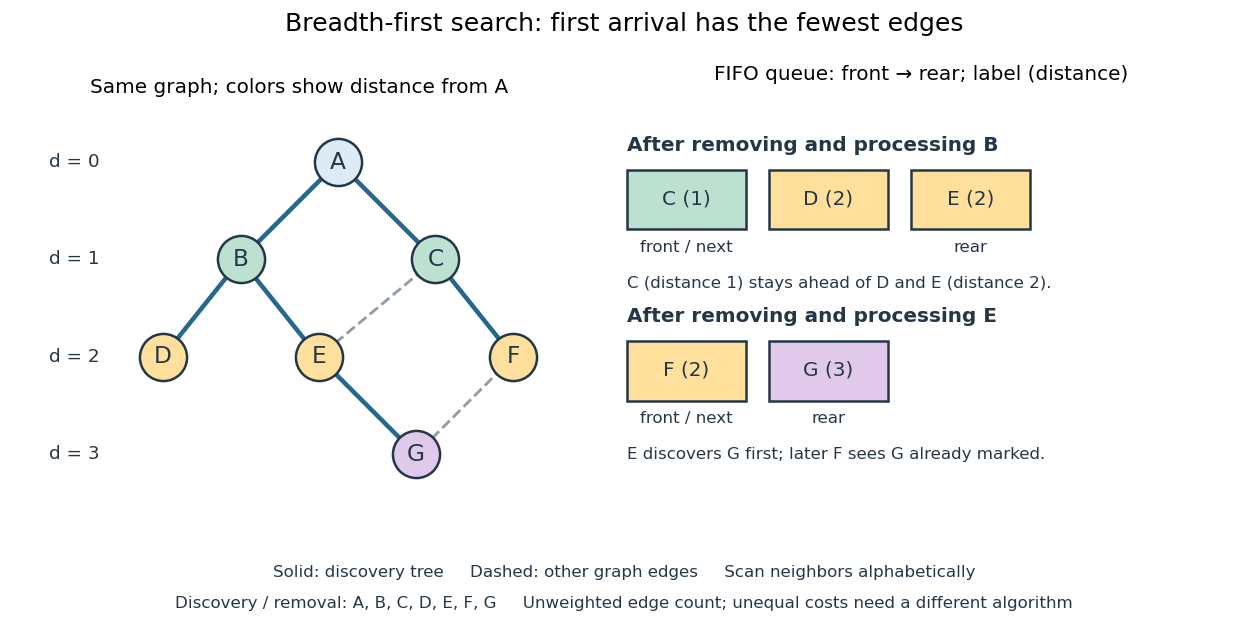
The discovery and removal orders both happen to be . After processing , the FIFO queue is : must be processed before the newer . Processing then skips the already discovered and enqueues , giving . Processing adds nothing. Processing discovers , giving ; later sees already marked and leaves its parent in a rooted tree unchanged. The discovery edges are , forming a rooted tree on all seven vertices even though the original graph contains graph cycles. The discovery tree contains six edges; it need not contain every examined edge.
First arrival is shortest because the FIFO queue keeps assigned distances in nondecreasing order, with entries from at most two consecutive layers. While processing distance , newly discovered vertices receive distance and join the rear. If an undiscovered vertex had a shorter graph path, its preceding vertex on that graph path would lie in an earlier layer and would already have discovered it. Thus is the minimum number of edges from to . This is a mathematical induction over the layers, not an assumption about the drawing. Following the parent in a rooted tree backwards at each step gives ; reverse that sequence to obtain the three-edge graph path . is another shortest graph path, but the specified graph neighbour order makes discover first. Changing that order can change the parent in a rooted tree without changing graph distances. [ref]
https://ocw.mit.edu/courses/6-006-introduction-to-algorithms-fall-2011/1208e162775f6f5cedfbb9f2b694ede0_MIT6_006F11_lec13.pdf. MIT 6.006, lecture 13: distance layers and shortest paths, pp. 4–6
The shortest-route guarantee concerns the shortest path problem measured by edge count. It also minimizes total cost when every edge has the same positive cost. With unequal edge weights, first discovery need not minimize total cost; nonnegative costs can instead be handled by the Dijkstra algorithm. Breadth-first search is useful for minimum-hop routes and for finding all vertices within a specified graph distance. Its FIFO queue finishes an older layer before the next one, whereas depth-first search uses a call stack or explicit LIFO stack to pursue one branch immediately.
With adjacency lists and constant-cost discovery checks, together with constant worst-case or amortized analysis cost for FIFO queue insertion and removal, the time complexity is in Big O notation. Every reached vertex is enqueued and removed once, each incident edge is scanned at most twice in an undirected graph, and initializing all marks and distances takes . The FIFO queue contains at most vertices; the example's maximum is three. Discovery marks, distances and the recorded parent in a rooted tree for each nonroot vertex also give auxiliary space complexity, excluding the graph. An array that shifts every entry on front removal can lose the linear time complexity; the FIFO queue abstraction alone does not make removal constant-cost. Ordering the adjacency lists is a separate preprocessing cost.
A single start reaches only its connected component of a graph. Unreached vertices retain distance and have no recorded parent in a rooted tree. Restarting at each still-undiscovered vertex, while preserving all discovery marks, produces a forest covering the graph; each new root of a tree gets distance zero, so these distances refer to that root of a tree, not to the original .

