Cantor's diagonal argument is a mathematical proof devised by Georg Cantor in the late 19th century. It demonstrates that not all infinities are equal, specifically showing that the set of real numbers is uncountably infinite and larger than the countably infinite set of natural numbers.
Articles by others on the same topic

Cantor's diagonal argument shows that the set of all infinite binary sequences is an uncountable set. Suppose a proposed enumeration is , where is coordinate of row . Construct a new binary sequence byIt differs from row at coordinate , for every . It is consequently absent from the entire proposed list, regardless of how that list was chosen. The failure of an enumeration of all binary sequences follows from this precise point of disagreement, rather than from a claim that the list looks too small.
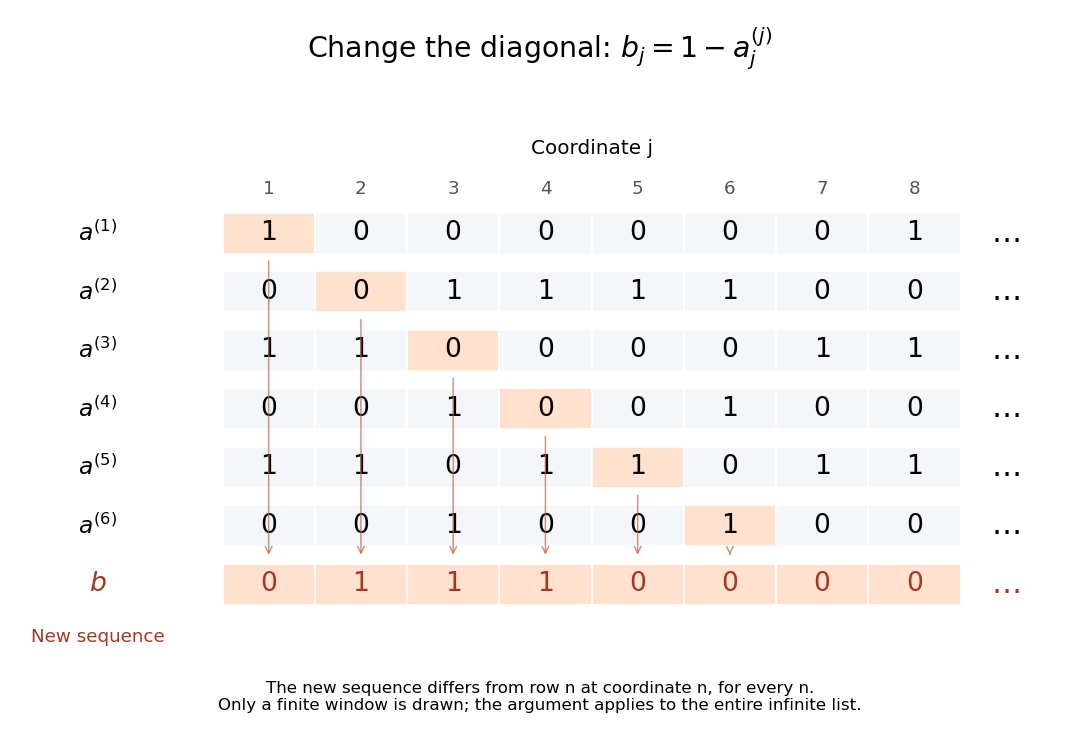
Flipping the nth coordinate of the nth row constructs a binary sequence missing from every proposed row
. Details. For the displayed window, the first six diagonal bits are , so the new sequence starts . The drawing shows only finitely many rows, but the rule defines every coordinate and excludes every row of an infinite list. This distinguishes the argument from the Cantor pairing function: that construction lists all pairs of finite indices, whereas this one concerns an entire infinite sequence as each object to be listed. Finite binary strings form a countable set; all infinite binary sequences do not.
The connection with power sets is exact: a subset corresponds to its indicator function, with a one in position exactly when . Changing the diagonal membership bit is the same mechanism as the Cantor's theorem construction . This reusable method turns a purported complete list into an explicit omitted object.
In his paper [ref]
https://onepagepapers.com/cantor-diagonal/read/. Cantor, Ueber eine elementare Frage der Mannigfaltigkeitslehre, pp. 75–78
, presented in 1891 and printed in the 1890–91 volume in 1892, Cantor uses infinite sequences of two symbols for the diagonal construction and then gives the broader comparison of cardinalities. The binary notation here is a modern presentation of that construction.