In topology, a **closed set** is a fundamental concept related to the structure of a topological space. A subset \( C \) of a topological space \( X \) is called closed if it contains all its limit points. Here are some important properties and characteristics of closed sets: 1. **Complement**: A set is closed if its complement (with respect to the whole space \( X \)) is open.
Articles by others on the same topic

A subset of a topological space is closed when its complement in that same ambient space is open: . For example, the closed interval is closed in the usual real line because its complement is the open set . Always specify the ambient topological space: a subset can be closed in a subspace topology without being closed in the surrounding space. [ref]
https://www.maths.ox.ac.uk/system/files/attachments/Preliminary%20Reading%20%281%29.pdf. Richard Haydon, Oxford topology preliminaries, Section 0.1
Being closed is not the logical negation of being open. In the usual real line, all four combinations occur: is open but not closed; is closed but not open; the half-open interval is neither open nor closed; and both the empty set and the whole real line are open and closed, hence clopen. Nor does being closed imply being a bounded set: is closed because its complement is open, but it is not a bounded set. The symbol is not an extra point that this interval must contain.
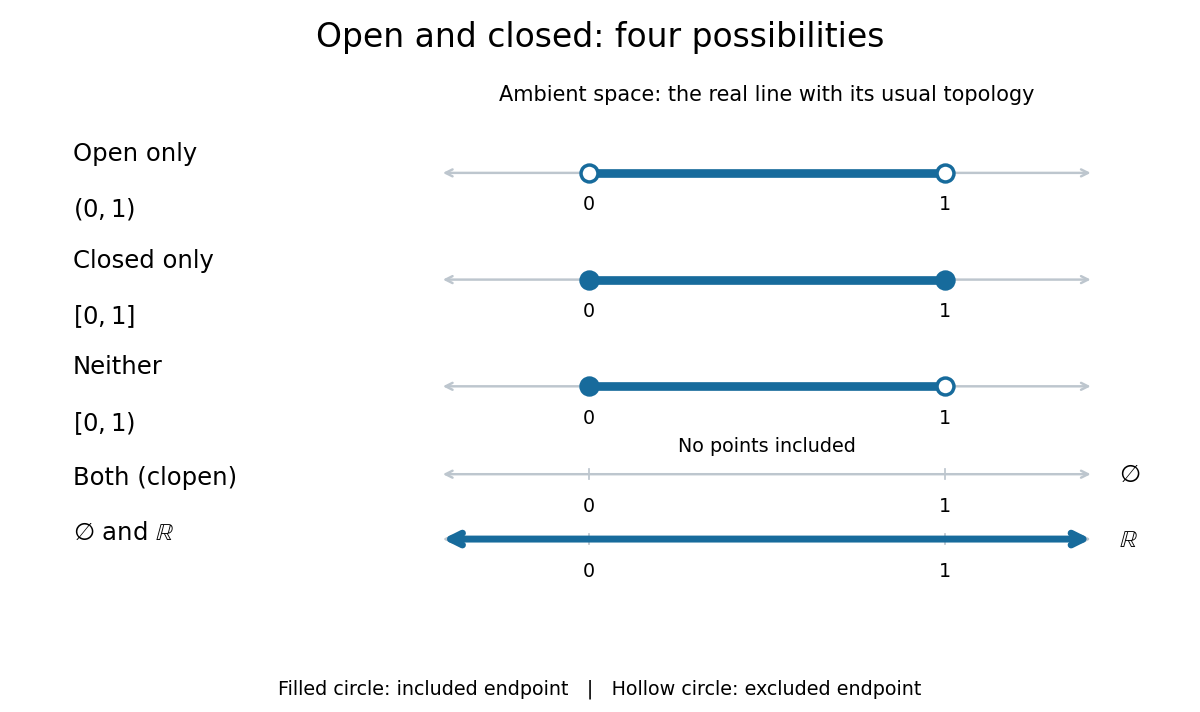
The four combinations of openness and closedness in the real line
. Details. 
The coloured strokes mark membership; filled endpoint circles mean included points, and hollow endpoint circles mean excluded points. The empty set has no coloured points, while arrows at both ends of the coloured real line indicate that membership continues indefinitely. These examples use the usual topology of the real line.
In a metric space , a subset is closed exactly when every convergent sequence in whose limit of a sequence lies in has . For example, lies in for and has limit of a sequence , which is missing; thus this half-open interval is not closed in the real line. This criterion is useful for keeping limiting constructions inside a prescribed set. [ref]
In every topological space, the general criterion is , using closure; equivalently, contains all its limit points. A closed set is always a sequentially closed set, but the converse can fail outside metric spaces. Arbitrary intersections and finite unions of closed sets are closed, by taking complements in the topology axioms.